How to Use Drugstores in Japan | Medicine for Sudden Injuries or Illness, Buying Japanese OTC Drugs, Plus Cosmetics, Food and Drinks (Sugi Pharmacy Example, Tax-Free)
At Japanese drugstores you can buy not only medicine but also cosmetics, everyday goods, drinks and food. With photos taken by the site operator, this guide explains where to get help if you are suddenly injured or feel unwell while traveling, the four classes of Japanese OTC drugs and the medicines you can buy only while a pharmacist is on duty, the quantity rules for cough medicine, cold medicine and similar products, Sugi Pharmacy stores in Asakusa, Ueno, Ginza, Shinjuku, Shibuya, Umeda, Dotonbori, Kyoto and Nagoya, and how to pay and shop tax-free.
Ad · Affiliate This article contains links to partner booking and shopping pages (affiliate links). If you book or buy through these links, the site operator may receive a commission from the partner. Our advertising policy
Overview
Drugstores in Japan are shops that sell cosmetics, everyday goods, drinks and food alongside medicine. Using the drugstore chain Sugi Pharmacy as an example, this article explains how to use a drugstore if you are suddenly injured or feel unwell while traveling, how to buy Japanese OTC drugs (medicines you can buy without a doctor's prescription), and what else you can buy besides medicine. Information about Sugi Pharmacy is based on the guidance on Sugi Pharmacy's official website (checked on October 20, 2026), and the rules on medicines are based on materials from the Ministry of Health, Labour and Welfare (checked on October 20, 2026).
- For minor injuries or when you feel unwell, you can choose and buy medicine at a drugstore. In the store, you can ask a pharmacist or a registered seller (a person qualified to sell OTC drugs) for advice. However, some types of medicine can only be bought during the hours when a pharmacist is present. This is explained in “Conditions” in this article.
- If you suddenly fall seriously ill or are badly injured and need treatment right away, do not go to a drugstore; call an ambulance (119). Where to get help is explained in “Step by step” in this article.
- Besides Japanese OTC drugs, drugstores also sell cosmetics, everyday goods, drinks and food. Some stores also sell alcohol.
- Some Sugi Pharmacy stores are open 24 hours, and some stay open late at night. Stores in places that are easy for travelers to reach are listed in “Where to buy” in this article.
- According to the company's information, as of the end of September 2026 there were 2,617 Sugi Pharmacy Group stores (this number includes pharmacies that only fill prescriptions). Besides “Sugi Pharmacy”, some stores have signs reading “Sugi Drug”; both are Sugi Pharmacy Group stores.
- Some stores let you shop tax-free. Japan's tax-free system changed on November 1, 2026. This is explained in “Paying” in this article.
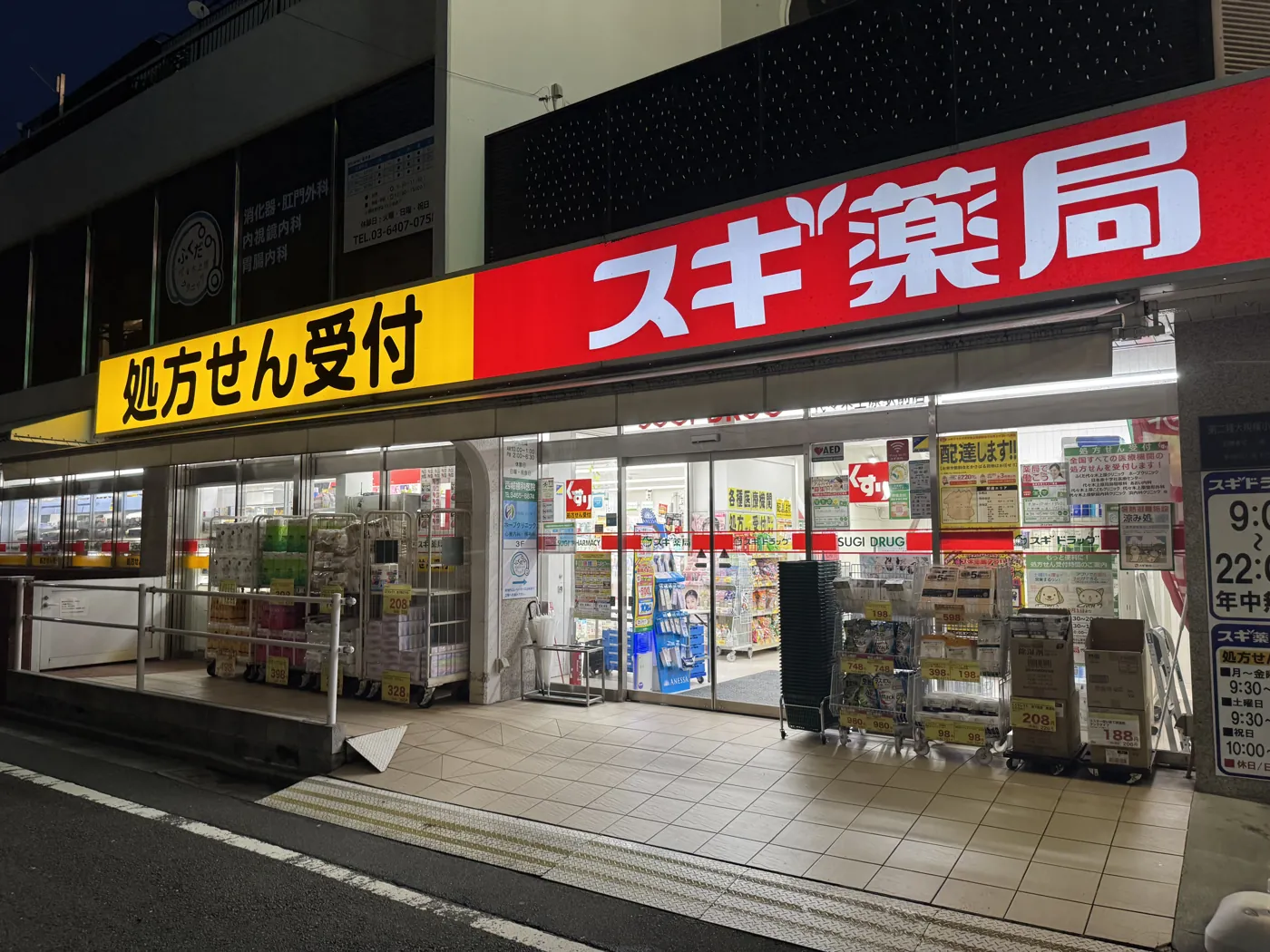
The photo, taken by the site operator, shows the outside of a Sugi Pharmacy Group store at night. A red sign reads 「スギ薬局」 (Sugi Pharmacy), and a yellow sign reads 「処方せん受付」 (Prescriptions accepted). 「処方せん受付」 means the store has a counter where, if you hand in a prescription written by a doctor, a pharmacist prepares the medicine. On the glass of the entrance there was a large sign reading 「くすり」 (medicine), a sign showing that the store has an AED (a device that gives the heart an electric shock), and a free Wi-Fi sign. A notice on the pillar on the right showed the store's opening hours and the hours for accepting prescriptions. Opening hours differ from store to store.
Step by step
Where to get help if you are injured or feel unwell
If you are injured or feel unwell while traveling, use the following contacts depending on your condition.
- If you suddenly fall seriously ill or are badly injured and need treatment right away: Call an ambulance (119). According to the Fire and Disaster Management Agency's guidance for travelers, when the call is answered, say “Medical emergency”, then give your location, symptoms, age, name and contact details. The Fire and Disaster Management Agency advises asking someone nearby who speaks Japanese to help with the call, if there is such a person.
- If you are not sure whether to call an ambulance: In some areas, you can call #7119 to get advice by phone from a doctor, nurse or paramedic. According to the Fire and Disaster Management Agency, #7119 is available in 42 areas, and in places such as Tokyo, Osaka Prefecture, Kyoto Prefecture and Fukuoka Prefecture it is available 24 hours a day. The agency's guidance does not say whether you can get advice in languages other than Japanese. Ask someone who speaks Japanese to help you.
- If you want to find a hospital or need language help: Call the Japan Visitor Hotline of the Japan National Tourism Organization (JNTO) (050-3816-2787, or +81-50-3816-2787 when calling from outside Japan). It offers advice about sudden illness or injury 24 hours a day, every day, in English, Chinese and Korean. In addition, the AMDA International Medical Information Center (0120-339-266 or 03-6233-9266) gives free information about medical institutions where foreign languages are spoken, Monday to Friday from 10:00 to 16:00 (except public holidays and December 29 to January 3).
- If it is not serious enough to see a doctor: You can buy OTC drugs at a nearby drugstore or pharmacy. The guide for illness and injury by the Japan Tourism Agency and JNTO also advises that, in this case, you go to a pharmacy or drugstore and, if necessary, ask a pharmacist or registered seller for advice.
Emergency phone numbers are also explained in Emergency Numbers in Japan | Police 110, Ambulance 119, and Help in English.
Asking for advice at a drugstore
- Under Japanese rules, drugstore staff wear name tags that show whether they are a pharmacist, a registered seller or other staff. Ask a pharmacist or registered seller about medicines.
- According to Sugi Pharmacy's English guidance, Sugi Pharmacy has staff who speak foreign languages, as well as translation devices that support more than 85 languages.
- Medicine boxes and the leaflets inside them are written in Japanese. The Japan Tourism Agency and JNTO guide links to a website where you can look up OTC drugs in English.
- It is easier to get advice if you translate your symptoms and any other medicines you are currently taking, for example with a translation app on your smartphone, and pass that on.
If you need prescription medicine
- According to the Japan Tourism Agency and JNTO guide, to get medicine that requires a doctor's prescription, you see a doctor at a medical institution in Japan, receive a prescription, and hand that prescription in at a pharmacy to receive the medicine.
- A Japanese prescription can be used for 4 days, including the day it was issued (Ministry of Health, Labour and Welfare guidance). At Sugi Pharmacy, you cannot receive medicine without the original prescription.
- Whether a prescription issued outside Japan can be used at a Japanese pharmacy was not stated in the guidance for travelers from the Ministry of Health, Labour and Welfare, the Japan Tourism Agency or JNTO that we checked this time.
- The rules for bringing medicine into Japan from your own country are explained in Bringing Medicines into Japan | Quantities Allowed Without Procedures, Applying for an Import Certificate, and Medicines That Need Permission or Are Banned.
Conditions
The four classes of Japanese OTC drugs
Under Japanese law, OTC drugs are divided into the following four classes, and who can sell them and how they must be explained differ by class (Ministry of Health, Labour and Welfare materials). The name of the class is printed on medicine boxes and on store price tags.
| Class | Who can sell it | How it is explained, and examples of medicines in this class |
|---|---|---|
| Guidance-mandatory drugs (「要指導医薬品」) | Pharmacists only | A pharmacist explains it using written information. The explanation is given face to face or by another method where you can see each other as you talk, such as a video call. As a rule, it can be sold only to the person who will use the medicine. |
| Class 1 OTC drugs (「第1類医薬品」) | Pharmacists only | A pharmacist explains it using written information. |
| Class 2 OTC drugs (「第2類医薬品」) | A pharmacist or a registered seller | A pharmacist or registered seller is expected to make an effort to explain it. According to government guidance, for cold medicines, medicines that bring down fever and relieve pain, and stomach and bowel medicines alike, many of each type are in this class. |
| Class 3 OTC drugs (「第3類医薬品」) | A pharmacist or a registered seller | A pharmacist or registered seller explains it when the buyer asks for advice. According to government guidance, vitamin preparations and medicines that help regulate the bowels are in this class. |
Among Class 2 OTC drugs, those that need particular care are Designated Class 2 OTC drugs (「指定第2類医薬品」), and their boxes show the number “2” inside a frame. For medicines of any class, a pharmacist or registered seller is expected to explain them when the buyer asks for advice.
Medicines you can buy only while a pharmacist is present
- Guidance-mandatory drugs and Class 1 OTC drugs cannot be bought when no pharmacist is present. The Japan Tourism Agency and JNTO guide also says that some medicines cannot be bought when no pharmacist is present.
- According to Sugi Pharmacy, at stores that have a counter that fills prescriptions (「スギ薬局調剤」, Sugi Pharmacy prescription counter), Class 1 OTC drugs and guidance-mandatory drugs can be bought only during that counter's opening hours. You can check these hours under 「調剤受付時間」 (prescription reception hours) on each store's page on the Sugi Pharmacy website.
- So even at a store open 24 hours, you cannot buy Class 1 OTC drugs or guidance-mandatory drugs at times outside the prescription reception hours, such as at night.
- Separately, Sugi Pharmacy's guidance does not say whether Class 1 OTC drugs can be bought at stores without a prescription counter.
Quantity rules for cough medicine, cold medicine and similar products (from May 1, 2026)
OTC drugs containing ingredients that could be misused (for example, by taking more than the specified amount) are called OTC drugs designated as at risk of misuse (「指定濫用防止医薬品」). From May 1, 2026, the way these drugs are sold has been set as follows (Ministry of Health, Labour and Welfare materials). This applies to oral medicines and similar products containing any of these 8 ingredients: ephedrine, codeine, dihydrocodeine, diphenhydramine, dextromethorphan, pseudoephedrine, bromovalerylurea and methylephedrine. Some cough medicines, cold medicines and similar products fall into this group. Medicines used on the outside of the body, such as patches, creams and eye drops, and medicines whose main ingredients are crude drugs (herbal ingredients) are not included.
- When you buy one, store staff will check things such as your age, other medicines you are using, and whether you have bought similar medicine at other stores. If it is not clear from your appearance that you are 18 or older, you may be asked to show ID.
- People under 18 can buy only one item, and only in a small pack. They cannot buy a large pack, and they cannot buy two or more items. Even when buying one small pack, a pharmacist or registered seller explains it face to face or by another method where you can see each other as you talk, such as a video call.
- When people aged 18 or older buy a large pack, or buy two or more items, a pharmacist or registered seller explains it face to face or by another method where you can see each other as you talk, such as a video call, and checks the reason for buying two or more. As examples of reasons for buying two or more, the Ministry of Health, Labour and Welfare materials give keeping the medicine at home and taking it on a long trip outside Japan. However, whether to sell is decided on the spot by the pharmacist or registered seller.
- Apart from the legal rules, a store may also set its own limit on how many of each product one person can buy. In the store photographed by the site operator, some medicines had price tags reading 「お一人様1点まで」 (limit 1 per customer) (see the cold medicine photo below).
The medicine section in photos
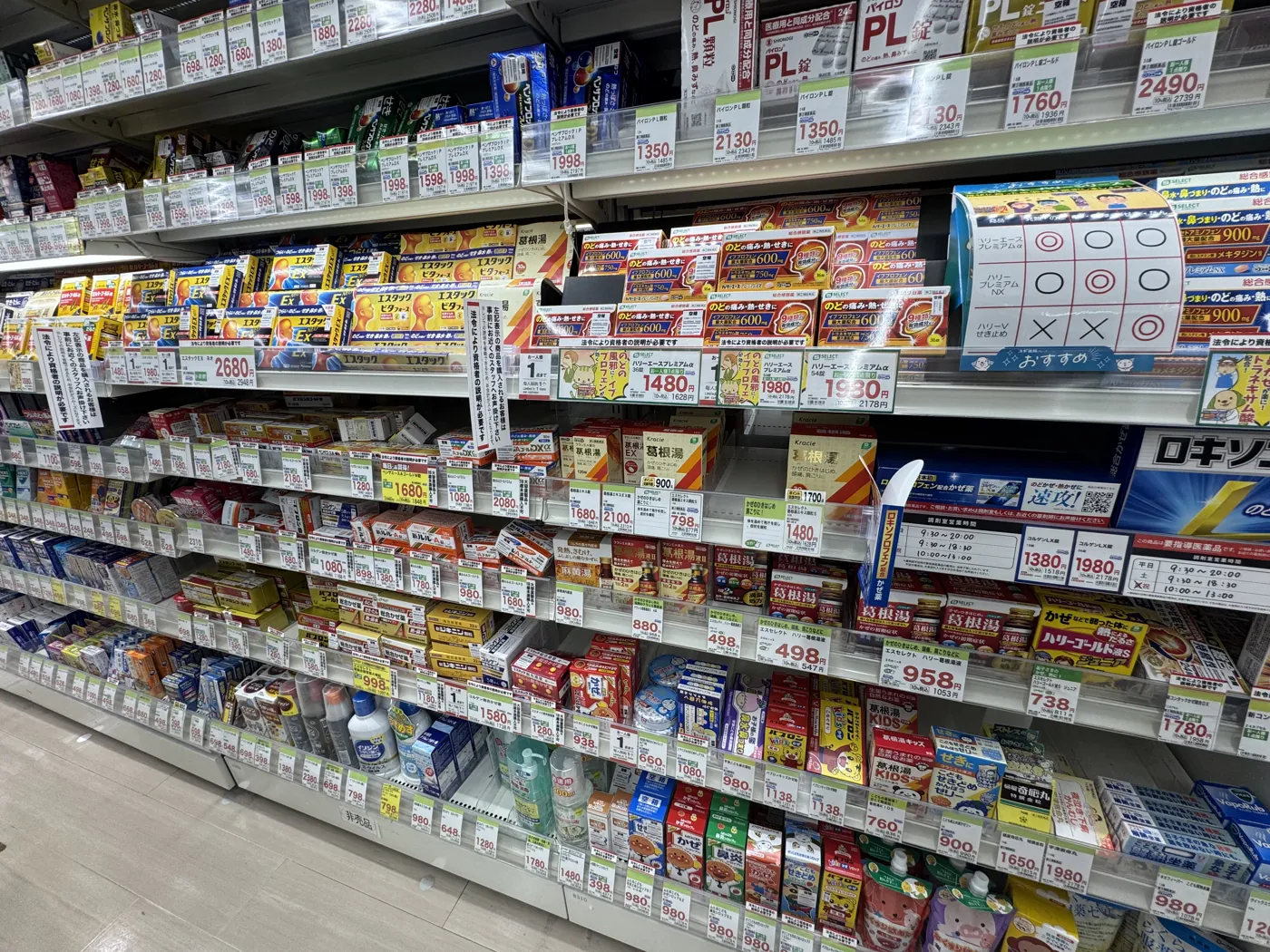
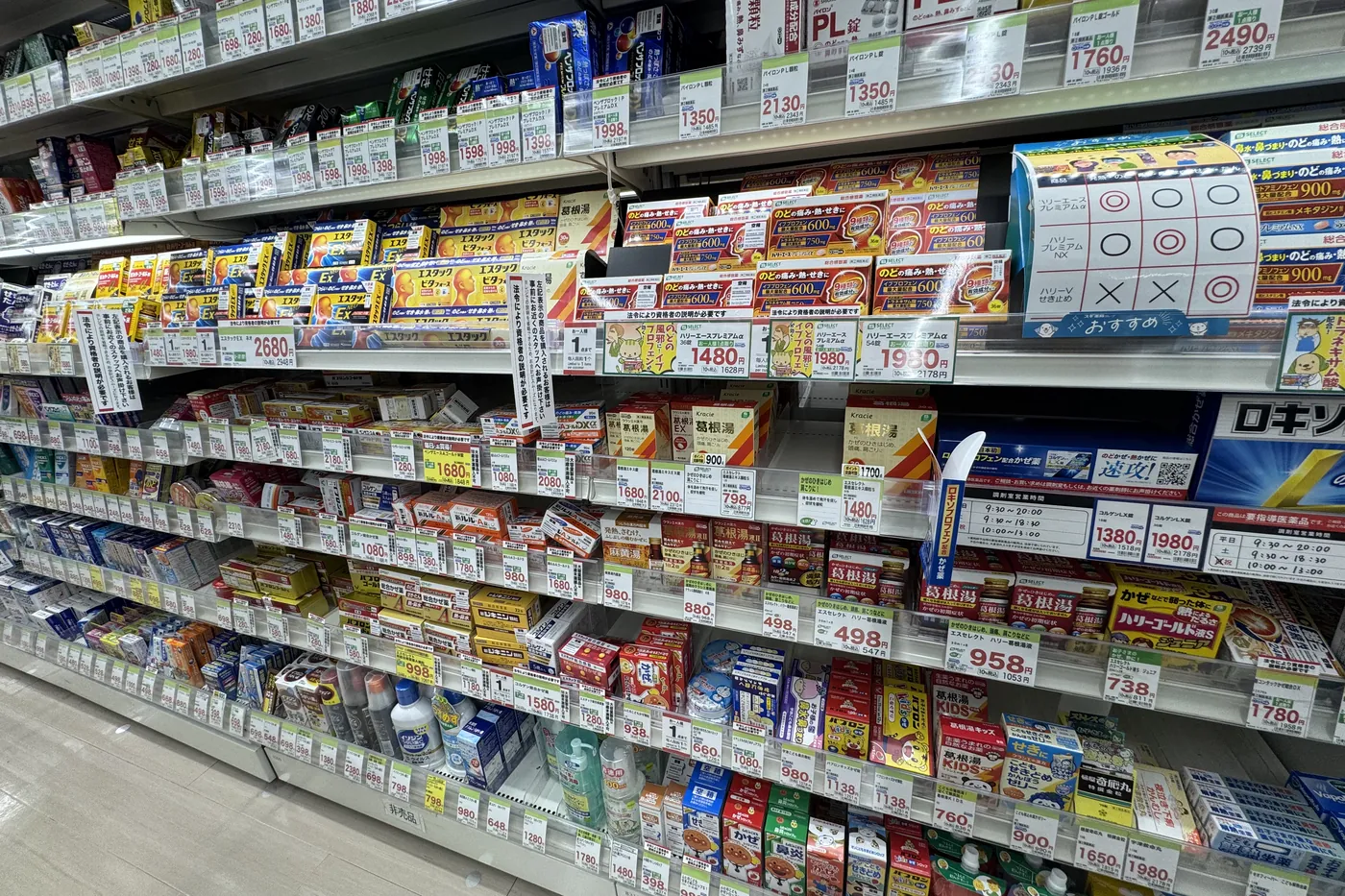
The photo, taken by the site operator, shows the cold medicine shelves in a Sugi Pharmacy Group store. Boxes of cold medicines from various companies and of kakkonto (a traditional Kampo medicine made from crude drugs) are lined up. Some price tags showed the class, such as 「第2類医薬品」 (Class 2 OTC drugs), and some read 「お一人様1点まで」 together with the English “Limited to 1 item per customer”. Some of the boxes on the shelves are marked 「空箱」 (empty box) and have nothing inside. Toward the right, there were three cold medicines of S SELECT, a store brand of Sugi Pharmacy Group stores. Next to them was a store chart that used circles and crosses to compare which of fever, sore throat, and cough and phlegm each of these three cold medicines is suited to.
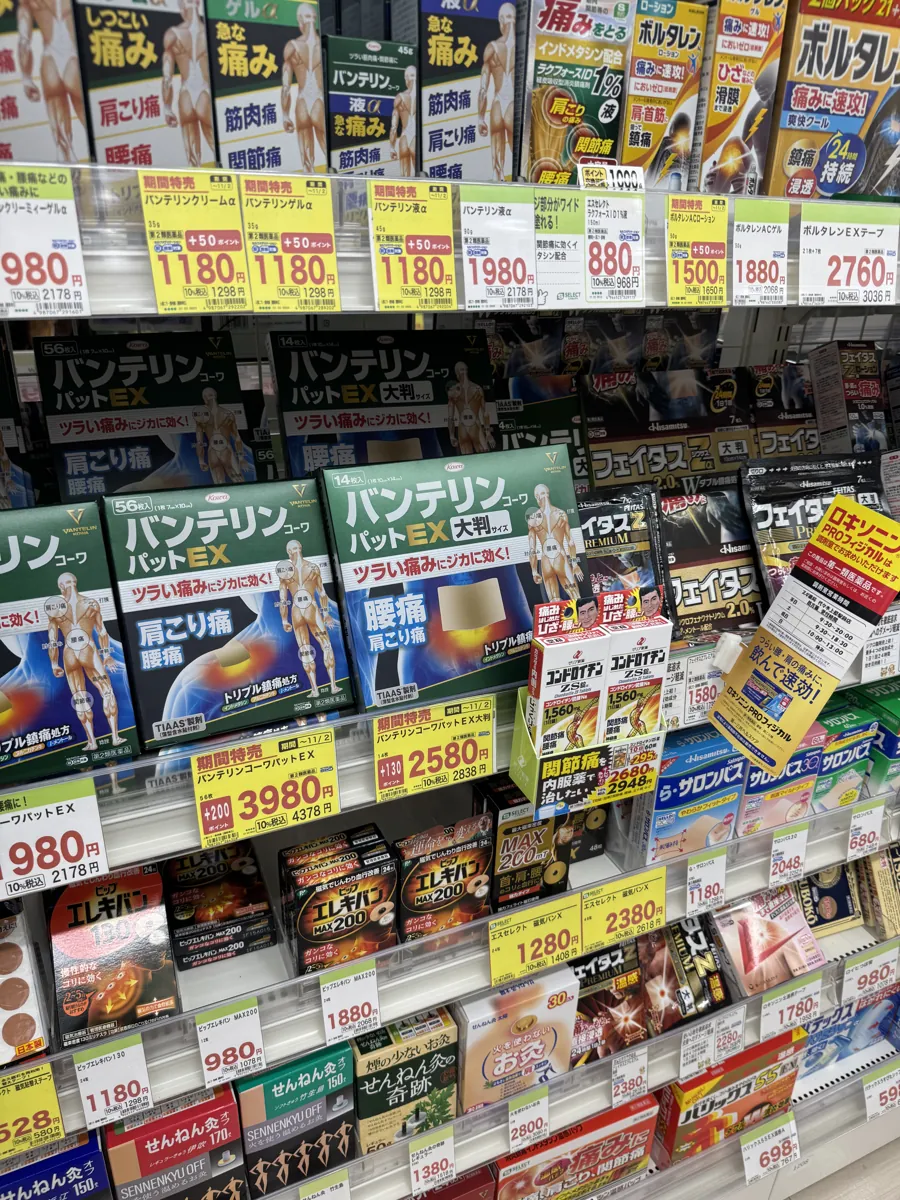
The photo shows the shelves of patches and creams used for pain in places such as the shoulders and lower back. Boxes with drawings of the human body are lined up. On the lower shelf there were also products with magnets that you stick on your body.
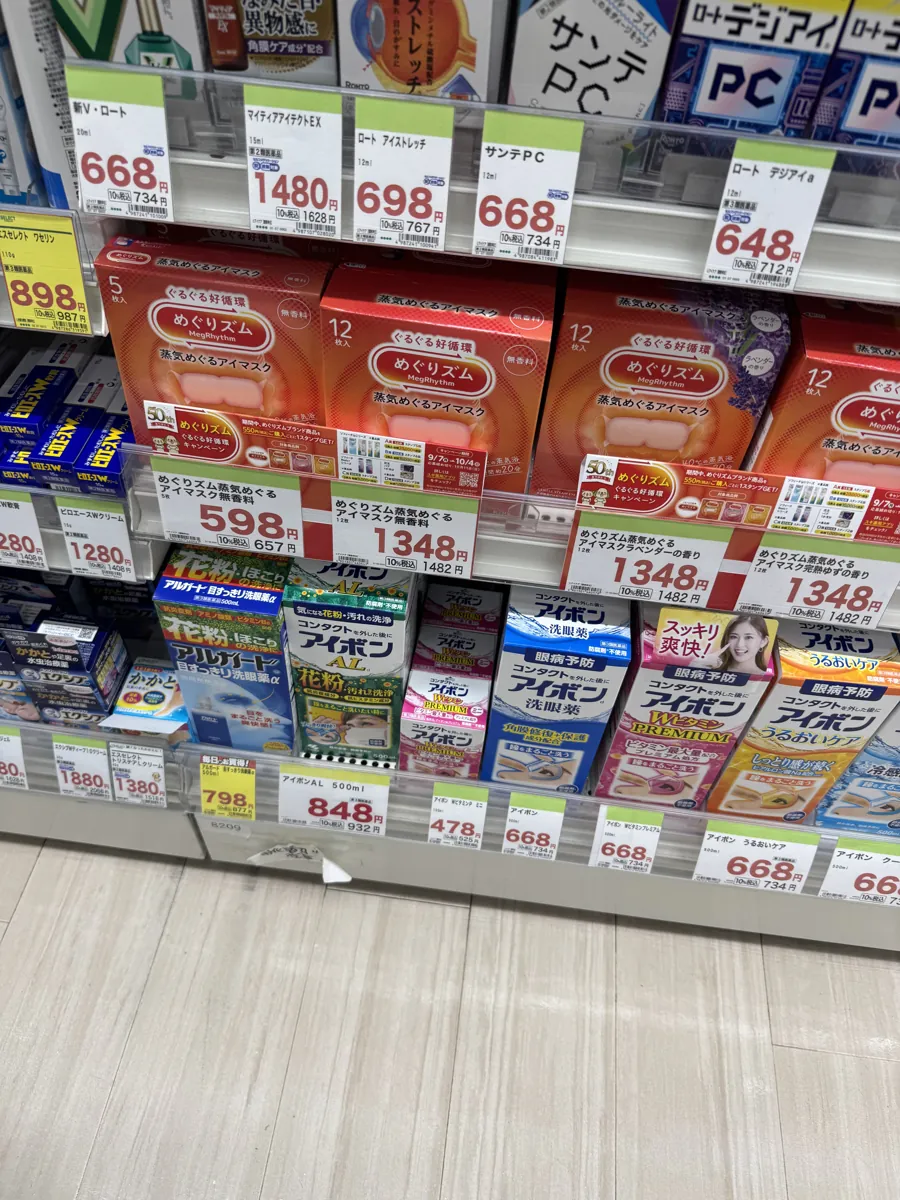
The photo shows the shelves of eye drops and products used around the eyes. Eye drops are on the upper shelf, disposable eye masks that warm the eyes are on the middle shelf, and eye wash solutions are on the lower shelf.
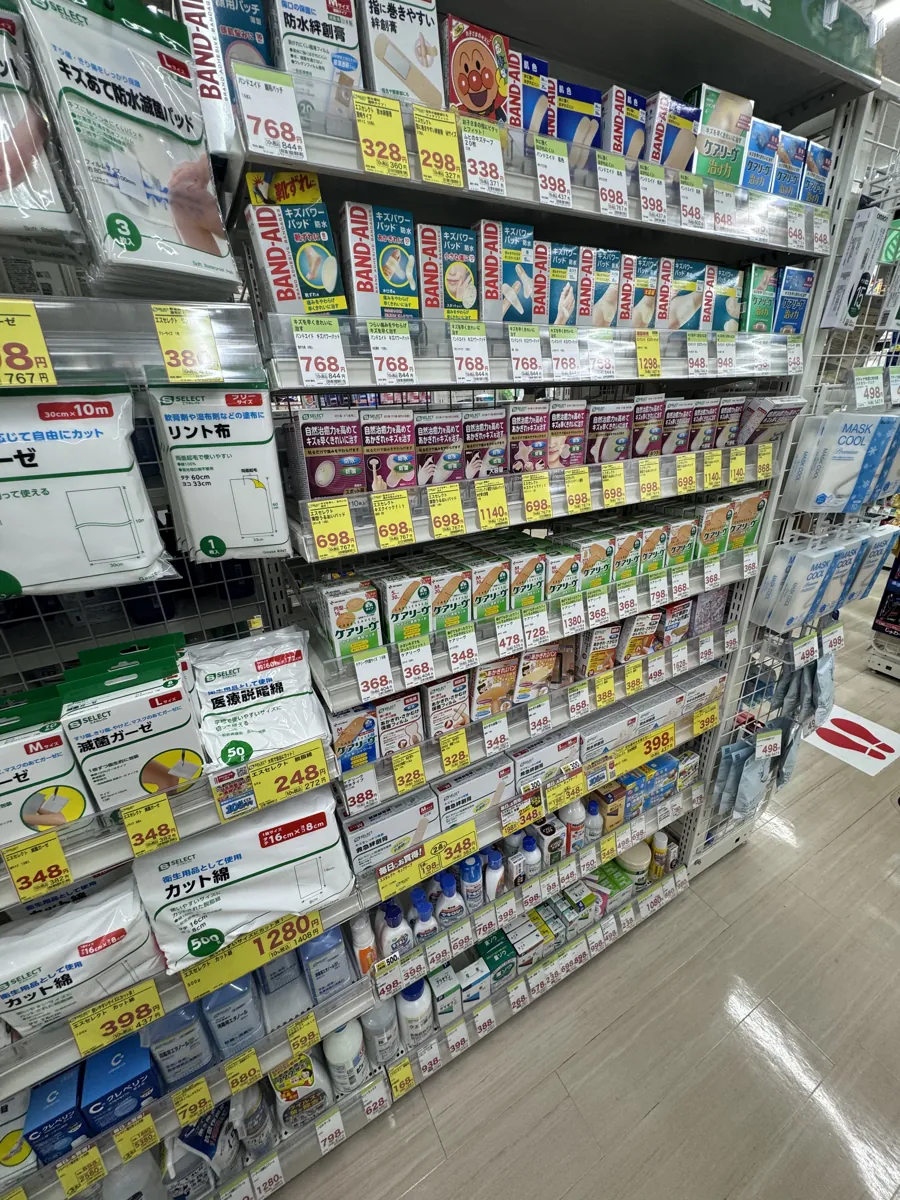
The photo shows the shelves of products for treating injuries. Adhesive bandages of various sizes, gauze, bandages, medical tape, antiseptic solutions and more are lined up.
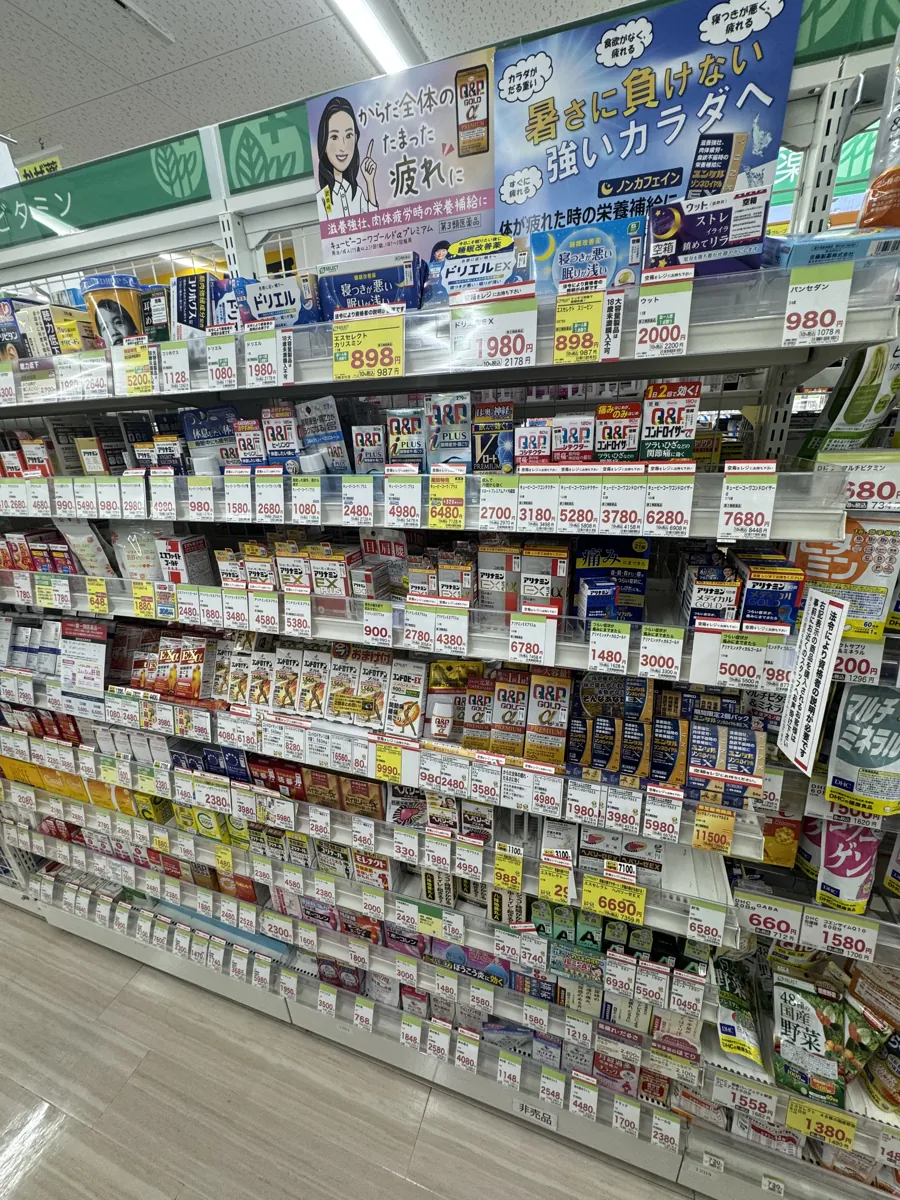
The photo shows the shelves of vitamin preparations and drinks for when you are tired. The price tags showed the class. Some products had a shelf sign reading 「空箱をレジにお持ち下さい」 (Please bring the empty box to the checkout). For these products, the box on the shelf is empty, so you take that box to the checkout to buy the product. Toward the right, there were also health foods that are not medicines.
What to buy
Products other than medicine
According to Sugi Pharmacy's English guidance, Sugi Pharmacy sells OTC drugs, cosmetics, everyday goods, drinks and food, and some stores also sell alcohol. The range of products differs by store, and you can check it under 「取扱商品」 (products available) on each store's page on the Sugi Pharmacy website.
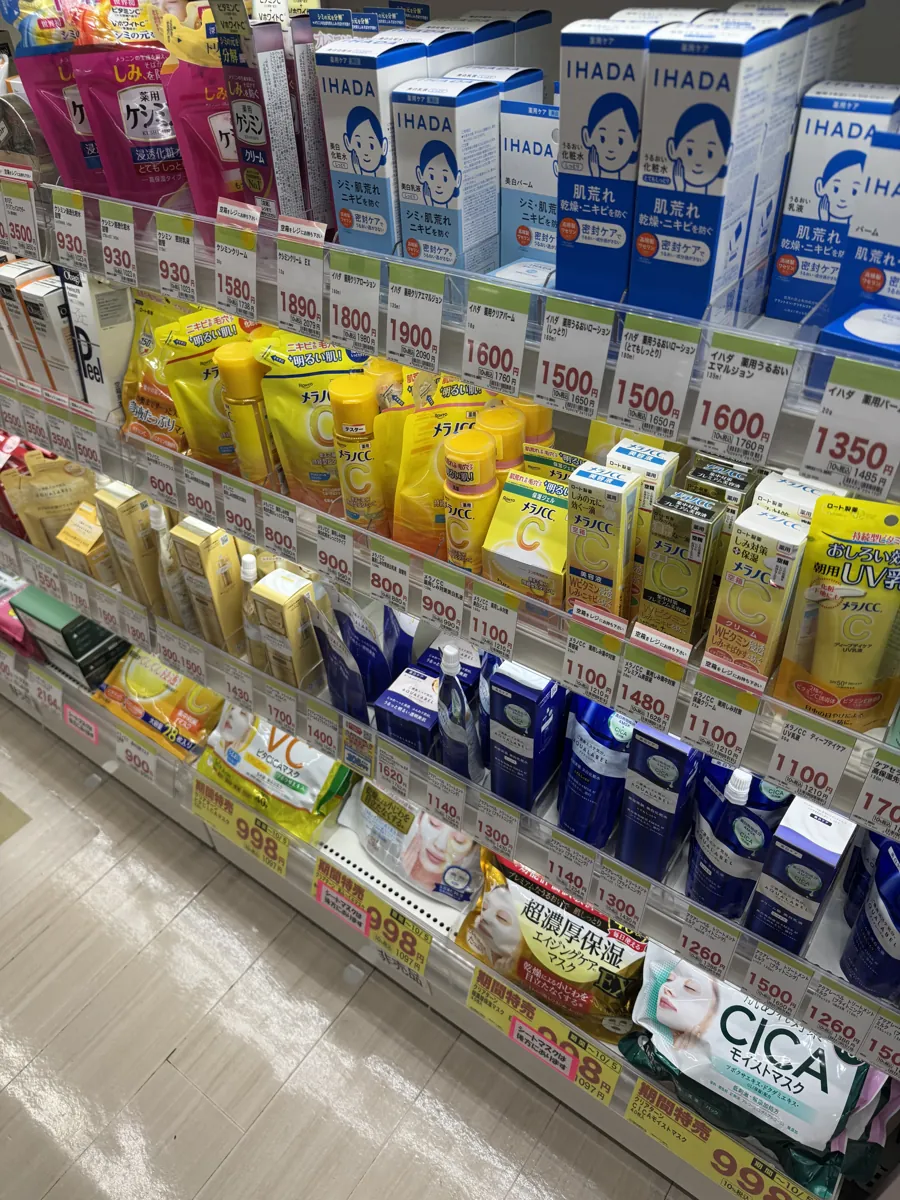
The photo, taken by the site operator, shows the skincare shelves in a Sugi Pharmacy Group store. Lotions, serums and creams from Japanese companies for dark spots and acne, and sheet masks for the face, are lined up. On the price tags, the large number on top was the price without consumption tax, and the small number below was the price including consumption tax. Yellow price tags reading 「期間特売」 (limited-time sale) mark products whose price is lowered only for a set period.
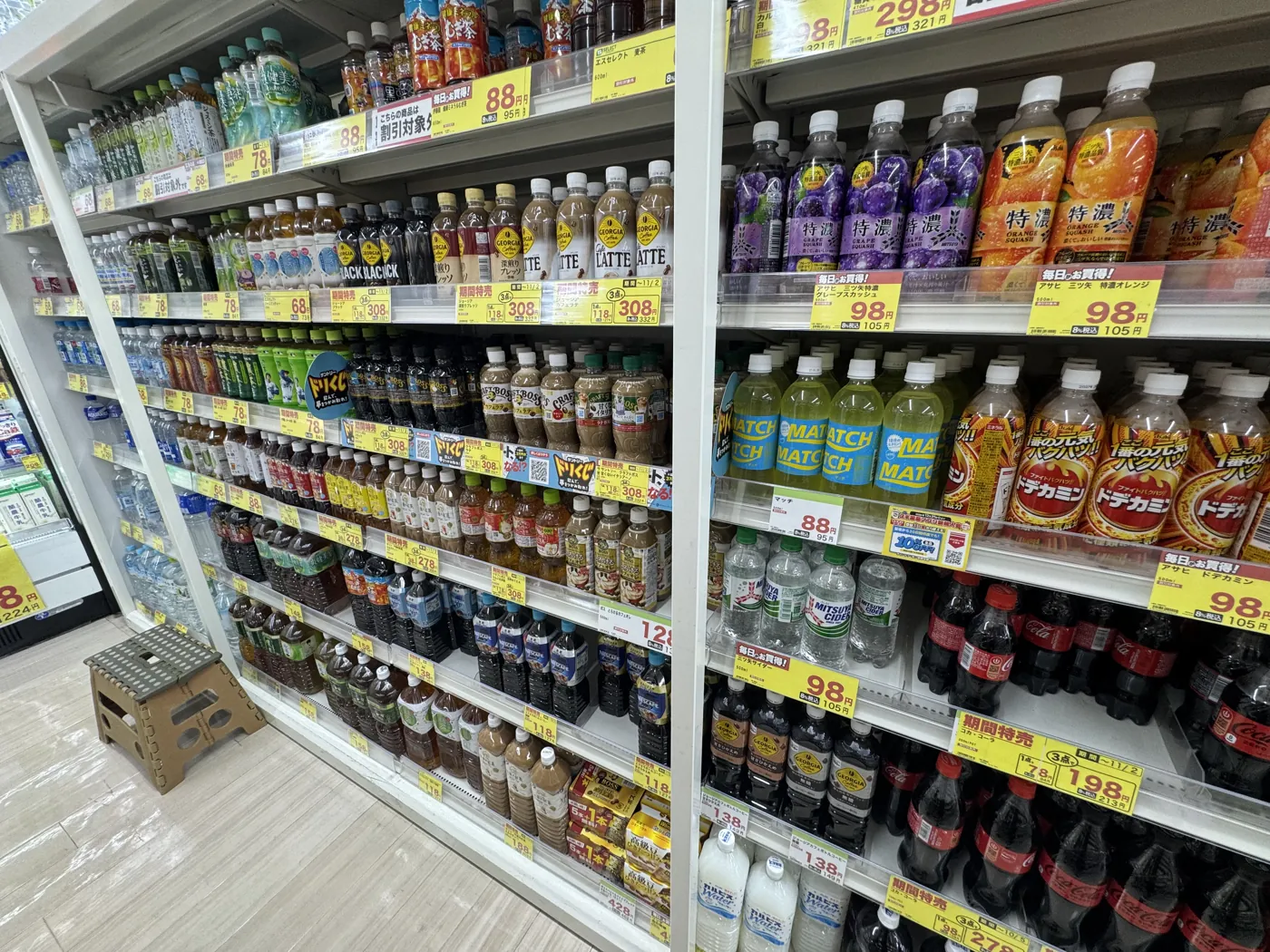
The photo shows the drink shelves. Plastic bottles of tea, coffee, sports drinks, carbonated drinks and more are lined up.
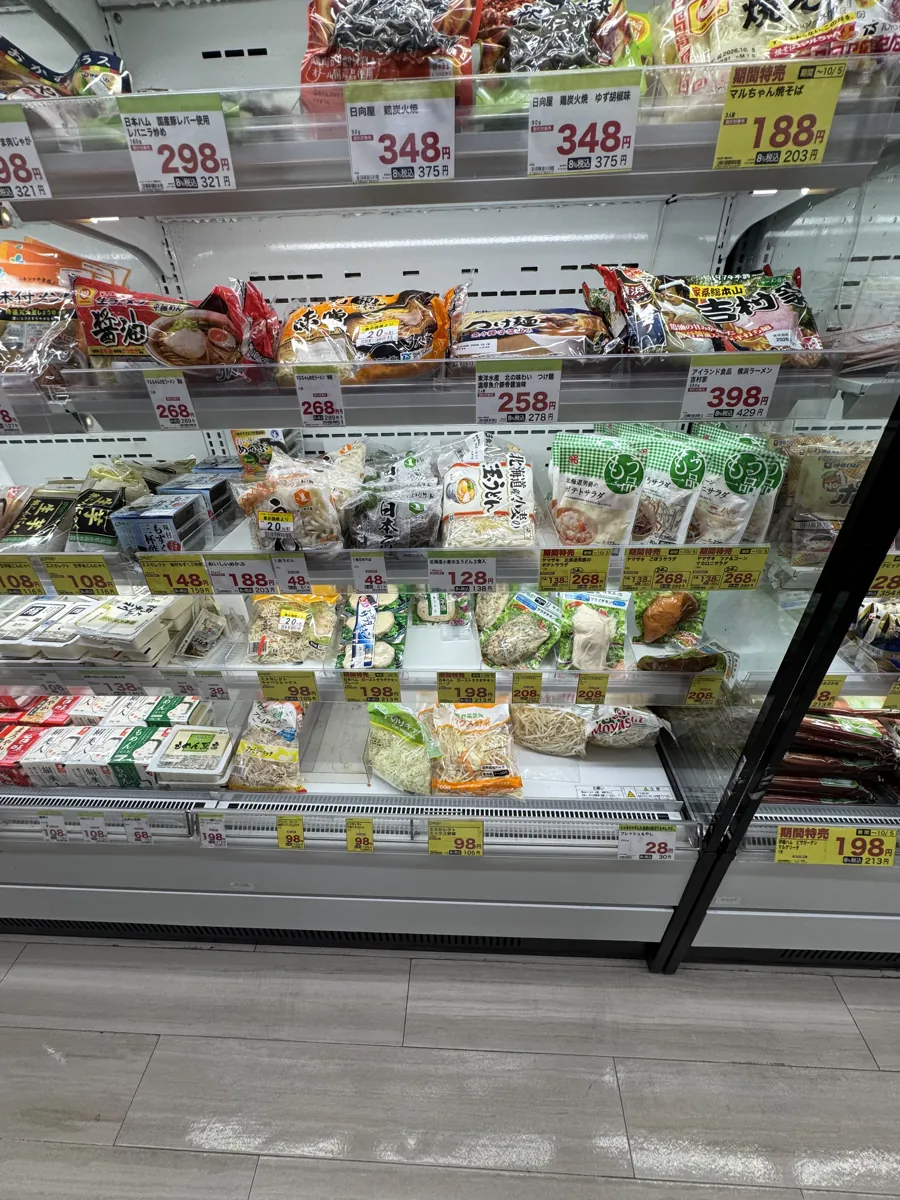
The photo shows the chilled food shelves. Noodles such as udon and ramen, tofu, bean sprouts, cut vegetable salads, cooked chicken and more are lined up.
The store photographed by the site operator also had everyday goods such as hand soap and room deodorizers, and alcohol such as canned beer and chuhai.
Other stores where you can shop late at night are covered in What You Can Do at Japanese Convenience Stores | ATM Cash Withdrawals, Payment Methods, Sending Luggage and Shopping at Don Quijote (Donki) in Japan | Tax-free conditions, the refund method from November 1, 2026, how to use the 5% and 7% OFF tax-free coupons, 24-hour stores (Shinjuku, Shibuya, Ginza, Osaka, Fukuoka), payment methods, and return rules.
Where to buy
Sugi Pharmacy stores in places easy for travelers to reach
The table below shows examples of Sugi Pharmacy stores in places with many travelers. For every store, the store's page on the Sugi Pharmacy website listed 「免税」 (tax-free) under its services (checked on October 20, 2026). At stores where “Prescription counter” is “Yes”, Class 1 OTC drugs and guidance-mandatory drugs can be bought only during the counter's opening hours (prescription reception hours). The counter's hours differ by day of the week, so check each store's page.
| Area | Store name | Store opening hours | Prescription counter |
|---|---|---|---|
| Tokyo, Asakusa | Shin-Nakamise store | Open 24 hours | No |
| Tokyo, Ueno | Ueno Okachimachi store | Open 24 hours | No |
| Tokyo, Ginza | Ginza 1-chome store | Open 24 hours | Yes |
| Tokyo, Shinjuku | Shinjuku 3-chome store | Open 24 hours | Yes |
| Tokyo, Shibuya | Dogenzaka store | Open 24 hours | Yes |
| Osaka, Umeda | Umeda store | 09:00 to 23:00 | Yes |
| Osaka, Dotonbori | Dotonbori Higashi store | Open 24 hours | No |
| Kyoto, Shijo Kawaramachi | Shijo Kawaramachi store | 09:00 to 5:00 the next morning | Yes |
| Nagoya, Nagoya Station | Meieki Kita store | Open 24 hours | Yes |
- To find a store, use the store search on Sugi Pharmacy's official website: open 「サービス・取扱商品で絞り込む」 (filter by services and products) and select 「免税」 to find only stores where you can shop tax-free. Each store's page is in Japanese only.
- Sugi Pharmacy's English pages also list stores in places with many travelers. However, for some stores, the opening hours on the English pages differ from those on the Japanese store pages. Check the Japanese store page before you go.
- According to Sugi Pharmacy's English guidance, free Wi-Fi is available at every store. Some stores, mainly in central city areas, have machines that change foreign money into Japanese yen. There is also a paid service for borrowing a smartphone charger.
Paying
Accepted payment methods
According to Sugi Pharmacy, the following payment methods are accepted. Some payment methods cannot be used at some stores, and some products can be bought only with cash.
- Japanese yen in cash
- Credit cards (VISA, Mastercard, JCB, American Express, Diners Club) and UnionPay cards. Contactless payment can also be used.
- QR code payments: Alipay+ and WeChat Pay
- Transit IC cards. Nine types of card are accepted in total, including Suica, PASMO and ICOCA.
Coupons and points for travelers
- Sugi Pharmacy's foreign-language pages show a coupon for travelers that can be used only by people shopping tax-free (checked on October 20, 2026). On the page, the coupon is called “Tax-Free Shopping Exclusive Coupon”. Show the coupon at the checkout before you pay. Check the discount, the period of validity and the products it cannot be used for on the foreign-language pages.
- According to Sugi Pharmacy, travelers from outside Japan cannot become members of the Sugi Pharmacy point card and cannot receive points.
- Apart from the coupon on the foreign-language pages, there are also coupons inside the Sugi Pharmacy app. Coupons inside the app cannot be used when shopping tax-free.
Returns
According to Sugi Pharmacy's English guidance, items bought tax-free cannot be returned. For purchases that are not tax-free, you can return unopened items within 7 days of the purchase date if you bring them with the receipt, even if it is simply your own choice.
Shopping tax-free
Japan's tax-free system changed on November 1, 2026. Sugi Pharmacy's foreign-language pages and guidance (checked on November 4, 2026) describe only the tax-free method that applied until October 31.
- For purchases made by October 31: According to Sugi Pharmacy, you could buy without paying consumption tax in the store. Purchases where the total of consumables such as medicine, cosmetics and food bought at the same store on the same day was ¥5,000 (tax excluded) or more and ¥500,000 (tax excluded) or less were eligible.
- For purchases made on or after November 1: Under the new national system, you pay the price including consumption tax in the store, and after the procedure when you leave Japan, the consumption tax is refunded to you. According to the Japan Tourism Agency, you must leave Japan within 90 days of the purchase date and, at that time, have your items checked by customs at the airport or seaport. As of November 4, 2026, Sugi Pharmacy's guidance still does not describe the procedure from November 1 onward. Ask store staff at the checkout before you buy.
The conditions for tax-free shopping and the procedure when you leave Japan are explained in Tax-Free Shopping in Japan | The Refund Method from November 2026 and What to Do When You Leave Japan.
Good to know
Taking medicine home to your country
- Some Japanese OTC drugs contain ingredients that are restricted by rules in other countries. An article on JNTO's official website also advises checking your own country's rules before taking Japanese OTC drugs home. Rules differ by country, so check the guidance from your own country's authorities.
About the photos
- All the photos in this article were taken by the site operator in September 2026 at a single Sugi Pharmacy Group store. No store staff or customers appear in the photos. The name of the store where the photos were taken is not given in this article.
- The products and prices in the photos are those at the time the photos were taken. The products sold and their prices differ by store and by time.
- This article does not recommend the medicines shown in the photos.
About Sugi Pharmacy's website
- Sugi Pharmacy's official website has pages in English, Simplified Chinese, Traditional Chinese and Korean. Each store's page is in Japanese only.