
What You Can Do at Japanese Convenience Stores | ATM Cash Withdrawals, Payment Methods, Sending Luggage
At Japan's convenience stores (7-Eleven, FamilyMart, Lawson), you can use ATMs that let you withdraw Japanese yen with cards issued abroad, and pay with transit IC cards or credit cards. Based on official information, this guide explains ATM withdrawal limits, payment methods, sending luggage, and currency exchange machines.
Overview
Japan's three major convenience store chains (7-Eleven, FamilyMart, and Lawson) have stores all over town and near stations. Besides shopping, you can do the following:
- Withdraw Japanese yen from an ATM with a card issued abroad
- Pay with a transit IC card (such as Suica) or a credit card
- Send luggage to the airport or your accommodation (some stores)
- Exchange foreign currency into Japanese yen (some stores with an exchange machine)
Each of these services may not be available at every store.
ATM
Withdrawing Japanese Yen from an ATM
All three chains have stores with ATMs where you can withdraw Japanese yen with a card issued abroad (Visa, Mastercard, etc.). Not every store has one. The company that runs the ATMs differs by chain, and so does the maximum amount you can withdraw per transaction.
| Convenience store | ATM | Maximum per withdrawal |
|---|---|---|
| 7-Eleven | Seven Bank | ¥100,000 (¥30,000 for cards read by magnetic stripe) |
| Lawson | Lawson Bank | ¥50,000 (withdrawn in units of ¥10,000) |
- At FamilyMart, you can withdraw cash at stores that have an E-net ATM or a Japan Post Bank ATM.
- Some Lawson stores do not have an ATM that accepts cards issued abroad.
- Seven Bank ATMs can be used 24 hours a day with Visa and Mastercard. With other cards, there is a period of about 10–20 minutes around midnight when they cannot be used. Lawson Bank ATMs are available 24 hours a day, but they stop for 15 minutes for maintenance at some point between 3:00 and 4:00 a.m.
- The on-screen languages vary by ATM. English, Chinese, and Korean are available at every ATM. Seven Bank and Japan Post Bank ATMs also offer Thai, Malay, Indonesian, Vietnamese, French, German, and Portuguese.
- A fee may be charged for withdrawals, and the amount depends on the type of card and the company that issued it. Separately from the ATM fee, your card issuer may also charge a fee.
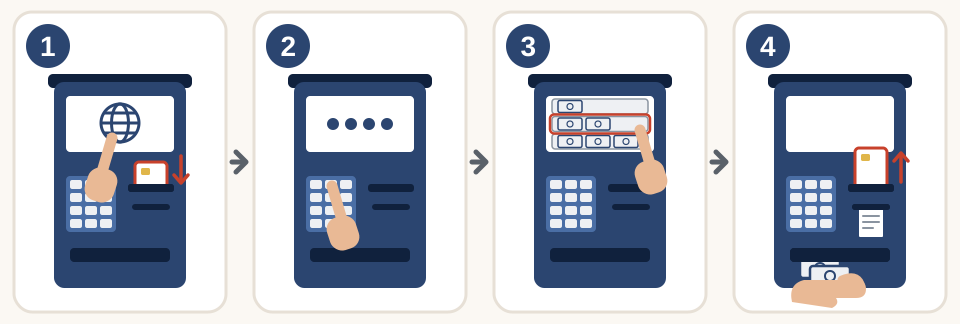
- Insert your card and choose a language on the screen.
- Enter your PIN.
- Choose the amount to withdraw. At Lawson Bank ATMs, the withdrawal amount and the fee are shown on the screen before the transaction goes through.
- Take your cash, card, and receipt. The order in which they come out differs by ATM.
When you use a Visa or Mastercard at a Seven Bank ATM, a screen appears asking which currency you want to be billed in. If you choose your home currency, the amount you will be charged is fixed on the spot. If you choose Japanese yen, the amount in your home currency is determined when your card issuer bills you.
Paying
How to Pay
- For cash, only Japanese yen is accepted.
- You can pay with transit IC cards (Suica, PASMO, ICOCA, etc.). Transit IC cards added to Apple Pay or Google Pay on your smartphone also work. For more on transit IC cards, see Welcome Suica: How to Buy and Use It | A 28-Day IC Card for Visitors to Japan.
- Credit cards such as Visa, Mastercard, JCB, and American Express are accepted. At 7-Eleven and FamilyMart, you can pay by holding a card or smartphone that has the contactless payment symbol over the reader.
- QR and barcode payments are also accepted. 7-Eleven and FamilyMart say they accept Alipay and WeChat Pay, and Lawson says it accepts WeChat Pay.
- Some payment methods cannot be used at certain stores or in certain areas.
The checkout process differs by store. At some stores, you choose your payment method on the customer-facing screen at the register; at others, you tell the staff. When paying with a transit IC card, select it on the screen or tell the staff first, then touch your card to the reader.
At FamilyMart and Lawson, you can top up (add money to) a transit IC card by asking the staff at the register. At FamilyMart, top-ups are cash only. Once a top-up is done, it cannot be canceled or refunded. Some stores do not offer top-ups.
Services
Sending Luggage, Exchanging Money, and Buying Tickets
- Sending luggage: At some 7-Eleven and FamilyMart stores, you can send luggage to the airport or your accommodation with Yamato Transport's TA-Q-BIN. It takes at least one day for luggage to reach the airport or your accommodation. Deadlines and fees for sending luggage to the airport are explained in Send Your Suitcase by Courier | Airport to Accommodation, Accommodation to Airport (Yamato Transport).
- At 7-Eleven, if you have a package delivered to the store's address, you cannot pick it up at the store, because staff cannot receive and hold it on your behalf.
- Exchanging money: Some 7-Eleven and FamilyMart stores have machines that exchange foreign currency into Japanese yen. Only banknotes are accepted; coins cannot be exchanged. You cannot exchange Japanese yen into foreign currency.
- Buying tickets: At FamilyMart's multi-copy machines, you can buy tickets for theme parks, aquariums, zoos, highway buses, and more. On the screen, you can choose English, Chinese, Korean, Thai, and other languages.
Checkout and store
Questions at the Register and Things to Know in the Store
- Plastic bags cost extra. Tell the staff if you need one.
- For boxed meals (bento) and similar items, you may be asked whether you want them heated. Some items cannot be heated.
- Ask for chopsticks, spoons, or forks when you need them.
- When buying alcohol or tobacco, press the age-confirmation button on the register screen. In Japan, drinking alcohol under the age of 20 is prohibited by law.
- If you eat in the store's eat-in area, the standard tax rate applies even to food that qualifies for the reduced tax rate.