Bringing Medicines into Japan | Quantities Allowed Without Procedures, Applying for an Import Certificate, and Medicines That Need Permission or Are Banned
This page explains the rules for bringing medicines into Japan when you travel, based on official information from the Ministry of Health, Labour and Welfare. It covers the quantities of medicines, cosmetics and medical devices you can bring without any procedure, applying online for an Import Certificate when you exceed them, permission for medical narcotics and stimulants' raw materials, how psychotropics are handled, and medicines you cannot bring even if a doctor in your own country prescribed them.
Ad · Affiliate This article contains links to partner booking and shopping pages (affiliate links). If you book or buy through these links, the site operator may receive a commission from the partner. Our advertising policy
Overview
Medicines for your own use during your trip can be brought into Japan without any special procedure, as long as they are within set quantities (according to the Ministry of Health, Labour and Welfare). If you bring more than the set quantities, obtain an Import Certificate (Yunyu Kakunin-sho) before you leave for Japan, and show it at customs if asked.
The medicines you bring are for your own use. You cannot sell them or give them to other people. You also cannot bring in other people's medicines together with yours (according to the Ministry of Health, Labour and Welfare).
Some medicines, such as medical narcotics, are subject to further rules under other laws. There are also medicines you cannot bring into Japan even if a doctor in your own country prescribed them. Both are explained in the last section of this page.
Conditions
Quantities you can bring without any procedure (per person)
| Item | Quantity |
|---|---|
| Medicines that require a doctor's prescription | Up to a 1-month supply |
| Medicines that do not require a doctor's prescription (excluding medicines for external use) | Up to a 2-month supply |
| Medicines for external use such as ointments and eye drops (excluding those that require a doctor's prescription) | Up to 24 per product type |
| Injectable medicines and syringes (limited to syringes prefilled with medicine or kits for self-injection) | Up to a 1-month supply |
| Cosmetics | Up to 24 per product type |
| Medical devices for home use (such as electric massagers) | 1 set |
| Disposable contact lenses | Up to a 2-month supply |
- How to count months' supply: Count the amount inside the boxes, not the number of boxes, and calculate it from the dosage specified for the medicine. For example, for tablets taken 2 at a time, 3 times a day, a 2-month supply is 360 tablets (according to the Ministry of Health, Labour and Welfare).
- How to count cosmetics: For example, lipsticks are limited to 24 in total, even if they differ in brand or color (according to the Ministry of Health, Labour and Welfare).
- When you bring syringes only: If you bring syringes without the medicine, you need an Import Certificate even for a single syringe (according to the Ministry of Health, Labour and Welfare).
If you bring more than the quantities in this table, obtain an Import Certificate before you leave. The next section explains how to apply.
Step by step
Applying for an Import Certificate
You apply for an Import Certificate online through the Ministry of Health, Labour and Welfare's Application for Import Confirmation system. As a rule, applications for medicines for your own use are made online (according to the Ministry of Health, Labour and Welfare).
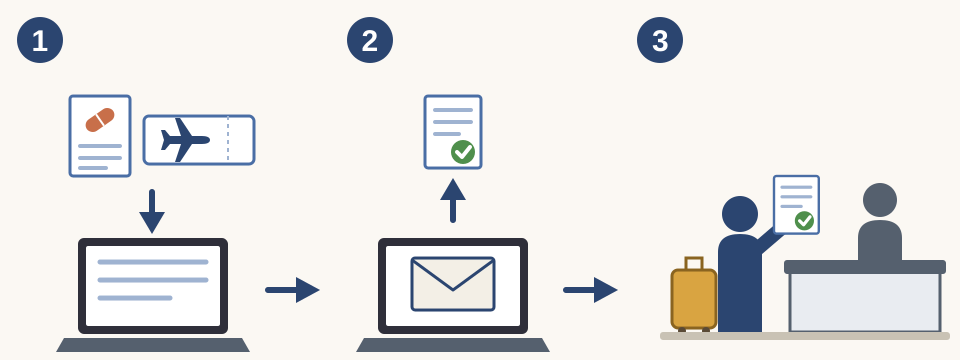
- Register an account on the system, log in, and choose "Import for personal use" as the application type. Fill in the required information, attach the required documents as files, and submit the application.
- If the Regional Bureau of Health and Welfare finds no problems in its review, the Import Certificate is issued. The PDF file of the Import Certificate is sent to the email address you registered.
- After you arrive in Japan, show the Import Certificate at customs when asked.
The application requires the following two documents (according to the Ministry of Health, Labour and Welfare).
- A doctor's prescription or a document written by a doctor, showing the patient's name, the name of the medicine and the doctor's name. Prepare one for every medicine and medical device you apply for.
- A document issued by the airline or shipping company (such as an itinerary or a copy of your ticket), showing the arrival date, the airport or port of arrival, the flight number and the passenger's name.
If your documents are complete, the Import Certificate is usually issued within a few days, excluding Saturdays, Sundays and public holidays. If you write on or make corrections to the Import Certificate you received, it becomes invalid (according to the Ministry of Health, Labour and Welfare).
If you have only a few days before departure, or if you have questions about the application, email the Regional Bureau of Health and Welfare in charge of the airport you will arrive at. The Kanto-Shin'etsu Regional Bureau of Health and Welfare is in charge of New Chitose Airport, Narita Airport, Haneda Airport and others, and the Kinki Regional Bureau of Health and Welfare is in charge of Chubu Airport, Kansai International Airport, Fukuoka Airport, Naha Airport and others (according to the Ministry of Health, Labour and Welfare). For other airports, check the Ministry of Health, Labour and Welfare's page to find which Regional Bureau of Health and Welfare is in charge.
Good to know
Medicines that need permission, and medicines you cannot bring
- Medical narcotics and stimulants' raw materials: For medical narcotics such as morphine, fentanyl, oxycodone and codeine, and stimulants' raw materials such as lisdexamfetamine (product names include Vyvanse), you must obtain permission from the director of the Regional Bureau of Health and Welfare before you enter Japan (according to the Ministry of Health, Labour and Welfare). Applications for this permission are handled by the Narcotics Control Department of the Regional Bureau of Health and Welfare. Send the application form, a doctor's certificate and photos of the medicine's packaging by email, fax or post to the Narcotics Control Department that covers the airport you will arrive at. The doctor's certificate must have been issued within the past 3 months. Apply at least 14 days before the day you leave for Japan. If you plan to take leftover medicine with you when you leave Japan, send the application for taking it out together with the application for bringing it in (according to the Narcotics Control Department).
- Psychotropics: Psychotropics such as zolpidem, alprazolam, diazepam and methylphenidate do not require permission. The Narcotics Control Department's website has a table of amounts for each psychotropic. If you bring more than the amount in that table, or if you bring injectables, carry a doctor's certificate stating the name of the illness, that the medicine is needed for treatment, and the name and amount of the medicine (according to the Narcotics Control Department). Separately, if you bring more than a 1-month supply of psychotropics, or if you bring injectables, obtain an Import Certificate before you leave (according to the Ministry of Health, Labour and Welfare).
- Carry them in yourself: Medical narcotics, psychotropics and stimulants' raw materials can be brought into Japan only when the person they were prescribed for carries them personally when entering Japan. You cannot send them by post or international courier, and you cannot have family members or anyone else carry them for you (according to the Ministry of Health, Labour and Welfare and the Narcotics Control Department).
- If you are not sure of the category: Ask the doctor who prescribed your medicine which category it falls under. The Narcotics Control Department's website has a list of substances controlled in Japan (in English). Product names are not included in the list (according to the Narcotics Control Department).
Medicines containing ingredients such as rhino horn, musk deer secretions, tiger bone or bear gallbladder cannot be imported freely because of the Washington Convention (CITES) (according to the Ministry of Health, Labour and Welfare). For items to declare at customs and duty-free allowances, see What to Declare at Japanese Customs | Duty-Free Allowances for Alcohol, Tobacco and Perfume, Cash over 1 Million Yen, and Prohibited Items; for whom to contact if you become ill in Japan, see Emergency Numbers in Japan | Police 110, Ambulance 119, and Help in English.