Licenses for Driving in Japan | International Driving Permit or Japanese Translation, How Long You Can Drive, and Road Rules
What travelers need to drive a rental car or other vehicle in Japan, based on official information from the National Police Agency and JAF (Japan Automobile Federation): International Driving Permits under the 1949 Geneva Convention, the Japanese translation required for driver's licenses from Switzerland, Germany, France, Belgium, Monaco and Taiwan, how long you can drive, how to get a translation from JAF and what it costs, and what to watch for on Japanese roads.
Ad · Affiliate This article contains links to partner booking and shopping pages (affiliate links). If you book or buy through these links, the site operator may receive a commission from the partner. Our advertising policy
Overview
To drive a car in Japan, you need a Japanese driver's license or one of the following two (National Police Agency guidance, as of April 1, 2026).
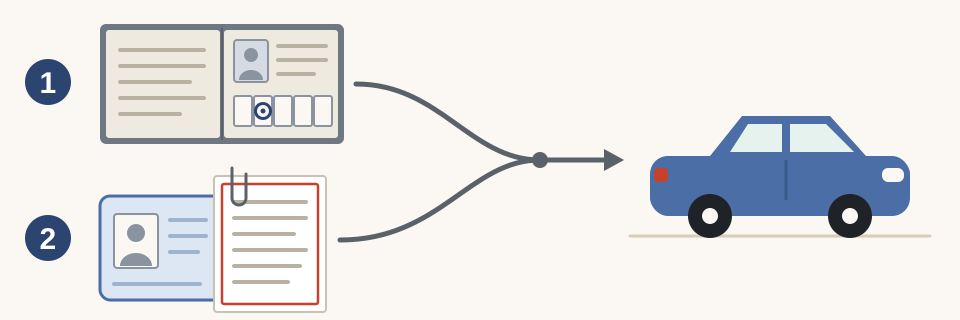
- International Driving Permit: one issued under the 1949 Geneva Convention (the Convention on Road Traffic).
- Foreign driver's license with a Japanese translation: a driver's license issued in one of 6 countries and regions — Switzerland, Germany, France, Belgium, Monaco and Taiwan — accompanied by a Japanese translation prepared by one of the organizations listed below.
Which one you use depends on the country or region that issued your driver's license. If you have neither a Japanese driver's license nor either of these two, you cannot drive in Japan. Driving without a license carries heavy penalties. People who, knowing that a driver has no license, lend that person a car or ride in a car that person is driving can also be penalized (National Police Agency guidance).
Conditions
Driving with an International Driving Permit
- The National Police Agency lists the United States, Italy, the United Kingdom, Canada, South Korea, Thailand and the Philippines as examples of places whose drivers use an International Driving Permit.
- In Japan, you can use only an International Driving Permit issued under the 1949 Geneva Convention. You cannot drive in Japan with an International Driving Permit issued by a country or region that is not a party to this convention, or with one that is not in the format set by the convention. Check with the issuing authority whether your International Driving Permit is based on this convention.
- An International Driving Permit is valid for 1 year from the date of issue.
- You can drive only the types of vehicles that have a stamp in the vehicle category section of your International Driving Permit. If there is no stamp, the section is blank, or it cannot be read, you cannot drive (National Police Agency Q&A).
How long you can drive
- Whether you use an International Driving Permit or a foreign driver's license with a translation, you can drive only until 1 year after the date you entered Japan. If your license expires before then, you can drive only until it expires (National Police Agency guidance).
- While you are driving, a police officer may ask to see your passport to check the date you entered Japan (JAF guidance).
- If you live in Japan and keep driving, you need to switch to a Japanese driver's license. This is done at the driver's license center of the prefectural police where you live (National Police Agency guidance).
Step by step
Getting a Japanese translation (driver's licenses from Switzerland, Germany, France, Belgium, Monaco and Taiwan)
The translation must be prepared by one of the following. A translation by a certified translator abroad cannot be used (National Police Agency guidance).
- The authority that issued the driver's license, or that country's embassy or consulate in Japan
- For German driver's licenses, ADAC; for Taiwanese driver's licenses, the Taiwan-Japan Relations Association
- A corporation designated by Japan's National Public Safety Commission, such as JAF (Japan Automobile Federation)
To get a translation from JAF, follow these steps (JAF guidance).
- Apply online on JAF's translation application website and send images of the front and back of your driver's license. You can apply only from a network in Japan. You cannot apply at a counter or by mail.
- Pay by credit card, or in cash at a convenience store. Debit cards and prepaid cards are not accepted.
- When the translation is ready, print it on a multifunction copier at a convenience store in Japan. It takes about 2–3 business days. It is not issued on the same day.
If you want the translation ready before you arrive in Japan, you can ask someone you know in Japan to apply on your behalf. The authority that issued your driver's license, or the embassy or consulate in Japan, may also provide translations (JAF guidance).
Costs
JAF translation fees
| Item | Fee |
|---|---|
| Japanese translation for driving in Japan | ¥6,000 |
| Printing at a convenience store | ¥20 per page |
Translations used for switching to a Japanese driver's license have a different fee. When your driver's license is renewed, or when details on it such as your address change, you need a new translation (JAF guidance).
Good to know
What to watch for on Japanese roads
Traffic rules and signs in Japan can differ from those in other countries. The National Police Agency asks drivers to pay particular attention to the following.
- In Japan, cars drive on the left side of the road. People used to driving in countries where traffic keeps right may end up on the right side, for example after turning at an intersection.
- Stop at red lights. When a green arrow is shown, you may go in the direction of the arrow. Where there is a stop sign, come to a complete stop and check both left and right.
- At railroad crossings, stop once and check that no train is coming, even if the alarm is not sounding.
- Pedestrians have priority. When pedestrians are crossing, or about to cross, at a crosswalk or intersection, stop and let them go first. When turning right, vehicles going straight and vehicles turning left have priority.
- Do not drive after drinking alcohol. Driving while alcohol from the previous day is still in your system is also illegal.
- Except in an emergency, do not make calls on a smartphone or similar device, or look at its screen, while driving.
If you have an accident
Even if no one is injured, always call 110 to report it to the police. If someone is injured, give first aid, call an ambulance at 119, and also report it to the police at 110 (National Police Agency guidance). Japan's emergency phone numbers are summarized in Emergency Numbers in Japan | Police 110, Ambulance 119, and Help in English.