How to Use the JR EAST PASS | 5-Day and 10-Day Prices, the Change That Merged the Tohoku and Nagano/Niigata Passes into One, Area Covered (Aomori, Sendai, Akita, Yamagata, Niigata, Nagano, Nikko), Trains You Can Ride, Stations Where You Can Collect It, and Whether It Pays Off
Based on JR East's official information, this article explains the JR EAST PASS: the railway companies and lines you can ride for 5 or 10 consecutive days, the main stations on the official map, how the Tohoku pass and the Nagano/Niigata pass became one new pass in March 2026, the trains you cannot ride such as the Tokaido Shinkansen, who can buy it, the three ways to buy it and the stations where you can collect it, seat reservations, and refunds. It also compares the pass with the total fares and charges for a round trip from Tokyo to each of Sendai, Shin-Aomori, Nagano and Niigata.
Ad · Affiliate This article contains links to partner booking and shopping pages (affiliate links). If you book or buy through these links, the site operator may receive a commission from the partner. Our advertising policy
Overview
The JR EAST PASS is a pass sold by JR East for people who hold a passport issued by a country other than Japan. For 5 or 10 consecutive days starting on the day you choose, you can ride JR East lines and specified lines of other railway companies as many times as you like, within a set area that includes Tohoku, Nagano, Niigata and the area around Tokyo. You can also use this pass to reserve Ordinary Car reserved seats on shinkansen and limited express trains within the area. The price of the 5-day pass is ¥35,000 for adults (age 12 and over) and ¥17,500 for children (age 6 to 11). The prices and rules in this article were checked on the JR East official website on October 28, 2026. The conditions of carriage on the JR East official website are marked "as of March 2026".
There used to be two passes: the "JR EAST PASS (Tohoku area)" for use in Tohoku, and the "JR EAST PASS (Nagano, Niigata area)" for use in Nagano and Niigata. According to JR East's announcement of January 28, 2026, sales of these two passes ended on March 13, 2026, and a new JR EAST PASS that can be used from March 14, 2026 is now on sale. A single new pass can be used in both the Tohoku area and the Nagano and Niigata area. If you bought one of the two previous passes by March 13, 2026, you can use it until the last day of its period of use.
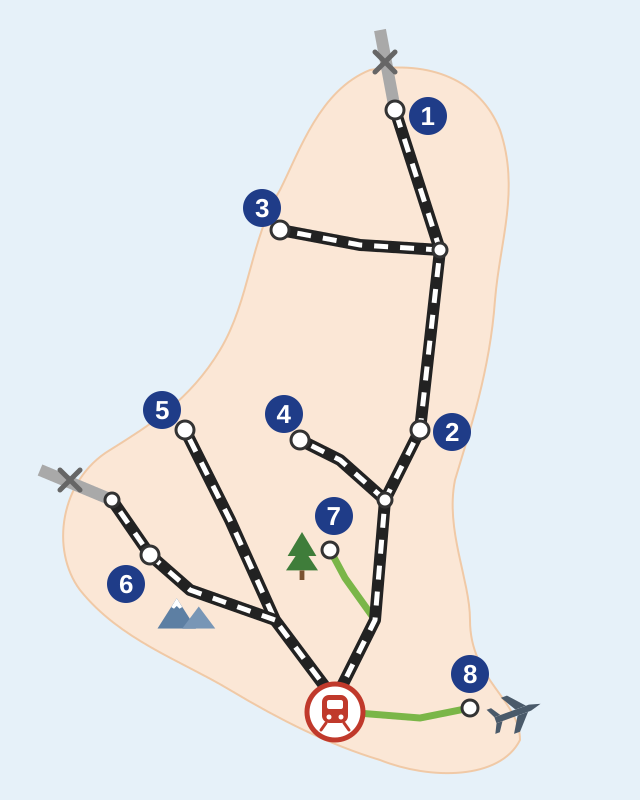
The map is a simplified drawing of the lines that run from Tokyo out to the edges of the area the pass covers. The thick white-and-black lines are shinkansen, and the thin green lines are lines that are not shinkansen. The gray lines are shinkansen you cannot ride with this pass. The numbers do not show an order of travel; they mark the following places.
- Shin-Aomori Station. The northernmost station on the Tohoku Shinkansen. You cannot ride the Hokkaido Shinkansen (the gray line) north of Shin-Aomori Station with this pass.
- Sendai Station. You can get there from Tokyo Station on the Tohoku Shinkansen.
- Akita Station. You can get there from Tokyo Station without changing trains on the "Komachi" of the Akita Shinkansen.
- Yamagata Station. You can get there from Tokyo Station without changing trains on the "Tsubasa" of the Yamagata Shinkansen.
- Niigata Station. You can get there from Tokyo Station on the Joetsu Shinkansen.
- Nagano Station. You can get there from Tokyo Station on the Hokuriku Shinkansen. With this pass, you can ride the Hokuriku Shinkansen only as far as Joetsumyoko Station, beyond Nagano Station. You cannot ride beyond Joetsumyoko Station (the gray line) with this pass.
- Nikko. You can ride the limited expresses that run from JR stations straight through to Tobu-Nikko Station and Kinugawa-Onsen Station on the Tobu lines. You can also go to JR Nikko Station on the JR Nikko Line.
- Narita Airport Terminal 1 Station and Narita Airport Terminal 2·3 Station. Both are stations inside Narita Airport, and you can ride the Narita Express (N'EX) limited express from them.
- The railway companies you can ride and the trains you cannot ride are summarized under "Railway companies and lines you can ride" and "Trains you cannot ride, and things you pay for separately".
- You cannot ride the Tokaido Shinkansen. This is not a pass for traveling from Tokyo to Kyoto or Osaka. A pass that covers JR lines all over Japan is explained in JAPAN RAIL PASS (JR Pass): Prices and How to Use It | Prices on the Official Website and from Agents Outside Japan, How to Buy, and How to Ride Nozomi and Mizuho.
Prices
Prices
| Days of use | Adult (age 12 and over) | Child (age 6 to 11) |
|---|---|---|
| 5 days | ¥35,000 | ¥17,500 |
| 10 days | ¥50,000 | ¥25,000 |
- Whether you count as an adult or a child is decided by your age on the day you buy the pass. When you buy a child's pass, you need to prove the child's age with the child's passport or a similar document.
- Children under 6 do not need a pass if they do not reserve a seat. To reserve a seat for a child under 6, you need a child pass or a child ticket for that child.
- There is no discounted price for students.
- To ride in the Green Car or Gran Class, you pay charges in addition to the pass.
Period of use
The pass can be used for 5 or 10 consecutive days, starting on the day you choose when you buy it. In the example on the official website, a 5-day pass can be used from October 2 to October 6, on consecutive days without any gaps. You cannot use it on separate days with gaps between them, such as October 2, 4, 5, 7 and 9.
- While you are traveling in Japan, you can use only one JR EAST PASS at a time. You cannot buy a second pass whose period of use overlaps with the first.
- After you buy the pass, you cannot change the pass's period of use. You also cannot exchange the pass for a different type of pass. If you want to change either of these, get a refund for that pass and then buy a new pass.
Conditions
Railway companies and lines you can ride
- JR East lines, on the sections inside the area shown on the official map (including BRT). You can ride Ordinary Car reserved and non-reserved seats on shinkansen, limited express, express and local trains. BRT means a Bus Rapid Transit system: sections where buses run.
- Tokyo Monorail Line. This is the line that goes to Haneda Airport.
- The entire sections of the Aoimori Railway, Iwate Galaxy Railway (IGR), Sanriku Railway, Sendai Airport Transit and Hokuetsu Express lines.
- Echigo Tokimeki Railway, on the section from Naoetsu Station to Arai Station.
- Ordinary Car reserved seats on the limited expresses that run straight through between JR lines and Tobu lines (the "Nikko", the "Kinugawa", the "SPACIA Kinugawa" and others).
- Tobu Railway local trains (including rapid trains) from Shimo-Imaichi Station to Tobu-Nikko Station and from Shimo-Imaichi Station to Kinugawa-Onsen Station.
- JR buses within the area on the official map. However, you cannot ride buses that run on expressways or some local bus routes.
Between Kurihashi Station and Shimo-Imaichi Station on Tobu Railway, you can ride only the limited expresses that run through from JR lines. You cannot use this pass on limited expresses that run only on Tobu lines (such as limited expresses departing from Asakusa Station). When you use this pass on a limited express running through between JR lines and Tobu lines, on any section, at least one of the two stations, the station where you board or the station where you get off, must be a station on a JR line.
Main stations on the official map
| Direction | Lines | Main stations on the official map |
|---|---|---|
| Aomori | Tohoku Shinkansen, Aoimori Railway Line | Sendai Station, Morioka Station, Hachinohe Station, Shin-Aomori Station, Aomori Station |
| Akita | Akita Shinkansen | Morioka Station, Omagari Station, Akita Station |
| Yamagata | Yamagata Shinkansen | Fukushima Station, Yonezawa Station, Yamagata Station, Shinjo Station |
| Niigata | Joetsu Shinkansen | Takasaki Station, Echigo-Yuzawa Station, GALA Yuzawa Station, Niigata Station |
| Nagano | Hokuriku Shinkansen, JR Shinonoi Line, JR Oito Line | Karuizawa Station, Nagano Station, Joetsumyoko Station, Matsumoto Station, Hakuba Station |
| Nikko and Kinugawa | Tohoku Shinkansen, JR Nikko Line, limited expresses running through between JR and Tobu lines | Utsunomiya Station, JR Nikko Station, Tobu-Nikko Station, Kinugawa-Onsen Station |
| Airports | Narita Express (N'EX), Tokyo Monorail, Sendai Airport Transit Line | Narita Airport Terminal 1 Station, Narita Airport Terminal 2·3 Station, the Tokyo Monorail stations at Haneda Airport, Sendai Airport Station |
| Tokyo and Yokohama | JR East lines | Tokyo Station, Ueno Station, Omiya Station, Yokohama Station |
GALA Yuzawa Station is open only from winter to spring.
Trains you cannot ride, and things you pay for separately
- The Tokaido Shinkansen. This shinkansen is run by a different company, not JR East.
- The Hokkaido Shinkansen (north of Shin-Aomori Station). Hokkaido is not included in the area on this pass's official map.
- The section of the Hokuriku Shinkansen beyond Joetsumyoko Station (toward Toyama Station and Kanazawa Station). It is outside the area on the official map.
- The Izukyu Line and the Fujikyu Railway Line. The official website states that they are outside the area.
- Gran Class. To ride it, you pay the Gran Class charge and the limited express charge.
- The Green Car on shinkansen and limited express trains. To ride it, you pay the Green Car charge and the limited express charge.
- Lines of companies that are not in the list under "Railway companies and lines you can ride", and sections outside the area on the map. To ride them, you pay the fare and charges for that section. For example, Tokyo Metro, Toei Subway, the Keisei Line (Skyliner) and the Odakyu Line are not in the list.
You can ride the "Hayabusa" on the Tohoku Shinkansen and the "Komachi" on the Akita Shinkansen with this pass. All seats on both are reserved, so get a seat reservation ticket before boarding. Some "Hayabusa" and "Hayate" trains continue straight onto the Hokkaido Shinkansen north of Shin-Aomori Station. If you ride one of these trains beyond Shin-Aomori Station, you pay separately the fare and charges for the section north of Shin-Aomori Station.
Costs
How to compare with paying fares and charges one by one (adults)
Add up the fares and charges for the trains you will ride during the period of use. If the total is higher than the price of the pass, the pass is cheaper. The table below shows the one-way adult fares and charges for the sections used as examples in this article. All are prices for Ordinary Car reserved seats, and are the values for the regular season, which is neither a period when charges are higher nor a period when they are lower.
| Section (one way) | Fare and charges |
|---|---|
| Tokyo Station to Sendai Station (Tohoku Shinkansen) | ¥11,630 |
| Tokyo Station to Morioka Station (Tohoku Shinkansen) | ¥15,450 |
| Tokyo Station to Shin-Aomori Station (Tohoku Shinkansen) | ¥18,110 |
| Sendai Station to Shin-Aomori Station (Tohoku Shinkansen) | ¥11,640 |
| Tokyo Station to Nagano Station (Hokuriku Shinkansen) | ¥8,450 |
| Tokyo Station to Echigo-Yuzawa Station (Joetsu Shinkansen) | ¥6,900 |
| Tokyo Station to Niigata Station (Joetsu Shinkansen) | ¥10,980 |
| Narita Airport Terminal 1 Station or Narita Airport Terminal 2·3 Station to Tokyo Station (Narita Express) | ¥3,140 |
The values in the table were looked up with the official timetable and fare search tools of JR Hokkaido and JR West. Both search tools show fares and charges for JR East sections. The values are for travel on December 4, 2026 for the Tohoku Shinkansen sections, and on November 6, 2026 for the other sections. If your travel date falls in a period when charges are higher or lower, the reserved seat charge changes.
- One round trip between Tokyo Station and Sendai Station costs ¥23,260. If the only trip you take during the pass's period of use is one round trip between Tokyo Station and Sendai Station, paying the fares and charges is cheaper than buying the pass.
- One round trip between Tokyo Station and Shin-Aomori Station costs ¥36,220. The 5-day pass is ¥1,220 cheaper.
- If you go from Tokyo Station to Sendai Station and stay one night, then go from Sendai Station to Shin-Aomori Station, and return from Shin-Aomori Station to Tokyo Station, the total is ¥41,380. The 5-day pass is ¥6,380 cheaper.
- If, within the same 5 days, you make one round trip between Tokyo Station and Nagano Station and one round trip between Tokyo Station and Niigata Station, the total is ¥38,860. The 5-day pass is ¥3,860 cheaper.
- If, within 10 days, you make one round trip each between Tokyo Station and Shin-Aomori Station, between Tokyo Station and Nagano Station, and between Tokyo Station and Niigata Station, the total is ¥75,080. The 10-day pass is ¥25,080 cheaper.
- The JR East official website gives this example trip: from Narita Airport Terminal 1 Station to Tokyo Station on the Narita Express, then to Sendai Station and Shin-Aomori Station on the Tohoku Shinkansen. The fares and charges for Ordinary Car reserved seats come to about ¥52,000 in total (regular season).
The totals compared in this article do not include the fare and charges for the Narita Express (the example on JR East's official website does include them). If the day you ride the Narita Express from Narita Airport Terminal 1 Station or Narita Airport Terminal 2·3 Station to Tokyo Station falls within the pass's period of use, you can also ride that section (¥3,140 one way) with the pass, so the pass saves you even more by that amount. The rules for child fares and charges are explained in Child Fares on Japan's Trains and Subways | When Kids Pay Adult Fare, Free Rides for Young Children, Child IC Cards.
Where to buy
Who can buy and use the pass
- Only people who hold a passport issued by a country other than Japan can buy and use this pass. People with Japanese nationality cannot use it.
- You do not need the "Temporary Visitor" status of residence to use this pass. JR East's page on how to buy lists this pass among the passes that do not have this condition.
- When you buy and when you collect the pass, show the original passport of the person who will use it. You cannot buy or collect the pass with a copy of your passport. JR East's page on how to buy the pass says that the pass is not sold to anyone other than the person who will use it, including family members.
- Your passport must also be valid during the period you use the pass. While you are using the pass, carry the original passport and show it if staff ask for it. An identity document other than a passport, such as a residence card, cannot be used instead.
Three ways to buy
- Buy it on JR-EAST Train Reservation, JR East's booking website. You can buy it from 10:00 (Japan time) one month before the day you start using the pass. After you arrive in Japan, collect the pass at a station.
- Buy a voucher (e-ticket) to exchange for the pass from a travel agency outside Japan. After you arrive in Japan, show the voucher and your passport at a JR EAST Travel Service Center or another collection point, and exchange the voucher for the pass.
- Buy it at a station after you arrive in Japan. You can buy it at a Reserved Seat Ticket Vending Machine with a passport reader or at a JR EAST Travel Service Center.
Stations where you can collect the pass
There are two kinds of places where you can collect the pass. At a JR EAST Travel Service Center, you can both exchange a travel agency's voucher for the pass and collect a pass bought on JR-EAST Train Reservation. At a Reserved Seat Ticket Vending Machine with a passport reader, you can collect only a pass bought on JR-EAST Train Reservation. To collect it at this ticket vending machine, you need a passport with an IC chip.
| Area | Stations with a JR EAST Travel Service Center | Stations with only a Reserved Seat Ticket Vending Machine with a passport reader |
|---|---|---|
| Airports | Narita Airport Terminal 1 Station, Narita Airport Terminal 2·3 Station, Haneda Airport Terminal 3 Station | None |
| Around Tokyo and Ibaraki Prefecture | Tokyo Station, Shinjuku Station, Shibuya Station, Ikebukuro Station, Ueno Station, Takanawa Gateway Station, Yokohama Station, Kawasaki Station, Omiya Station, Tachikawa Station, Funabashi Station, Kashiwa Station | Shinagawa Station, Hamamatsucho Station, Mito Station |
| Tohoku | Sendai Station, Morioka Station, Aomori Station, Akita Station, Yamagata Station, Fukushima Station | Hachinohe Station |
| Nagano and Niigata | Nagano Station, Niigata Station | Matsumoto Station |
- This table was checked against the list of collection points on the JR East official website on October 28, 2026. The hours when you can collect the pass differ by location, so check them in the official list.
- You cannot collect the pass at Midori-no-madoguchi (JR ticket office). However, you can collect it at the Midori-no-madoguchi at Narita Airport Terminal 1 Station and Narita Airport Terminal 2·3 Station.
- At the Tourist Information Center at Haneda Airport Terminal 2, you can also exchange a travel agency's voucher for the pass. A pass bought on JR-EAST Train Reservation cannot be collected there.
Refunds
- If you have a paper pass in hand (a pass bought at a station, or a pass after you have collected it at a station), you can get a refund within its period of use if you have not used it yet. 10% of the pass price is deducted as a refund fee. The official information says the refund is given at "the place where the pass was sold." For a pass bought on JR-EAST Train Reservation and collected at a station, it does not say whether this means the booking website or the station where you collected the pass.
- A pass bought on JR-EAST Train Reservation and not yet collected can be canceled on the booking website without a fee until 23:50 (Japan time) on the day before the first day of use. After that time, and until 23:50 (Japan time) on the last day of the period of use, it can be canceled on the booking website for a fee. The amount of this fee is not given on the page on how to buy the pass. This cancellation cannot be done at a station.
- If you bought a voucher from a travel agency outside Japan and have not yet exchanged the voucher for the pass, contact the travel agency where you bought it. In this case, you cannot get a refund from JR East.
- If you have only received a seat reservation ticket with the pass and have not yet ridden any train with the pass, you can get a refund for the pass before the departure time of the train for that reserved seat. Once the departure time of that train has passed, the pass cannot be refunded, even if you did not ride that train. If you will not ride a train, cancel its seat reservation before the departure time.
- Once you have started using the pass, the period of use is not extended and no refund is given, even if trains are suspended or delayed. A lost or stolen pass is not reissued.
Booking
Reserving seats
- To sit in a reserved seat, get a seat reservation ticket before boarding, at a reserved seat ticket vending machine at a JR East station, at Midori-no-madoguchi or at a JR EAST Travel Service Center. The pass alone does not guarantee you a seat.
- You can ride in non-reserved seats with just the pass. Some trains have no non-reserved seats.
- On the "Hayabusa", the "Komachi", the "Hayate", the "Tsubasa", the "Nikko", the "Kinugawa" and the "SPACIA Kinugawa", all seats are reserved. You cannot ride these trains unless you have received a seat reservation ticket.
- On the Narita Express (N'EX), the "Hitachi", the "Tokiwa", the "Akagi", the "Azusa", the "Kaiji", the "Fuji Excursion", the "Odoriko", the "Shonan" and others, every seat in the Ordinary Car can be reserved. If you board without a seat reservation, sit in any seat that is not taken.
- On JR-EAST Train Reservation, a person using the pass can make up to 15 bookings in total, with the booking for the pass also counted as one. According to the official FAQ, when you collect your booked tickets at a station, the count of your bookings is "reset" and you can book again.
- After you have collected the pass, you can also get seat reservation tickets directly at the Midori-no-madoguchi or a reserved seat ticket vending machine at a station, without using the booking website.
How to go through the ticket gates
- To go through, insert the pass into the automatic ticket gate. Do not forget to take the pass back after you go through.
- At stations on lines of companies other than JR East, you cannot use the automatic ticket gates. Go through the staffed gate.
- At JR East stations as well, if you cannot go through the automatic ticket gate with the pass, go through the staffed gate.
The rules for bringing large luggage on the shinkansen are explained in How to Bring a Large Suitcase on the Shinkansen | Reserving a Seat with an Oversized Baggage Area and Where to Put Your Luggage.
Good to know
- JR East also sells passes that cover a different area from this pass. According to JR East's announcement of January 28, 2026, the "JR East-South Hokkaido Rail Pass", which can also be used around Hakodate, Sapporo and Otaru in Hokkaido, is ¥40,000 for adults for 6 days, and the "Hokuriku Arch Pass", which can also be used in Hokuriku and Kansai, is ¥35,000 for adults for 7 days. The Hokuriku Arch Pass can be used only by people whose status of residence is "Temporary Visitor".
- A 3-day pass used only in the area around Tokyo is explained in How to Use the JR TOKYO Wide Pass | 3-Day Price, Area Covered (Kawaguchiko, Nikko, Karuizawa, GALA Yuzawa), Trains You Can and Cannot Ride, Seat Reservations, and Whether It Pays Off, and passes for Hokkaido in How to Use the Hokkaido Rail Pass | Prices for 5, 7 and 10 Days, How It Differs from the Two Sapporo Area Passes, Trains and Buses You Can Ride, Reserving Seats on All-Reserved Limited Express Trains, and Whether It Pays Off.
- How to get from Narita Airport to Tokyo is explained in From Narita Airport to Central Tokyo | Skyliner, Narita Express or Airport Bus?, and how to get around Nikko in Day Trip from Tokyo to Nikko | Tobu Limited Expresses from Asakusa (SPACIA X, Revaty) Compared with Routes from Shinjuku and Tokyo Station, NIKKO PASS vs. Individual Ticket Totals, and a Route to Toshogu and Rinnoji Before Closing.
- Temperatures and snow in Tohoku, Niigata and Nagano in winter are explained in Japan Winter Weather and Temperatures | December, January and February Normals by Location (Tokyo, Osaka, Kyoto, Sapporo, Kawaguchiko, Naha in Okinawa), Days with Snow or Sleet and Sunset Times.