How to Use the JR Kyushu Rail Pass | Prices and Areas of the All Kyushu, Northern Kyushu and Southern Kyushu Passes, Trains You Can and Cannot Ride, Number of Seat Reservations, and Whether It Pays Off
Based on JR Kyushu's official information, this article explains the three types of the JR Kyushu Rail Pass sold by JR Kyushu (All Kyushu, Northern Kyushu and Southern Kyushu): the areas and trains you can ride for 3, 5 or 7 consecutive days, the price when you buy at a station or from a travel agency outside Japan and the price when you buy on JR Kyushu's booking website, who can buy the pass, how to buy it and at which stations to exchange it, how many reserved seats you can book, the trains you cannot ride, and refunds. It also compares the pass with the total fares and charges for round trips from Hakata Station to Kagoshima-Chuo Station, Nagasaki Station and Yufuin Station.
Ad · Affiliate This article contains links to partner booking and shopping pages (affiliate links). If you book or buy through these links, the site operator may receive a commission from the partner. Our advertising policy
Overview
The JR Kyushu Rail Pass is a pass sold by JR Kyushu for people who hold a passport issued by a country other than Japan and who have come to Japan for sightseeing or similar purposes with the status of residence "Temporary Visitor". There are three types: "All Kyushu", which can be used across all of Kyushu; "Northern Kyushu", which can be used in the northern part of Kyushu; and "Southern Kyushu", which can be used in the southern part of Kyushu. For a set number of consecutive days starting from the first day of use, you can ride JR Kyushu's Shinkansen, limited express trains, rapid trains and local trains within the pass area as many times as you like. The 3-day All Kyushu pass costs ¥22,000 for adults (age 12 and over) and ¥11,000 for children (age 6 to 11). The prices and rules in this article were checked on JR Kyushu's official website on October 27, 2026.
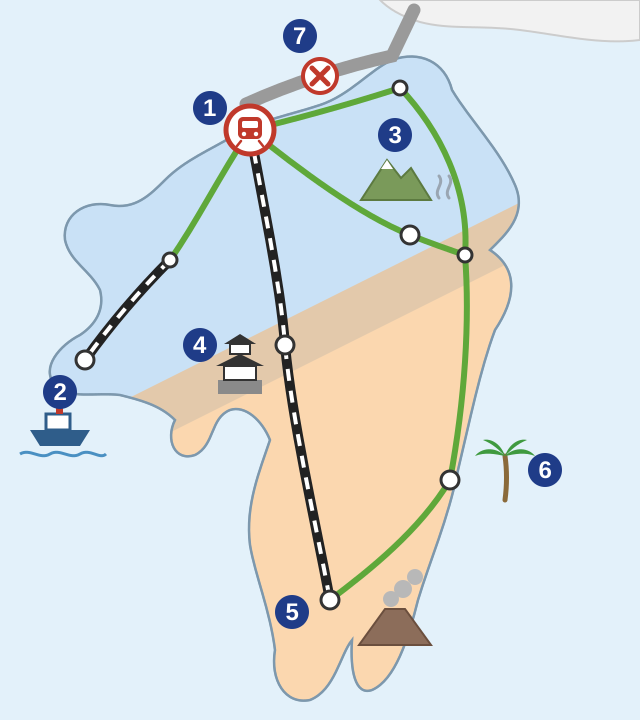
The map is a simplified summary of the main stations in Kyushu and the areas of the Northern Kyushu pass and the Southern Kyushu pass. The blue area is the area of the Northern Kyushu pass, and the orange area is the area of the Southern Kyushu pass. Kumamoto Station and Oita Station, which are in the band where the two colors overlap, can be reached with either pass. The All Kyushu pass can be used in the whole area of the map. The numbers do not show an order of travel; they point to the following places.
- Hakata Station. This station is in the center of Fukuoka, and the Kyushu Shinkansen starts from here. It can be used with the Northern Kyushu and All Kyushu passes.
- Nagasaki Station. From Hakata Station, take the limited express Relay KAMOME and change at Takeo-Onsen Station to the Nishi Kyushu Shinkansen KAMOME. You can reach it with the Northern Kyushu and All Kyushu passes.
- Yufuin Station. From Hakata Station, the limited express YUFUIN NO MORI takes you there without changing trains. You can reach it with the Northern Kyushu and All Kyushu passes.
- Kumamoto Station. You can reach it from Hakata Station on the Kyushu Shinkansen. With any of the passes (Northern Kyushu, Southern Kyushu or All Kyushu), you can travel as far as this station.
- Kagoshima-Chuo Station. You can reach it from Kumamoto Station on the Kyushu Shinkansen. You can reach it with the Southern Kyushu and All Kyushu passes.
- Miyazaki Station. You can reach it with the Southern Kyushu and All Kyushu passes.
- The Shinkansen between Kokura Station and Hakata Station (the gray line). This section is JR West's Sanyo Shinkansen, and you cannot ride it with any of the passes. Between Kokura Station and Hakata Station, you can still ride JR Kyushu's limited express and local trains with the Northern Kyushu and All Kyushu passes.
- Which trains you can ride with which pass is summarized in the table in "Trains and areas you can ride".
- You cannot ride the Shinkansen between Kokura Station and Hakata Station with any of the passes.
- A pass for JR lines all over Japan is explained in JAPAN RAIL PASS (JR Pass): Prices and How to Use It | Prices on the Official Website and from Agents Outside Japan, How to Buy, and How to Ride Nozomi and Mizuho.
Prices
Prices
The prices in the following table are the prices when you buy at a JR Kyushu station ticket office or from a travel agency outside Japan. The price in parentheses is the adult price when you buy on JR Kyushu's booking website, JR KYUSHU RAIL PASS Online Booking.
| Type and number of days | Adult (age 12 and over) | Child (age 6 to 11) |
|---|---|---|
| All Kyushu 3 days | ¥22,000 (on the booking website: ¥21,000) | ¥11,000 |
| All Kyushu 5 days | ¥24,000 (on the booking website: ¥23,000) | ¥12,000 |
| All Kyushu 7 days | ¥26,000 (on the booking website: ¥25,000) | ¥13,000 |
| Northern Kyushu 3 days | ¥15,000 (on the booking website: ¥14,000) | ¥7,500 |
| Northern Kyushu 5 days | ¥17,000 (on the booking website: ¥16,000) | ¥8,500 |
| Southern Kyushu 3 days | ¥12,000 (on the booking website: ¥11,000) | ¥6,000 |
- When you buy on the booking website, the child price is half of the adult price in parentheses. JR Kyushu's English page says that the booking website prices are for a limited period, but it does not say when that period ends.
- The Northern Kyushu pass comes only in 3-day and 5-day versions, and the Southern Kyushu pass only in a 3-day version.
- Whether you count as an adult or a child is decided by your age on the following date. If you bought an exchange voucher from a travel agency outside Japan, it is your age on the day you bought the exchange voucher. If you bought on the booking website, or bought at a station after arriving in Japan, it is your age on the first day you use the pass.
- Children age 5 and under can ride without a pass. However, when a child age 5 or under uses a reserved seat of their own, that child needs a child pass or a child ticket for the section they ride.
Period of use
- The pass can be used for the number of days of the pass you bought — 3, 5 or 7 consecutive days — starting from the first day of use. For example, a 3-day pass is used on consecutive days such as January 1, 2 and 3. You cannot use it on days with gaps in between.
- One person can buy two or more passes only if their periods of use do not overlap. However, you can buy both a Northern Kyushu pass and a Southern Kyushu pass if they overlap by only one day. For example, you can use a Northern Kyushu pass from January 1 to 3 and a Southern Kyushu pass from January 3 to 5.
JR KYUSHU MOBILE PASS
Separate from the JR Kyushu Rail Pass, there is also the JR KYUSHU MOBILE PASS (FUKUOKA WIDE Area), which you use by showing it on your smartphone screen. It covers a set area around Fukuoka for 2 consecutive days and costs ¥3,500 for adults. You can use it without exchanging anything at a station, but you can ride only the non-reserved seats of limited express and local trains, and you cannot ride the Shinkansen. Nagasaki Station, Kumamoto Station, Kagoshima-Chuo Station and Yufuin Station are outside the area of this pass.
Conditions
Trains and areas you can ride
- JR Kyushu's limited express, rapid and local trains within the pass area. You can use reserved seats and non-reserved seats in ordinary cars.
- Reserved and non-reserved seats in ordinary cars on the Kyushu Shinkansen MIZUHO, SAKURA and TSUBAME. You can ride between Hakata Station and Kagoshima-Chuo Station with the All Kyushu pass, between Hakata Station and Kumamoto Station with the Northern Kyushu pass, and between Kumamoto Station and Kagoshima-Chuo Station with the Southern Kyushu pass.
- Reserved and non-reserved seats in ordinary cars on the Nishi Kyushu Shinkansen KAMOME (between Takeo-Onsen Station and Nagasaki Station). You can ride it with the All Kyushu and Northern Kyushu passes.
- On the western side of Kyushu, the area of the Northern Kyushu pass extends to Kumamoto Station and Misumi Station, and on the eastern side to Oita Station. You can use it at these stations and in the area north of them. It can be used in Fukuoka, Saga, Nagasaki, Oita and Kumamoto Prefectures, among others.
- On the western side of Kyushu, the area of the Southern Kyushu pass starts from Kumamoto Station, and on the eastern side from Oita Station. You can use it at these stations and in the area south of them. It can be used in Oita, Kumamoto, Miyazaki and Kagoshima Prefectures, among others.
- According to the official description, the area of the All Kyushu pass also includes Shimonoseki Station, which is on Honshu. The descriptions of the Northern Kyushu and Southern Kyushu passes do not mention Shimonoseki Station.
The following table shows the trains mentioned in this article from among the main trains in JR Kyushu's official table.
| Train | All Kyushu | Northern Kyushu | Southern Kyushu |
|---|---|---|---|
| Kyushu Shinkansen MIZUHO, SAKURA and TSUBAME | Can ride | Can ride only between Hakata Station and Kumamoto Station | Can ride only between Kumamoto Station and Kagoshima-Chuo Station |
| Nishi Kyushu Shinkansen KAMOME | Can ride | Can ride | Cannot ride |
| Limited express Relay KAMOME, SONIC, MIDORI, HUIS TEN BOSCH, YUFUIN NO MORI and YUFU | Can ride | Can ride | Cannot ride |
| Limited express KYUSHU ODAN TOKKYU and ASO BOY! | Can ride | Can ride | Can ride |
| Limited express IBUSUKI NO TAMATEBAKO | Can ride | Cannot ride | Can ride |
Trains you cannot ride, and things you pay for separately
- The Shinkansen between Kokura Station and Hakata Station. This section is JR West's Sanyo Shinkansen.
- Subways, buses (including JR Kyushu buses and the B&S Miyazaki buses, which are highway buses), and railways of companies other than JR Kyushu. Even within Kyushu, you cannot ride lines of companies other than JR Kyushu.
- The sightseeing trains Cruise Train Seven Stars in Kyushu, ARU RESSHA and KANPACHI/ICHIROKU.
- On the limited express 36+3, every seat is in a Green Car. To ride it, you need a Green Car limited express ticket in addition to the pass. Buy it before you board.
- Green Cars. To ride in a Green Car, you pay a separate charge. Private compartments in Green Cars cannot be used with the pass.
- Sections that run outside the pass area. You pay the fare and charges for those sections.
Costs
How to compare with paying each fare and charge separately (adults)
Add up the fares and charges for the trains you will ride during the days you use the pass. If the total is higher than the price of the pass, the pass is cheaper. The following table shows the total of the fare and charges for one adult one-way trip, found with the search on JR-KYUSHU Train Reservation, JR Kyushu's website for buying regular tickets (a different website from the pass booking website), for trains on a Wednesday in November 2026. All are prices for reserved seats in ordinary cars.
| Train and section (one way) | Total of fare and charges |
|---|---|
| Kyushu Shinkansen from Hakata Station to Kagoshima-Chuo Station | ¥11,950 |
| Kyushu Shinkansen from Hakata Station to Kumamoto Station | ¥5,840 |
| Kyushu Shinkansen from Kumamoto Station to Kagoshima-Chuo Station | ¥7,970 |
| Limited express Relay KAMOME and Nishi Kyushu Shinkansen KAMOME from Hakata Station to Nagasaki Station | ¥6,490 |
| Limited express YUFUIN NO MORI from Hakata Station to Yufuin Station | ¥6,130 |
| Limited express SONIC from Hakata Station to Beppu Station | ¥6,910 |
| Limited express HUIS TEN BOSCH from Hakata Station to Huis Ten Bosch Station | ¥4,750 |
- One round trip between Hakata Station and Kagoshima-Chuo Station on the Kyushu Shinkansen costs ¥23,900. With this one round trip alone, the 3-day All Kyushu pass (¥22,000) is ¥1,900 cheaper.
- If, in addition to one round trip between Hakata Station and Kagoshima-Chuo Station, you also make one round trip between Hakata Station and Nagasaki Station within the same 5 days, the total is ¥36,880. The 5-day All Kyushu pass (¥24,000) is ¥12,880 cheaper.
- If you make only one round trip between Hakata Station and Nagasaki Station, the total is ¥12,980. Paying the fares and charges is ¥2,020 cheaper than buying the 3-day Northern Kyushu pass (¥15,000).
- If, in addition to one round trip between Hakata Station and Nagasaki Station, you also make one round trip between Hakata Station and Yufuin Station on the YUFUIN NO MORI within the same 3 days, the total is ¥25,240. The 3-day Northern Kyushu pass is ¥10,240 cheaper. Under the rules, the transfer between the Relay KAMOME and the KAMOME counts as one booking in total. Therefore, in this example you book reserved seats 4 times, which does not exceed the number of reservations you can make with the Northern Kyushu pass (6 times).
- One round trip between Kumamoto Station and Kagoshima-Chuo Station on the Kyushu Shinkansen costs ¥15,940. With this one round trip alone, the 3-day Southern Kyushu pass (¥12,000) is ¥3,940 cheaper.
- If you make only one round trip between Hakata Station and Kumamoto Station, the total is ¥11,680, and paying the fares and charges is cheaper than buying the 3-day Northern Kyushu pass.
- The comparisons above use the pass prices for buying at a station ticket office or from a travel agency outside Japan. If you buy on the booking website, compare with the prices in parentheses in the "Prices" table.
Child pass prices are in the "Prices" table. The rules for children's fares and charges are explained in Child Fares on Japan's Trains and Subways | When Kids Pay Adult Fare, Free Rides for Young Children, Child IC Cards.
Where to buy
Who can buy and use the pass
- Only people who meet both of the following two conditions can buy and use this pass. The first is that you hold a passport issued by a country other than Japan. The second is that you live outside Japan and have come to Japan for sightseeing or similar purposes with the status of residence "Temporary Visitor".
- Japanese nationals cannot use it. People who live in Japan cannot use it either, even if they are not Japanese nationals, because they do not meet the second condition.
- When you enter Japan, as a rule, a "Temporary Visitor" stamp or sticker is put in your passport at immigration. However, none is put in if you use the automated gates at immigration, so if you use the automated gates, ask a staff member in the immigration area to put a "Temporary Visitor" stamp or sticker in your passport.
- The pass can be used only by the person whose name is written on the pass. Always carry your passport when you use the pass.
- Whether you buy the pass at a station or exchange an exchange voucher for the pass, the person who will use the pass must go to the ticket office in person. You cannot buy or exchange a pass on behalf of someone else. Even when exchanging passes for several people at once, everyone who will use them must go to the ticket office.
Three ways to buy
- Buy on JR Kyushu's booking website, JR KYUSHU RAIL PASS Online Booking. You can buy from 10:00 (Japan time) on the same date one month before the first day you use the pass. For example, if you start using it on April 1, you can buy from 10:00 on March 1. You can buy for up to 7 people in one payment. Only credit cards are accepted, and cards for which no physical card is issued, such as virtual cards, cannot be used. After you arrive in Japan, exchange the exchange voucher printed with a QR code for the pass at a station ticket office.
- Buy an exchange voucher, which you exchange for the pass, from a travel agency outside Japan. The exchange voucher can be used for 3 months from the date it was issued. After you arrive in Japan, exchange the exchange voucher for the pass at a station ticket office. Travel agency shops in Japan do not sell the exchange voucher.
- Buy at the ticket office of a designated JR Kyushu station after arriving in Japan. Show the passport of the person who will use the pass. You can pay in cash, by credit card or with Alipay.
When exchanging, show the exchange voucher. Also show the original passports of everyone who will use the passes. Photos or copies of passports are not accepted for the exchange. If you bought on the booking website, also show the credit card you used for the booking. Without that card, you cannot exchange the voucher.
Stations where you can exchange and buy the pass
The stations where you can exchange or buy the pass depend on the type of pass.
| Station | Passes handled |
|---|---|
| Hakata Station, Kokura Station, Mojiko Station, Saga Station, Nagasaki Station, Sasebo Station and Beppu Station | All Kyushu and Northern Kyushu |
| Oita Station and Kumamoto Station | All Kyushu, Northern Kyushu and Southern Kyushu |
| Kagoshima-Chuo Station, Miyazaki Station and Miyazaki Airport Station | All Kyushu and Southern Kyushu |
- The ticket office at Hakata Station is open every day from 7:00 to 22:00. Check the hours of other stations in the list on JR Kyushu's official website.
- Fukuoka Airport has the JR KYUSHU RAIL PASS Exchange Counter, open every day from 9:00 to 17:00. You cannot buy a pass at this counter. It only handles the exchange for people who bought an exchange voucher from a travel agency outside Japan and for people who bought a pass on the booking website, and hands over reserved seat tickets booked in advance. This counter handles the All Kyushu and Northern Kyushu passes.
- However, JR Kyushu's FAQ page says that exchange vouchers cannot be exchanged for the pass at the airport. JR Kyushu does not say which is newer: the FAQ or the information about the Fukuoka Airport counter. If you cannot exchange at the Fukuoka Airport counter, exchange at the ticket office of one of the stations in the table above (such as Hakata Station).
Refunds
- For a pass bought on the booking website, according to the official information, apply for a refund on the booking website by 23:00 (Japan time) on the first day of use of the pass. The application must be made by the person who bought the pass. 10% of the pass price is deducted as a fee.
- For a refund of an exchange voucher bought from a travel agency outside Japan, contact that travel agency. JR Kyushu does not give refunds for these.
- A pass bought at a JR Kyushu station ticket office after arriving in Japan, and a pass received at a station ticket office in exchange for an exchange voucher from a travel agency outside Japan, can be refunded at the ticket office where you received it, up to the day before the first day of use. 10% of the pass price is deducted as a fee.
- For these two passes, from the first day of use there are no refunds for any reason, including when trains are cancelled.
- If a pass bought on the booking website has been exchanged at a station ticket office, the official information does not say which applies: a refund on the booking website (by 23:00 on the first day of use) or a refund at the ticket office (up to the day before the first day of use).
- There are no refunds if you could not get a seat because the train was fully booked.
Booking
Reserving seats
- After you arrive in Kyushu, reserve your seats before boarding, at a JR Kyushu Midori-no-madoguchi (JR ticket office) or a reserved seat ticket machine. For trains within the pass area, there is no charge for reserved seats. At a ticket office, filling out the reserved seat application form on JR Kyushu's official website and showing it makes it easier to explain what you want.
- The All Kyushu pass has no limit on the number of reserved seat bookings, and the Northern Kyushu and Southern Kyushu passes allow up to 6. If you want to sit in reserved seats more than 6 times with the Northern Kyushu or Southern Kyushu pass, buy a limited express ticket at the full, undiscounted price for each train you ride.
- When you transfer between the Nishi Kyushu Shinkansen KAMOME and a limited express, the reserved seats on the two trains together count as one booking.
- If you have not reserved a seat, sit in a non-reserved seat.
- In busy periods, reserved seats are harder to book. JR Kyushu's FAQ lists April 29 to May 6, August 13 to 16, and December 26 to January 3 as periods when booking is difficult. Some weekend days are also hard to book.
Reserving seats before you come to Japan (paid)
- People who bought the pass on the booking website, and people who bought an exchange voucher from one of the officially listed travel agencies (JTB, Nippon Travel Agency, KLOOK, KKday, Ctrip, etc.), can reserve seats on the booking website before coming to Japan. This booking is paid.
- The charge per section is ¥1,500 for sightseeing trains (D&S trains) and ¥1,000 for the Shinkansen, other limited express trains and rapid trains. Children pay half.
- Seats reserved this way do not count toward the number of reservations allowed with the Northern Kyushu and Southern Kyushu passes (6 times).
- For each train, the number of seats sold this way is fixed. Even if the train has empty seats, you may not be able to book them this way.
- Reserved seat tickets booked this way must also be picked up at a station ticket office before boarding. Before you pick them up, you can get a refund on the booking website up to the departure time of the train. The fee is ¥340.
- If you bought an exchange voucher from a travel agency outside Japan, check with the travel agency where you bought it whether you can make this booking.
Large luggage and ticket gates
- The rules for bringing large luggage onto the Kyushu Shinkansen and the Nishi Kyushu Shinkansen are explained in How to Bring a Large Suitcase on the Shinkansen | Reserving a Seat with an Oversized Baggage Area and Where to Put Your Luggage.
- You can go through automatic ticket gates by inserting the pass. After passing through, do not forget to take your pass. You cannot go through automatic ticket gates with a reserved seat ticket alone.