Child Fares on Japan's Trains and Subways | When Kids Pay Adult Fare, Free Rides for Young Children, Child IC Cards
Based on official information from JR East and Tokyo Metro: at what age child and adult fares apply on Japan's trains and subways, when young children ride free and how many can, how to buy a Welcome Suica (Child), and why you can't pay a child fare by tapping a credit card.
Ad · Affiliate This article contains links to partner booking and shopping pages (affiliate links). If you book or buy through these links, the site operator may receive a commission from the partner. Our advertising policy
Overview
Train and subway fares in Japan are divided into four categories by age. JR East and Tokyo Metro use the same age ranges.
- From age 12, you pay the adult fare (even at 12, elementary school students pay the child fare). Children aged 6 to 11 pay the child fare, which is roughly half the adult fare.
- Young children aged 1 to 5 ride free, up to 2 for each accompanying person aged 6 or over.
- To pay the child fare with an IC card, you need a child IC card. Visitors can buy a Welcome Suica (Child).
- If you ride Tokyo Metro or other lines by tapping a contactless credit card, you are charged the adult fare, even for a child.
Conditions
Age categories
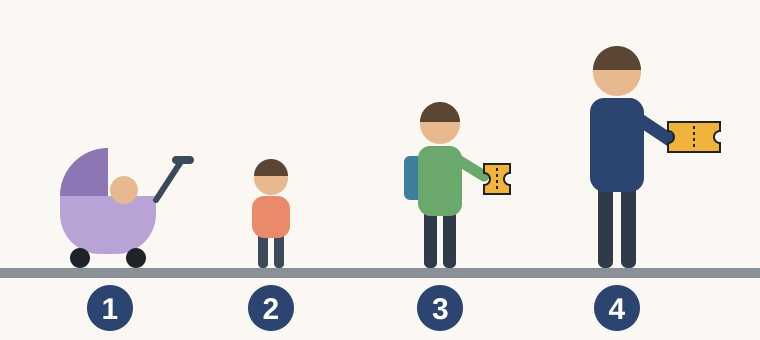
- Infants (under 1): free.
- Young children (aged 1 to 5): free, up to 2 for each accompanying person aged 6 or over.
- Children (aged 6 to 11): pay the child fare.
- Adults (aged 12 and over): pay the adult fare.
The category depends on both age and whether the child attends elementary school.
- A 12-year-old who is still an elementary school student is in the child category.
- A 6-year-old who has not yet started elementary school is in the young child category.
JR East defines elementary school here as "an elementary school established under Japan's School Education Act." If you are traveling with a child aged 6 or 12, ask station staff which category applies.
When young children and infants need a child fare
Young children and infants ride free, but if any one of situations 1 to 3 below applies, that young child or infant also needs a child fare (according to JR East). Situations 1 and 3 apply only to young children; situation 2 applies to both young children and infants.
- One accompanying person aged 6 or over is traveling with more than 2 young children. Each young child beyond the first 2 needs a child fare.
- A young child or infant uses one reserved seat (Ordinary Car or Green Car) or one berth.
- A young child rides with no accompanying person aged 6 or over.
On Tokyo Metro as well, a child fare is needed for each young child beyond 2 per accompanying person aged 6 or over, and for each young child who rides with no accompanying person aged 6 or over (including when only young children travel together).
Prices
How child fares are calculated
The child fare is half the adult fare, but each company rounds the result differently, so it is not always exactly half.
- JR East: child basic fare tickets, limited express tickets, express tickets and reserved seat tickets cost half the adult price. If halving the price leaves 5 yen in the ones digit, that 5 yen is dropped, so the price is rounded down. Green Car tickets (including Gran Class) and berth tickets cost the same for children as for adults.
- Tokyo Metro: for paper tickets, the child fare is half the adult fare, rounded up to the nearest 10 yen. With an IC card, the child fare is half the adult IC card fare, with any fraction of a yen dropped.
Examples of tickets with a child price
Tickets with unlimited rides for a set period and JR passes also have a child price.
| Ticket | Adult | Child |
|---|---|---|
| Tokyo Subway Ticket, 24-hour ticket (Tokyo Metro and Toei Subway) | ¥1,000 | ¥500 |
| Subway & Bus 1-Day Pass (Kyoto City Subway and Kyoto City Bus) | ¥1,100 | ¥550 |
| JAPAN RAIL PASS, Ordinary Car, 7 days (bought on the official website) | ¥50,000 | ¥25,000 |
For the JAPAN RAIL PASS, the child category is "people aged 6 to 11 at the time of use," and elementary school students aged 12 or over are in the adult category. This is where it differs from the categories for regular fares. When you buy on the official website, a child who is 11 on the day of payment is in the child category, even if they have turned 12 by the time they use the pass. When you buy an Exchange Order from a designated overseas agent or similar, a child who is 11 on the day the Exchange Order is issued is likewise in the child category.
How to use each ticket is covered in Tokyo Subway Ticket (24, 48 and 72 hours) | Prices, where to buy it and how to use Tokyo's unlimited subway pass, How to Ride the Kyoto City Bus and Subway | Paying Fares, IC Cards, and the Subway & Bus 1-Day Pass and JAPAN RAIL PASS (JR Pass): Prices, How to Buy and How to Use | Official Website vs. Overseas Agent Prices, and How to Ride Nozomi and Mizuho.
Paying
Welcome Suica (Child)
To pay the child fare with an IC card, you need a child IC card. Welcome Suica, the IC card for visitors, comes in a child version.
- You can buy it from a Welcome Suica vending machine in the stations at Narita Airport or in Haneda Airport Terminal 3 Station, or at a JR EAST Travel Service Center, among other places.
- When buying, show the identification (such as a passport) of the child who will use the card. A family member can buy it on the child's behalf, but the child's identification is still required. If you buy from a vending machine, you enter the child's date of birth.
- A Welcome Suica (Child) can be used until the first March 31 after the child's 12th birthday.
How to buy and top up a Welcome Suica is covered in Welcome Suica: How to Buy and Use It | A 28-Day IC Card for Visitors to Japan.
Child Suica and child PASMO
There are also child versions of Suica (My Suica) and PASMO. Both are registered with the child's name and date of birth, and you buy them at a station ticket office or similar counter by showing the child's identification. Each person can hold only one of these cards: either a child Suica or a child PASMO.
Tapping a contactless credit card
On Tokyo Metro and some other lines, you can go through the ticket gates by tapping a contactless credit card. This service only charges adult fares, so you cannot ride at the child fare. Each card can be used by only one person, so you cannot pay a child's fare with a parent's card either. A child can use this service only with a card in the child's own name, and even then the adult fare is charged.
Good to know
- Age categories and the rules for young children on buses are set by each bus company. On Kyoto City Bus, for example, if the person accompanying the young children is a parent or other guardian, any number of young children ride free. Check each company's information before you ride.
- Points to watch when buying Shinkansen tickets for children are covered in How to buy Shinkansen tickets | Online booking such as smartEX, ticket machines and ticket offices, reserved and non-reserved seats, and the days when all Nozomi seats are reserved.
- Fares and categories may change. Before you ride, check the latest information on the official websites of JR East, Tokyo Metro and other operators.