How to Use the Hokuriku Arch Pass | 7-Day Price, Area Covered (Tokyo, Nagano, Toyama, Kanazawa, Wakura Onsen, Tsuruga, Kyoto, Osaka), Narita, Haneda and Kansai Airports, Trains You Cannot Ride, Seat Reservations, and Whether It Pays Off
How the Hokuriku Arch Pass from JR East and JR West works, based on official information from both companies: 7 consecutive days on the Hokuriku Shinkansen (between Tokyo Station and Tsuruga Station), the THUNDERBIRD, HARUKA and Narita Express limited expresses, and the Tokyo Monorail; the main stations on the official map; trains you cannot ride, such as the Tokaido Shinkansen; who can buy it; the four ways to buy and collect it; seat reservations; and refunds. We also compare it with the total fare and charges between Tokyo Station and Kanazawa Station.
Ad · Affiliate This article contains links to partner booking and shopping pages (affiliate links). If you book or buy through these links, the site operator may receive a commission from the partner. Our advertising policy
Overview
The Hokuriku Arch Pass is a pass sold jointly by JR East and JR West for people who hold a passport issued by the government (or a similar authority) of a country other than Japan and who entered Japan with the "Temporary Visitor" status of residence. For 7 consecutive days from your start date, you can ride JR East and JR West lines, and the lines of certain other companies, as many times as you like within an arch-shaped area: from Tokyo along the Hokuriku Shinkansen through Nagano, Toyama and Kanazawa to Tsuruga, and from Tsuruga on to Kyoto and Osaka (some sections of the other companies' lines can be ridden only when you ride the whole section from end to end and change to a JR line there). With this pass you can also reserve Ordinary Car reserved seats on shinkansen and limited express trains within the area as many times as you like. However, JR West's English information says that once your seat reservations reach 7, that reservation and every one after it are made at a station ticket office. The price is ¥35,000 for adults (age 12 and over) and ¥17,500 for children (age 6 to 11). The prices and rules in this article were checked on the official websites of JR East and JR West on November 1, 2026. JR West's English page says "information as of January 28, 2026."
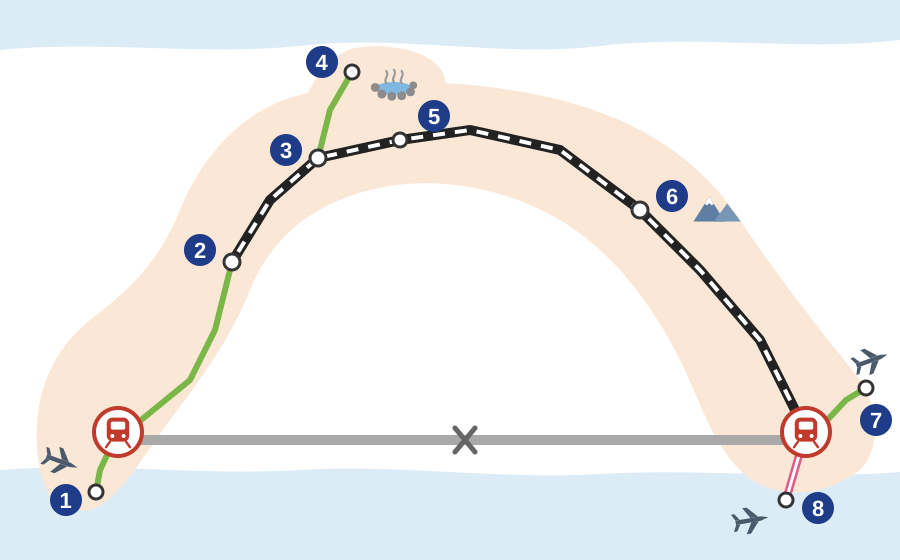
The figure is a simplified summary of the area you can travel in with the pass between Tokyo and Osaka. The numbers do not show an order of travel; they point to the following places.
- Kansai-Airport Station. A station inside Kansai International Airport, where you can board the Kansai-Airport Express HARUKA.
- Tsuruga Station. The western end of the Hokuriku Shinkansen. If you come on the Hokuriku Shinkansen and are going on to Kyoto or Osaka, change here to the THUNDERBIRD limited express.
- Kanazawa Station. You can get here from Tokyo Station without changing trains on the KAGAYAKI on the Hokuriku Shinkansen.
- Wakura Onsen Station. You can get here from Kanazawa Station without changing trains on the NOTO KAGARIBI limited express.
- Toyama Station. A station on the Hokuriku Shinkansen.
- Nagano Station. A station on the Hokuriku Shinkansen. From Nagano Station you can go to Matsumoto Station on JR lines. From Matsumoto Station you can also go to Hakuba Station on the JR Oito Line.
- Narita Airport Station. You can get here from Tokyo Station without changing trains on the Narita Express (N'EX) limited express.
- Haneda Airport. You can get here on the Tokyo Monorail from Monorail Hamamatsucho Station, the Tokyo Monorail station near JR Hamamatsucho Station. You can also ride the Tokyo Monorail with this pass.
- You cannot ride the Tokaido Shinkansen. The gray line at the bottom of the figure is the Tokaido Shinkansen. If you travel from Tokyo Station to Kyoto Station or Shin-Osaka Station on the Tokaido Shinkansen, you pay the fare and charges.
- The price changed on March 14, 2026. Before that, it was ¥30,000 for adults. On the same day, the area you can ride with the pass was also expanded.
Prices
Prices
| Category | Price (7 days) |
|---|---|
| Adult (age 12 and over) | ¥35,000 |
| Child (age 6 to 11) | ¥17,500 |
- Whether you are an adult or a child is decided by your age when you buy the pass. If you bought an exchange voucher from a travel agency outside Japan, it is decided by your age when the voucher was issued.
- JR West's English information says that one person with an adult or child pass can take up to two children aged 1 to 5 with them without a pass. From the third child on, each child needs a child pass. Even a child aged 1 to 5 needs their own child pass when the child uses a reserved seat of their own, or when the child travels alone, not together with an adult or an older child.
- JR East's information says that children who are not yet 6 do not need a pass if they do not need a seat reservation. JR East's information does not say how many children can travel with one person without a pass.
- The price table lists only the 7-day prices. There are no discounted prices for students.
Validity period
- The pass can be used for 7 consecutive days from your start date. You cannot use it on non-consecutive days.
- It is valid from 0:00 on your start date until 24:00 on the last day (Japan time). If 24:00 passes on the last day while you are on a train, the pass covers the fare until you leave the station, and the charges until you get off the train.
- One person cannot buy two or more passes whose validity periods overlap. If the validity periods do not overlap, you can buy a second pass.
- After you collect the pass, you cannot change the start date or the type of pass.
- The validity period is not extended even if trains are stopped or delayed.
Conditions
Lines you can ride
- The Hokuriku Shinkansen between Tokyo Station and Tsuruga Station. You can ride the KAGAYAKI, HAKUTAKA, TSURUGI and ASAMA in Ordinary Car seats: reserved seats on all four, and non-reserved seats on all except the KAGAYAKI, which has no non-reserved seats.
- The Tohoku Shinkansen between Tokyo Station and Omiya Station. The Joetsu Shinkansen between Tokyo Station and Takasaki Station. However, to ride the Hayabusa on the Tohoku Shinkansen or the Komachi on the Akita Shinkansen, you need a limited express ticket separate from this pass.
- Sections of JR East and JR West lines that are inside the area on the official map. You can ride Ordinary Car reserved and non-reserved seats on limited express, Special Rapid Service, Rapid Service and local trains. This includes the THUNDERBIRD, HARUKA, Narita Express and NOTO KAGARIBI limited expresses.
- The whole Tokyo Monorail. It runs between Monorail Hamamatsucho Station and Haneda Airport.
- The Noto Railway between Nanao Station and Wakura Onsen Station.
- The IR Ishikawa Railway between Kanazawa Station and Tsubata Station. The Ainokaze Toyama Railway between Toyama Station and Takaoka Station. The Hapi-Line Fukui between Fukui Station and Echizen-Hanando Station. On these three sections, you can use the pass only when you ride the entire section from one end to the other and then change to the JR line that continues beyond that end. If you get off at a station other than the two end stations of the section, or ride beyond the section, you pay the fare and charges for the whole section you rode.
- JR West's English information says that on the Ainokaze Toyama Railway and the Hapi-Line Fukui, you can ride only local trains. However, JR East's pass page says that to ride the Ainokaze Toyama Railway's Ainokaze Liner rapid train, you need to pay a liner charge.
Main stations on the official map
| Direction | Main stations on the official map |
|---|---|
| Tokyo and around Tokyo | Tokyo Station, Ueno Station, Shinjuku Station, Shibuya Station, Shinagawa Station, Yokohama Station, Kamakura Station, Omiya Station, Takasaki Station |
| Airports | Narita Airport Station, Haneda Airport (Tokyo Monorail), Kansai-Airport Station |
| Nagano and Matsumoto | Karuizawa Station, Sakudaira Station, Nagano Station, Matsumoto Station, Hakuba Station |
| Hokuriku Shinkansen stations in Niigata Prefecture | Joetsumyoko Station, Itoigawa Station |
| Toyama | Toyama Station, Kurobe-Unazukionsen Station, Shin-Takaoka Station, Takaoka Station, Himi Station, Johana Station, Inotani Station |
| Ishikawa | Kanazawa Station, Komatsu Station, Nanao Station, Wakura Onsen Station |
| Fukui | Fukui Station, Kuzuryuko Station, Tsuruga Station, Obama Station |
| Kyoto and Shiga | Kyoto Station, Saga-Arashiyama Station, Otsu Station, Maibara Station |
| Osaka, Nara and Kobe | Osaka Station, Shin-Osaka Station, Tennoji Station, Universal-City Station, Nara Station, Sannomiya Station |
Trains you cannot ride, and things you pay for separately
- The Tokaido Shinkansen. This is the shinkansen that runs between Tokyo Station and Kyoto Station and between Tokyo Station and Shin-Osaka Station, and it is operated by a company that is neither JR East nor JR West.
- The Sanyo Shinkansen.
- Sleeper cars, and the Sunrise Seto and Sunrise Izumo sleeper limited expresses.
- Green Cars and GranClass. To ride a Green Car on a shinkansen or limited express, you pay the Green Car charge and the limited express charge. To ride GranClass on the Hokuriku Shinkansen, you pay the GranClass charge. To ride a Green Car on a rapid or local train, you pay the Green Car charge for local trains.
- Sections outside the area on the official map, and lines of companies not in the list under "Lines you can ride." To ride them, you pay the fare and charges for that section. For example, Keisei Electric Railway, Tokyo Metro, Toei Subway, Keihan, Hankyu, Kintetsu and Osaka Metro are not in the list.
- The line to Takayama. The JR line on the official map that runs from Toyama Station toward Takayama goes only as far as Inotani Station. Takayama Station is not on any of the official maps.
Costs
How to compare with paying each fare and charge separately (adults)
Add up the fares and charges for the trains you will ride during the 7 days. If the total is higher than the price of the pass (¥35,000), the pass is cheaper. The table below shows the total one-way adult fare and charges for the sections used as examples in this article. The shinkansen and limited express amounts are for Ordinary Car reserved seats in the regular season, which is neither the season when charges are higher nor the season when they are lower.
| Train and section (one way) | Total fare and charges |
|---|---|
| Narita Express, from Narita Airport Station to Tokyo Station | ¥3,140 |
| KAGAYAKI on the Hokuriku Shinkansen, from Tokyo Station to Kanazawa Station | ¥14,600 |
| Hokuriku Shinkansen, from Tokyo Station to Nagano Station | ¥8,450 |
| NOTO KAGARIBI, from Kanazawa Station to Wakura Onsen Station | ¥2,900 |
| Hokuriku Shinkansen and THUNDERBIRD, from Kanazawa Station to Kyoto Station (change at Tsuruga Station) | ¥7,720 |
| Hokuriku Shinkansen and THUNDERBIRD, from Kanazawa Station to Osaka Station (change at Tsuruga Station) | ¥9,410 |
| HARUKA, from Kansai-Airport Station to Kyoto Station | ¥3,590 |
- On the KAGAYAKI from Tokyo Station to Kanazawa Station, the example train took 2 hours 34 minutes. The travel time differs from train to train.
- If you ride the Narita Express from Narita Airport Station to Tokyo Station, the KAGAYAKI from Tokyo Station to Kanazawa Station, the Hokuriku Shinkansen and THUNDERBIRD from Kanazawa Station to Kyoto Station, and the HARUKA from Kyoto Station to Kansai-Airport Station, once each, the total is ¥29,050. For this trip alone, paying the fares and charges is ¥5,950 cheaper than buying the pass.
- One round trip between Tokyo Station and Kanazawa Station on the KAGAYAKI costs ¥29,200. For this round trip alone, paying the fares and charges is ¥5,800 cheaper than buying the pass.
- If, within the same 7 days, you make one round trip between Tokyo Station and Kanazawa Station on the KAGAYAKI and one round trip between Narita Airport Station and Tokyo Station on the Narita Express, the total is ¥35,480. The pass is ¥480 cheaper than this total.
- Beyond the examples above, the more trains you ride within the area, such as going to Nagano Station or Wakura Onsen Station, the higher the total of the fares and charges becomes. If that total is higher than the price of the pass, the pass is cheaper.
- Reserved seat charges change according to seasonal categories. JR East's information says that the Hokuriku Shinkansen and the THUNDERBIRD use the same seasonal categories as JR East lines. In the season when charges are higher (peak season), they are ¥200 higher per train than in the regular season. In the season when charges are lower (off-peak season), they are ¥200 lower per train than in the regular season. Under these categories, Mondays to Thursdays from November 1, 2026 to December 27, 2026 are in the off-peak season (excluding public holidays, days before public holidays, and substitute holidays). Fares stay the same throughout the year. The amounts in the table are for travel on December 4, 2026 (Friday).
Travel time between Tokyo and Osaka
- From Tokyo Station to Shin-Osaka Station via Kanazawa Station and Tsuruga Station on the Hokuriku Shinkansen and the THUNDERBIRD, the example trains took 5 hours 21 minutes. This time includes waiting for the next train at Kanazawa Station and Tsuruga Station.
- On the Nozomi on the Tokaido Shinkansen, the example train took 2 hours 27 minutes from Tokyo Station to Shin-Osaka Station. However, you cannot ride the Nozomi with this pass. The total fare and charges for the Nozomi are ¥14,720.
The child pass costs ¥17,500. The rules for children's fares and charges are explained in Child Fares on Japan's Trains and Subways | When Kids Pay Adult Fare, Free Rides for Young Children, Child IC Cards. How to get from Narita Airport to Tokyo is explained in From Narita Airport to Central Tokyo | Skyliner, Narita Express or Airport Bus?, and how to get from Kansai Airport in Kansai Airport to Osaka and Kyoto: How to Get There | Choosing between the Kansai-Airport Express HARUKA, Nankai Rapi:t and the Limousine Bus.
Where to buy
Who can buy and use the pass
- Only people who hold a passport issued by the government (or a similar authority) of a country other than Japan and who entered Japan with the "Temporary Visitor" status of residence can buy and use this pass. People with Japanese nationality cannot use it, even if they have permanent residency in a country other than Japan. People who entered Japan with a status of residence other than "Temporary Visitor" cannot use it either.
- When you collect the pass, show the original passport of the person who will use it. You cannot collect it with a copy of the passport. The conditions are checked with the "Temporary Visitor" indication on the sticker attached to the passport or on the stamp in it. If they cannot be checked, the pass is not issued. However, JR West's Japanese information says that the pass can be issued if it can be confirmed that you entered Japan through the automated gates at immigration.
- To collect passes for several people together, you need the passports of everyone who will use them.
- Each pass can be used only by the one person whose passport was used to check the conditions when the pass was collected. You cannot give or lend a pass to anyone else, even a family member. While you are using the pass, carry your passport with you and show it if staff ask for it.
Four ways to buy
- Buy it on JR-WEST ONLINE TRAIN RESERVATION, JR West's booking website. You can buy it from 10:00 (Japan time) on the same date in the month before your start date. You pay by credit card; you cannot pay at a station. After you arrive in Japan, collect the pass at a station.
- Buy it on JR-EAST Train Reservation, JR East's booking website. You can buy it from one month before your start date. After you arrive in Japan, collect the pass at a station.
- Buy an exchange voucher (MCO or E-TICKET) for the pass from a travel agency outside Japan. Exchange the voucher for the pass within 3 months of the day it was issued, and no later than your start date. After you arrive in Japan, show the voucher and your passport at an exchange location and exchange them for the pass.
- After you arrive in Japan, buy it at a branch of certain travel agencies in Japan. You can buy it from one month before your start date.
Passes bought on JR-WEST ONLINE TRAIN RESERVATION are collected at a ticket machine or a ticket office at a station. To collect one, you need the reservation number, the 4-digit number you chose when you booked, the credit card you used for the booking, and your passport. To collect it at a ticket machine, you need a passport with an IC chip. If your passport has no IC chip, collect the pass at a station ticket office.
Passes bought on JR-EAST Train Reservation are collected at a Reserved Seat Ticket Vending Machine with a passport reader or at a JR EAST Travel Service Center at JR East stations. The only JR West stations where you can collect them are the ticket machines and ticket offices at Tsuruga Station, Fukui Station, Kanazawa Station and Toyama Station, and the ticket office at Kansai-Airport Station. You cannot collect them at Kyoto Station, Shin-Osaka Station or Osaka Station.
Check the places and hours for collection and exchange in the lists on the official websites of JR West and JR East. Both lists include Tokyo Station, Narita Airport Station, Haneda Airport, Kanazawa Station, Kyoto Station and Kansai-Airport Station, among others. Which passes you can collect at each place differs depending on how the pass was bought.
Refunds
- Exchange vouchers that have not yet been exchanged are refunded by the travel agency outside Japan where you bought them. The conditions, such as the refund fee, differ from agency to agency.
- Passes received in exchange for a voucher and passes bought from a travel agency in Japan can be refunded before the start date or during the validity period, as long as you have not yet ridden any train with the pass. 10% of the pass price (at least ¥220 per pass) is deducted as a refund fee. A pass received in exchange for a voucher is refunded at the ticket office where it was exchanged, and a pass bought from a travel agency in Japan is refunded at a branch of the travel agency where it was bought.
- The refund fee for passes bought on JR-WEST ONLINE TRAIN RESERVATION or JR-EAST Train Reservation is ¥560 per person. However, for a pass bought on JR-EAST Train Reservation that has not yet been collected, there is no refund fee if you get the refund by 23:50 (Japan time) on the day before your start date.
- Once you have ridden a train with the pass even once, you cannot get a refund. There is also no refund if trains are stopped or delayed.
- Lost or stolen passes are not reissued.
Booking
Reserving seats
- To sit in a reserved seat, reserve it at a ticket machine or a ticket office at a station before you board. If you bought the pass on JR-WEST ONLINE TRAIN RESERVATION, you can reserve seats on the booking website only before you collect the pass. After you collect the pass, reserve at a ticket machine or a ticket office at a station. If you bought the pass on JR-EAST Train Reservation, you can also reserve seats on the booking website. If you board without reserving a seat, sit in a non-reserved seat.
- With this pass, you can reserve Ordinary Car reserved seats as many times as you like. However, JR West's English information says that once your seat reservations reach 7, that reservation and every one after it cannot be made at a ticket machine or on a booking website; they are made at a station ticket office.
- JR West's Japanese information says that you can make up to 9 reserved seat reservations on JR-WEST ONLINE TRAIN RESERVATION. On JR-EAST Train Reservation, you can hold up to 15 reserved seat reservations that you have not yet collected at a station. When you collect at a station the reserved seats you booked on JR-EAST Train Reservation, you can book that same number of seats again. The official information does not explain how these numbers relate to the rule above about reservations once they reach 7.
- On trains that have only reserved seats, you reserve a seat before you board. The KAGAYAKI on the Hokuriku Shinkansen, the THUNDERBIRD limited express and the Narita Express have only reserved seats.
- The official materials word the handling of the Narita Express differently. JR West's Japanese information says that you must reserve a seat before you board. JR East's pass rules state that if you board without reserving a seat, you use a vacant seat. To follow both sets of information, reserve a seat before you board.
- You cannot reserve a seat on the train after you have boarded.
Going through the ticket gates
JR East's information says that you go through the automatic ticket gates at stations in the area by inserting the pass. Do not forget to take the pass back after you pass through. At ticket gates where you cannot use the automatic gates, show the pass at the staffed gate. If you board at a station with no staff, show the pass to the train crew.
Good to know
- The JR East pass for the shinkansen to Tohoku, Nagano and Niigata is explained in How to Use the JR EAST PASS | 5-Day and 10-Day Prices, the Change That Merged the Tohoku and Nagano/Niigata Passes into One, Area Covered (Aomori, Sendai, Akita, Yamagata, Niigata, Nagano, Nikko), Trains You Can Ride, Stations Where You Can Collect It, and Whether It Pays Off, JR West's pass for the Kansai area in How to Use the JR Kansai WIDE Area Pass | 5-Day Price, Area Covered (Amanohashidate, Kinosaki Onsen, Shirahama, Tottori, Okayama, Takamatsu), Trains You Can and Cannot Ride, Seat Reservations, and Whether It Pays Off, and the pass for JR lines throughout Japan in JAPAN RAIL PASS (JR Pass): Prices and How to Use It | Prices on the Official Website and from Agents Outside Japan, How to Buy, and How to Ride Nozomi and Mizuho.
- The nearest station to Universal Studios Japan is JR Universal-City Station. This station is inside the area on the official map.