
How to Take a Taxi in Japan and Use Ride-Hailing Apps | GO, Uber and DiDi, Fares, Automatic Doors and How Many People Can Ride
Based on official information from each company, the Tokyo Hire-Taxi Association and the Japanese government, this guide explains the three ways to catch a taxi in Japan (taxi stands, raising your hand on the street, and ride-hailing apps), how to register and pay with GO, Uber and DiDi, whether you can use a phone number or card from outside Japan, example fares in Tokyo, pick-up fees and app fees, and rules for riding such as automatic doors and seat belts.
Ad · Affiliate This article contains links to partner booking and shopping pages (affiliate links). If you book or buy through these links, the site operator may receive a commission from the partner. Our advertising policy
Overview
You can take a taxi in Japan in any of the following three ways. The information in this article was checked against the official information of each company, the taxi associations and the Japanese government on October 11, 2026.
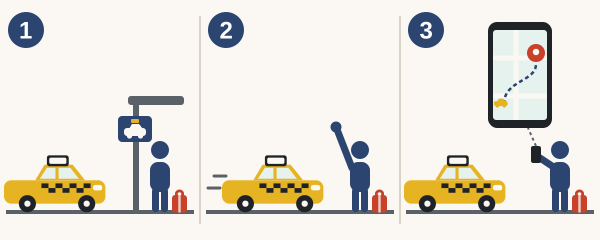
- Taxi stand: Line up and wait at a taxi stand, found in front of stations, airports, large hotels and similar places.
- Raise your hand on the street: Signal a vacant taxi driving along the street by raising your hand.
- Ride-hailing app: Use an app on your smartphone to call a taxi to where you are now.
- In big cities such as Tokyo, you can use all three ways. In rural areas, fewer taxis are driving around, but there are usually taxis in front of the station (according to the Japan National Tourism Organization [JNTO]).
- The fare is usually calculated by the meter. When you call a taxi with an app, a pick-up fee and app fees may be added.
- You do not need to tip.
Your options
Ride-hailing apps
The Tokyo Hire-Taxi Association (the taxi industry association in Tokyo) and JNTO list GO, Uber, DiDi, S.RIDE and others as apps you can use to call a taxi. Whichever app you use, the car that comes is a taxi company's car or a car operated under a taxi company's management.
| App | What each company's official information says |
|---|---|
| GO | Available in 47 prefectures of Japan (except some areas). The app is shown in Japanese and English |
| Uber | You can use the account you created outside Japan as it is. In Japan, it is mainly used to call taxis (Uber Taxi) |
| DiDi | You can call taxis in many parts of Japan. You can pay in the app or pay in the car |
| S.RIDE | Has an English website. When the car you called arrives, tell the driver your name and get in |
### GO
- To register, you need a phone number that can receive SMS. GO's pages for visitors to Japan (in Korean and Traditional Chinese) say that phone numbers from outside Japan can also be used.
- A data-only SIM cannot receive SMS. If you cannot receive SMS, you can register by verifying your identity with your passport and a photo of your face. In this case, you also need an email address.
- For payment, you choose either "GO Pay", which pays in the app, or paying in the car. GO says you can pay with credit cards issued outside Japan. The cards you can register with GO Pay are Visa, Mastercard, JCB, American Express and Diners Club.
- The app is shown only in Japanese and English. If your smartphone's language is not Japanese, the app is shown in English. Even when it is shown in English, some parts remain in Japanese.
- When you use the app in English, tell the driver your "Confirmation number" when you get in.
- When a foreign traveler staying in Japan for a short period calls a taxi with GO, a fee called the International Service Charge is charged. You can check the amount on the "Fare Details" screen before calling.
### Uber
- You can use the account you created outside Japan as it is, without changing the country setting.
- In Japan, Uber is mainly used to call taxis run by taxi companies (Uber Taxi). It is available only in certain cities (Tokyo, Osaka, Kyoto, Fukuoka and others).
- Uber Taxi fares are calculated by the taxi's meter. Before you ride, the app shows an estimated fare range.
- In some areas, you can also call Uber Private Car. This is a system called Japanese-style ridesharing, in which drivers under contract with a taxi company carry passengers in private cars and other vehicles. The fare is fixed before you ride, and you can only pay in the app.
- From September 28, 2026, each time you ride an Uber Taxi in the covered areas, an app arrangement fee of ¥100 (tax included) is charged.
### DiDi
- DiDi's official website is in Japanese. You can pay with a credit card, debit card or PayPay registered in the app, or pay in the car with the payment methods the taxi company accepts (such as cash).
- DiDi and S.RIDE do not state on their official websites whether you can use them with a phone number from outside Japan or a card issued outside Japan.
Step by step
Getting a taxi at a taxi stand or on the street
- You can tell whether a taxi is vacant by the sign in front of the driver's seat. The sign is usually in Japanese. According to JNTO, a red sign means you can take that taxi, and a green sign means the taxi has passengers.
- There are taxi stands at major stations in Tokyo (Tokyo Station, Shinjuku Station, Shibuya Station, Ueno Station and others) and at airports.
- In Ginza, Tokyo, on days other than Saturdays, Sundays and public holidays, from 22:00 until 1:00 the next day, you can get a taxi only at taxi stands (Tokyo Hire-Taxi Association).
Calling a taxi with an app
- Open the app and enter your pick-up location and destination.
- On the fare screen, check the estimated fare and fees, then call the taxi.
- When the car arrives, check that it is the same car shown in the app, then get in. If you use GO in English, tell the driver your confirmation number; in S.RIDE, tell the driver your name.
- If you chose to pay in the app, you do not need to pay in the car when you get out.
From getting in to getting out
- In many taxis, the rear doors are automatic, and the driver opens and closes them. Both when you get in and when you get out, first wait for the door to open. Do not open or close an automatic door by hand.
- Fasten your seat belt even in the back seat. In Japan, wearing a seat belt in the back seat is required on all roads (National Police Agency).
- To make sure the driver understands your destination, show the address or name written in Japanese (according to JNTO). Taxis in Tokyo carry an information sheet in English, Korean and Chinese that you can point to (Tokyo Hire-Taxi Association).
- A standard taxi can carry up to 4 adults (according to GO). If there are more than 4 adults, split up and take two taxis.
- Whether large luggage can be loaded depends on the taxi company and the car. GO advises that if you have many suitcases, you call a taxi company in that area and ask.
Costs
Fares
Taxi fares are set for each area and are usually calculated by the meter. An example from Tokyo (standard taxis in Tokyo's 23 wards, Musashino City and Mitaka City; fares from April 20, 2026):
| Distance traveled | Fare |
|---|---|
| Up to the first 1.0 km | ¥500 |
| After that, every 232 m traveled | Add ¥100 |
- The amounts in this table are the upper limits of the fares approved by the government. Some companies charge a slightly lower starting amount, such as ¥480.
- While the taxi is moving slowly, for example in traffic jams, the fare also increases according to the time.
- In Tokyo, from 22:00 to 5:00, fares are 20% higher. According to GO, in other areas too, many taxi companies raise fares by the same rate during the same hours.
- Passengers pay expressway tolls.
Charges added when you call with an app
In addition to the metered fare, the following charges may apply. The amounts differ by company, area and app, so check them on the app's fare screen before calling.
- Pick-up fee: A charge for having the taxi come to where you want to be picked up. The amount is set by each taxi company, and some companies do not charge it.
- App arrangement fee: With GO, ¥100 is charged in covered areas such as Tokyo and Osaka. With Uber, ¥100 (tax included) is charged when you ride Uber Taxi in covered areas.
- GO's handling charge: If you choose to pay in the car with GO, ¥100 is added in covered areas. If you pay with GO Pay, this charge does not apply.
- GO's International Service Charge: Charged when a foreign traveler staying in Japan for a short period calls a taxi with GO.
Fares fixed before you ride
Some apps let you call a taxi with a "pre-fixed fare", which is decided before you ride. The fare is calculated based on the road distance from the pick-up location to the destination. Even if a traffic jam makes the ride take longer, the fare does not change. If you change the destination on the way, the fare may change. The pick-up fee and toll road charges are paid separately from this fare.
How to pay
- In Tokyo, credit cards can be used with almost all taxi companies (Tokyo Hire-Taxi Association). Taxis in rural areas may accept only cash (according to JNTO).
- The payment methods you can use in the car depend on the taxi company and the car. If you also carry cash, you can pay even in a car that does not accept cards.
Good to know
- You do not need to tip. Drivers do not expect tips either (according to JNTO). The GO and Uber apps have a tipping feature for people who want to pay a tip. Tipping customs in Japan are explained in Tipping in Japan | Is a Tip Needed at Restaurants, Taxis, Hotels, Ryokan and with Guides? Service Charges, Otoshi and Consumption Tax.
- Fixed-fare taxis from Narita Airport to central Tokyo are explained in Narita Airport Direct to Your Hotel | Airport Limousine Bus or Fixed-Fare Taxi.
- Fares, fees and app details were checked on October 11, 2026. They may change, so check the app or the taxi company's information before you ride.