Tipping in Japan | Is a Tip Needed at Restaurants, Taxis, Hotels, Ryokan and with Guides? Service Charges, Otoshi and Consumption Tax
Explains whether you need to tip when traveling in Japan, based on official information from the Japan National Tourism Organization (JNTO), the National Tax Agency and the Ministry of Finance. Covers how to think about restaurants, taxis, hotels, ryokan and guides, the service charges, table charges and consumption tax that may be added to your bill, and how to give kokorozuke when you want to show your thanks.
Ad · Affiliate This article contains links to partner booking and shopping pages (affiliate links). If you book or buy through these links, the site operator may receive a commission from the partner. Our advertising policy
Overview
In Japan, there is no custom of tipping at restaurants, bars, cafés, taxis, hotels and similar places (according to the Japan National Tourism Organization [JNTO]).
If you try to give a tip, it may be politely declined (according to JNTO).
On the other hand, Japan also has a custom called "kokorozuke" (literally, "from the heart"). It is money you choose to give of your own accord, as a sign of your gratitude. Kokorozuke is not something the other person asks for. You are free to decide whether to give it.
Services
How to think about each situation
| Situation | Tip |
|---|---|
| Restaurants, izakaya (Japanese pubs), bars and cafés | Not needed |
| Taxis | Not needed |
| Hotels | Not needed |
| Ryokan (Japanese inns) | Not needed. Some ryokan staff accept kokorozuke |
| A private guide or interpreter you hired yourself | Not needed. Some accept a tip as a token of thanks |
Private guides and interpreters who are used to customs abroad may accept a tip as a token of thanks. Even then, a tip is not expected. If you give one, do it discreetly (according to JNTO).
Costs
Your bill may come to more than the total of the menu prices. This is not a tip; it is because charges like the following have been added.
- Service charge: Hotels, ryokan and some restaurants may add a fixed percentage of the bill as a service charge. Whether it is added, and the percentage, differ from one restaurant or accommodation to another. Check the menu, the booking screen or the itemized bill. Even if you pay a service charge, you do not need to pay a tip on top of it.
- Table charge: At izakaya and similar places, some establishments charge a table charge per person (according to JNTO). Some bars and similar places also charge a fee per person when you enter.
- Late-night charge: Some family restaurants add a late-night charge to orders placed late at night (How to Use a Family Restaurant in Japan | Ordering, Drink Bar and Payment at Gusto (ガスト) and Saizeriya).
Price tags and consumption tax
As a rule, the prices on price tags and menus in stores and restaurants include consumption tax (according to the Ministry of Finance and the National Tax Agency). The consumption tax rate is 10%. When you buy food or drinks (excluding alcohol), it is 8%, but meals eaten inside the restaurant or store are 10%. For this reason, the same dish may cost a different amount depending on whether you eat it inside or take it away (according to the National Tax Agency).
Step by step
If you decide to give kokorozuke, do it as follows (according to JNTO).
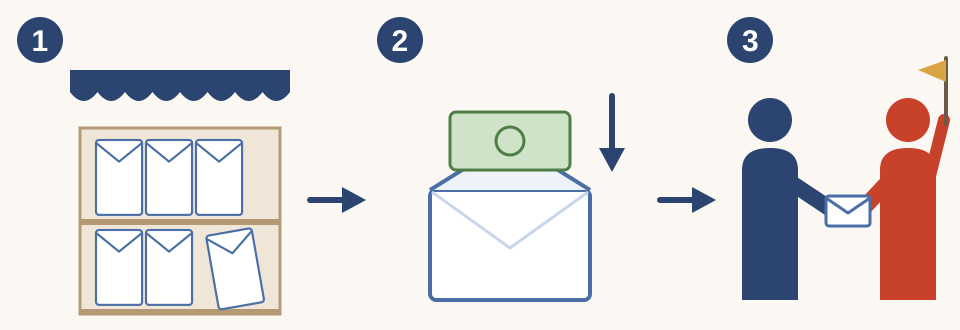
- Buy a small envelope for money at a convenience store, a stationery shop or a 100-yen shop (What You Can Do at Japanese Convenience Stores | ATM Cash Withdrawals, Payment Methods, Sending Luggage, How to Use 100-Yen Shops in Japan | Reading Prices at DAISO, Can Do and Seria, What They Sell, Payment and Returns).
- Put the money in the envelope.
- Quietly hand the envelope to the person, so that other people do not see it.
Good to know
- If the person declines to accept your kokorozuke, do not insist on giving it.
- Small shops may not accept cards (according to JNTO). For getting cash ready, see Do You Need Cash in Japan? | Where Cards Work, ATMs That Accept Overseas Cards, and Currency Exchange.
- An Accommodation Tax may be added to hotel and ryokan charges. The Accommodation Tax is not a tip; it is a local government tax (Taxes Travelers Pay in Japan | The International Tourist Tax (Departure Tax) and Accommodation Taxes in Tokyo, Osaka, Kyoto, Fukuoka and Hokkaido).