What to Declare at Japanese Customs | Duty-Free Allowances for Alcohol, Tobacco and Perfume, Cash over 1 Million Yen, and Prohibited Items
A guide to the customs procedure when you enter Japan, based on official Japan Customs information. It covers the duty-free allowances for alcohol, tobacco, perfume and other goods, the tax you pay when you go over them, how to choose between the green channel and the red channel, declaring cash over 1 million yen, and items you cannot bring into Japan or that need quarantine inspection.
Ad · Affiliate This article contains links to partner booking and shopping pages (affiliate links). If you book or buy through these links, the site operator may receive a commission from the partner. Our advertising policy
Overview
Everyone entering Japan submits a Declaration of Accompanied Articles and Unaccompanied Articles to customs (Japan Customs). Paper declaration forms are available on the plane or ship and at customs. You can also register the details of your declaration on Visit Japan Web before you arrive, and Japan Customs recommends declaring electronically through Visit Japan Web. For the registration steps, see How to Use Visit Japan Web | One QR Code for Japan's Immigration and Customs: Registration Steps and What Happens at the Airport.
Goods for your own personal use are not taxed up to a set quantity or value. This upper limit on quantity or value is called the "duty-free allowance". Goods for sale and commercial samples are not for your own personal use, so they are taxed (Japan Customs).
Conditions
Duty-free allowances (per person)
| Item | Duty-free allowance |
|---|---|
| Alcoholic beverages | 3 bottles (760 ml per bottle) |
| Cigarettes | 200 cigarettes |
| Heated tobacco | 10 packs |
| Cigars | 50 cigars |
| Other tobacco | 250 g |
| Perfume | 2 oz (1 oz is about 28 ml) |
| Other goods | Up to ¥200,000 in total, based on their overseas prices |
The tobacco quantities in the table are the allowances when you bring in only one type of tobacco. When you bring in two or more types of tobacco, the allowance is 250 g for all of them combined (Japan Customs).
- Age: The duty-free allowance cannot be used for alcoholic beverages or tobacco brought in by people under 20. For children under 6, the duty-free allowance covers only goods that are clearly for the child's own use, such as toys (Japan Customs).
- Overseas price: The value of "other goods" is counted at the price at which they are normally sold in shops abroad. If the total price of goods of the same kind is ¥10,000 or less, those goods are in principle duty-free and are not counted toward the ¥200,000 total.
- When the total goes over the limit: Goods whose prices add up to ¥200,000 or less are not taxed, and the remaining goods are taxed (Japan Customs). A single item (or a single set) that costs more than ¥200,000 is taxed on its full price.
- Unaccompanied articles: If you have luggage that will arrive separately after you enter Japan (unaccompanied articles), your hand luggage and the unaccompanied articles are counted together toward the duty-free allowance. If you have unaccompanied articles, you also write them on the declaration form and submit it when you enter Japan. You cannot declare them after you have entered Japan (Japan Customs).
Costs
When you go over the duty-free allowance
Tax is charged on the goods that go beyond the duty-free allowance. In many cases, the following simplified tax rates, which combine customs duty, consumption tax and other taxes, are used (Japan Customs).
| Item | Tax rate |
|---|---|
| Whisky, brandy | ¥800 per liter |
| Rum, gin, vodka | ¥500 per liter |
| Liqueur | ¥400 per liter |
| Shochu | ¥300 per liter |
| Other alcoholic beverages, such as wine and beer | ¥200 per liter |
| Cigarettes | ¥15 per cigarette |
| Other goods | 15% |
Goods with no customs duty, such as wristwatches and golf clubs, are subject only to consumption tax. Expensive goods and some other goods are taxed at rates different from this table (Japan Customs). You pay the tax at the bank inside the customs inspection area (Japan Customs).
Step by step
Choosing a channel
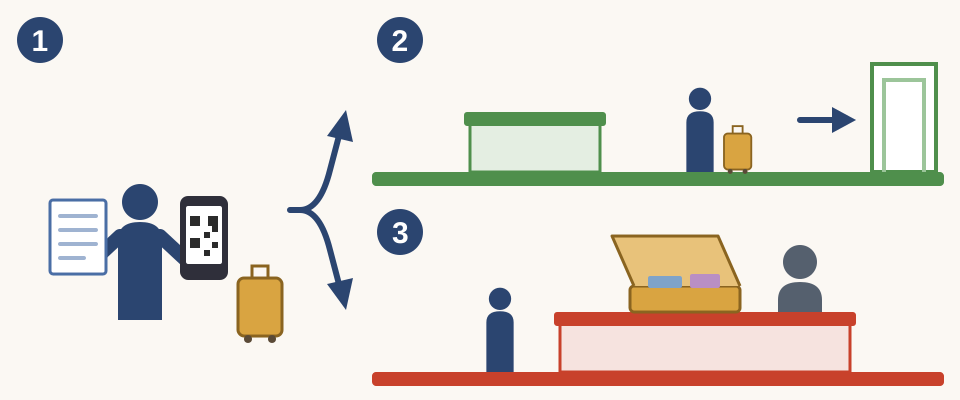
- Prepare the Declaration of Accompanied Articles and Unaccompanied Articles. Fill in the paper declaration form, or register the details of your declaration on Visit Japan Web.
- If you have no goods beyond the duty-free allowance and no goods that are prohibited or restricted from being brought in, go to the green channel.
- Everyone else goes to the red channel and declares their goods (Japan Customs).
If you declared on Visit Japan Web, scan your QR code and passport at an electronic declaration terminal in the customs inspection area and follow the instructions on the terminal (How to Use Visit Japan Web | One QR Code for Japan's Immigration and Customs: Registration Steps and What Happens at the Airport). Even if you declared electronically, your luggage may be inspected (Japan Customs).
When you carry more than 1 million yen in cash
If the total of the following is more than ¥1,000,000, submit a Declaration of Carrying of Means of Payment, etc. to customs, both when you enter and when you leave Japan. Foreign currency is counted after converting it into Japanese yen (Japan Customs).
- Cash (Japanese yen and foreign currency)
- Checks (including traveler's checks)
- Promissory notes
- Securities such as stock certificates and government bonds
You also submit this declaration form if you carry gold bullion with a purity of 90% or more weighing more than 1 kg. This declaration form is available at customs at airports and seaports, and you can also print it from the Japan Customs website. When you enter Japan, submit it in the customs inspection area (Japan Customs).
Good to know
Items you cannot bring into Japan
The following items are prohibited by law from being brought into Japan (Japan Customs; main items only).
- Narcotics, psychotropic substances, cannabis, stimulants and similar drugs
- Firearms such as pistols, and their ammunition and parts
- Explosives and gunpowder
- Counterfeit coins, counterfeit banknotes and counterfeit credit cards
- Obscene books, images and similar materials, and child pornography
- Goods that infringe intellectual property rights, such as counterfeit brand goods and pirated copies
Items that need an inspection or a permit
- Meat products, fruit and plants: Raw meat, dried meat, ham, sausages, fruit, vegetables, cut flowers, plants with soil on their roots and similar items must be inspected at the Animal Quarantine Service or Plant Protection Station counter before the customs inspection (Japan Customs). Check the information from the Animal Quarantine Service and the Plant Protection Station to see whether you can bring them in.
- Medicines and cosmetics: There are rules on the quantity you can bring in. Check the information from the Ministry of Health, Labour and Welfare (Japan Customs).
- Hunting guns, air guns, swords and similar items: You cannot bring them in without a possession permit (Japan Customs).
- Animals and plants protected by the Washington Convention (CITES): Bringing in the animals and plants themselves, and products made from them such as furs, stuffed animals and traditional Chinese medicines, is restricted (Japan Customs).
For the procedure when you leave Japan with goods you bought tax-free in Japan, see Tax-Free Shopping in Japan | The Refund Method from November 2026 and What to Do When You Leave Japan.