Onsen Etiquette and How to Bathe | Checking Tattoo Policies and Bathing Precautions
At most Japanese onsen (hot springs), you bathe naked in a large gender-separated bath, and the rule is to wash your body before getting into the water. Based on official information, this guide explains how to bathe, how to check whether you can bathe with tattoos, examples of measures presented by the Japan Tourism Agency, and the health and safety precautions listed by the Ministry of the Environment.
Overview
At a Japanese onsen (hot spring), you bathe together with other people in a large shared bath (daiyokujo). Most onsen are separated by gender, and you bathe naked, without a swimsuit. To keep the water clean for everyone, there are rules, such as washing your body before getting into the bath.
- Whether people with tattoos can bathe varies from facility to facility. Some facilities do not allow them to bathe, some let them in if the tattoos are covered with stickers, and others offer a private bath instead.
- Depending on your health, it may be better not to bathe at times. The second half of this article covers the precautions listed by Japan's Ministry of the Environment.
Step by step
How to Bathe at an Onsen
Take off your shoes at the facility entrance or another designated spot, then go to the changing room (the room where you undress).
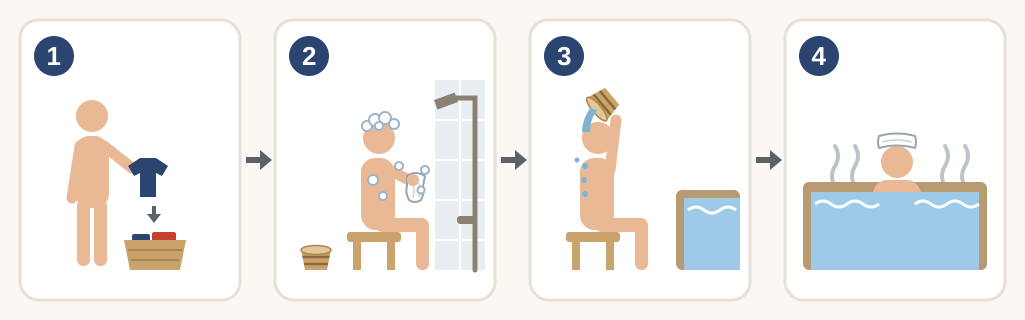
- In the changing room, take off all your clothes and put them in a basket or locker. Take off your swimsuit too. Bring only a small towel into the bathing area.
- At the washing area of the bathing room, sit down and wash your body and hair with soap and shampoo, then rinse off all the suds. Remove your makeup as well.
- Before getting into the bath, pour hot water over yourself, starting with your hands and feet (this is called "kakeyu"), so your body gets used to the water temperature.
- Soak in the bath. Tie up long hair so it does not go in the water. Do not put the small towel in the water; place it on your head or leave it outside the bath.
- In the bath, stay quiet and move your arms and legs only gently.
- Do not take photos or videos in the bathing area. Do not bring cameras or smartphones into the bathing area.
- Avoid bathing after drinking alcohol (see "Health and Safety Precautions" below).
Conditions
If You Have Tattoos
In Japan, some onsen do not allow people with tattoos to bathe. Policies vary by facility, so check the facility's website or contact the facility before you go.
In 2016, the Japan Tourism Agency (the national government agency in charge of tourism in Japan) told industry associations for hotels, ryokan (Japanese-style inns) and hot springs that it is not appropriate to refuse bathing solely because a person has tattoos. It also presented examples of measures for facilities to consider. What each facility actually does is up to that facility.
| Example measure | Details |
|---|---|
| Ask guests to cover tattoos with stickers or similar | Guests cover the tattooed area with a sticker or similar so that other bathers cannot see it |
| No special measures for small tattoos | If a tattoo is about the size of a palm and does not intimidate other bathers, no special measures are required |
| Suggest a time to bathe | Guests are guided to bathe at times when few families are using the bath |
| Suggest a private bath or similar | Guests are guided to a private bath or a guest room with its own bath. At facilities with more than one bath, guests are guided to a bath separate from other bathers |
The Japan Tourism Agency also asks facilities to keep in mind that people have tattoos for many reasons, including religion, culture and fashion, and that having tattoos does not in itself cause any hygiene problem.
Good to know
Health and Safety Precautions
Onsen facilities are required by law to post bathing precautions. The Ministry of the Environment lists points such as the following as the standard for what these notices should say.
- Avoid bathing right before or right after a meal, and after drinking alcohol. Especially avoid bathing when you are drunk.
- Drink about a glass of water before and after bathing.
- How long to stay in the water at one time also depends on the water temperature, but start with about 3–10 minutes. Once you are used to it, you may extend this to about 15–20 minutes.
- Older adults, people with high blood pressure or heart disease, and people who have had a stroke should avoid hot water of 42°C or higher.
- Older adults, children and people with physical disabilities should avoid bathing alone.
- Do not bathe when you have symptoms of illness, such as a fever.
- Get out of the bath slowly so that you do not feel dizzy when you stand up.
- After bathing, get dressed so you do not get chilled, and rest for about 30 minutes.