Where in Japan can you use Suica and ICOCA? | IC card areas and what to know when riding between areas
A Suica or PASMO bought in Tokyo also works on trains and buses in Osaka, Kyoto, Nagoya, Fukuoka and other regions: just tap it. Based on official information from the JR companies, this guide explains the 10 IC cards that can be used nationwide, the main railway companies in each region, how to buy a ticket when your trip crosses from one area into another, and what to know about topping up and refunds.
Overview
Among Japan's transport IC cards, 10 cards, including Suica, PASMO and ICOCA, are linked through the "Nationwide Mutual Use Service". With just one of these cards, you can ride trains and buses in the other cards' areas and also pay in shops (exceptions are explained below). For example, you can take a Suica or PASMO bought in Tokyo and simply tap it at the ticket gates of trains in Osaka or Kyoto. No special procedure is needed.
- The 10 cards: Kitaca, Suica, PASMO, TOICA, manaca, ICOCA, PiTaPa, Hayakaken, nimoca and SUGOCA.
- Ticket gates, ticket machines and shops that accept them display the logos of these cards or the Nationwide Mutual Use symbol (the IC mark).
- Welcome Suica, the card for visitors to Japan, can be used in the same way. How to buy it is covered in Welcome Suica: How to Buy and Use It | A 28-Day IC Card for Visitors to Japan.
- However, on a single ride, you can use an IC card only within one area. Here, an "area" is a zone that the railway companies define as the range you can travel with an IC card, and areas are divided more finely than the regions in the table below. This is explained in detail under "Riding between areas".
Areas
Main regions and railway companies where the cards can be used
The table below shows the main regions where the cards can be used, based on information from JR West and JR East. The regions in the table are a different division from the "areas" that apply when you ride. One region can contain several areas. For example, Tohoku has separate Sendai, Morioka, Aomori and Akita areas. On trains in any of these regions, as a rule you can use any of the 10 cards (exceptions are listed below the table).
| Region | Main local cards | Main railway companies where they work |
|---|---|---|
| Hokkaido (Sapporo, etc.) | Kitaca | JR Hokkaido, Sapporo City Transportation Bureau, etc. |
| Kanto (Tokyo, etc.) | Suica, PASMO | JR East, Tokyo Metro, Keikyu, etc. |
| Tohoku (Sendai, etc.) and Niigata | Suica | JR East, etc. |
| Tokai (Nagoya, etc.) | TOICA, manaca | JR Central, Meitetsu, Nagoya Municipal Subway, etc. |
| Western Japan (Osaka, Kyoto, etc.) | ICOCA, PiTaPa | JR West, Hankyu, Hanshin, Osaka Metro, Keihan, Kintetsu, Nankai, etc. |
| Kyushu (Fukuoka, etc.) | SUGOCA, nimoca, Hayakaken | JR Kyushu, Nishitetsu, Fukuoka City Subway, etc. |
| Okinawa (Naha, etc.) | All 10 cards in this table can be used | Yui Rail (monorail) |
- Even within the regions in the table, some railway and bus companies do not accept Suica and the other cards. Buses in particular differ from company to company, so check the bus company's information before you board.
- For shopping, in shops that display only the PiTaPa logo, you cannot pay with the other cards. PiTaPa is not part of the mutual use for payments in shops.
Conditions
Riding between areas
You can ride with an IC card only when the station where you board and the station where you get off are in the same area. If you are going to a station in a different area, or to a station that is not in any area, do not enter the gate with your IC card. Instead, before boarding, buy a ticket to your destination station at a ticket machine or similar.
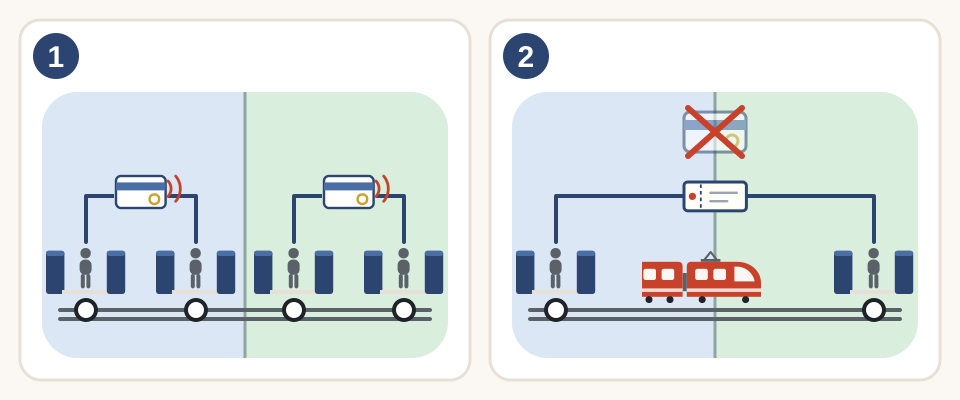
- Between stations within the same area, you can enter and exit by tapping your IC card at the ticket gate.
- When riding to a station in a different area, buy a ticket to your destination station before boarding, and go through the ticket gate with that ticket.
- For example, you cannot ride from Tokyo (in Suica's Greater Tokyo area) to Sendai (in Suica's Sendai area) with an IC card: both are on JR East lines, but they are in different areas. This example is given in JR East's information.
- There are exceptions. In and around Tokyo, you can keep riding with an IC card between Suica's Greater Tokyo area and the PASMO area (for example, when you transfer from a JR line to Tokyo Metro). In Kyushu, you can keep riding with an IC card on some sections with through services between the SUGOCA area and the Hayakaken area.
- If you ride beyond the area by mistake, tell the station staff at the station where you get off, or the train crew, and pay the fare from the station where you boarded to the station where you got off (according to JR Central).
Good to know
Other points to note
- On a single ride, tap the same card when you enter and when you exit the ticket gate. If you tap two IC cards stacked together, an entry record may be saved on both cards, so keep them apart and use one at a time.
- You can top up your card with cash in Japanese yen at ticket machines or charge machines that support IC cards. Some machines cannot be used for top-ups. The maximum balance for Suica and ICOCA is ¥20,000.
- The balance you need to enter the ticket gate differs by area. When your balance gets low, top up early.
- Refunds are available only from the company that issued the card. For example, a Suica issued by JR East can be refunded only at JR East stations. The ¥500 deposit is returned, and a ¥220 fee is deducted from the balance. If you have a Suica issued by JR East and plan to fly home from a place that has no JR East station, such as Kansai International Airport, get it refunded the last time you use a JR East station, or use up the remaining balance, for example by paying in shops.
- Welcome Suica cannot be refunded.
- The areas and conditions of use may change. This article is based on the official information available on the date it was retrieved, so check the latest conditions on each company's official website before you set off.