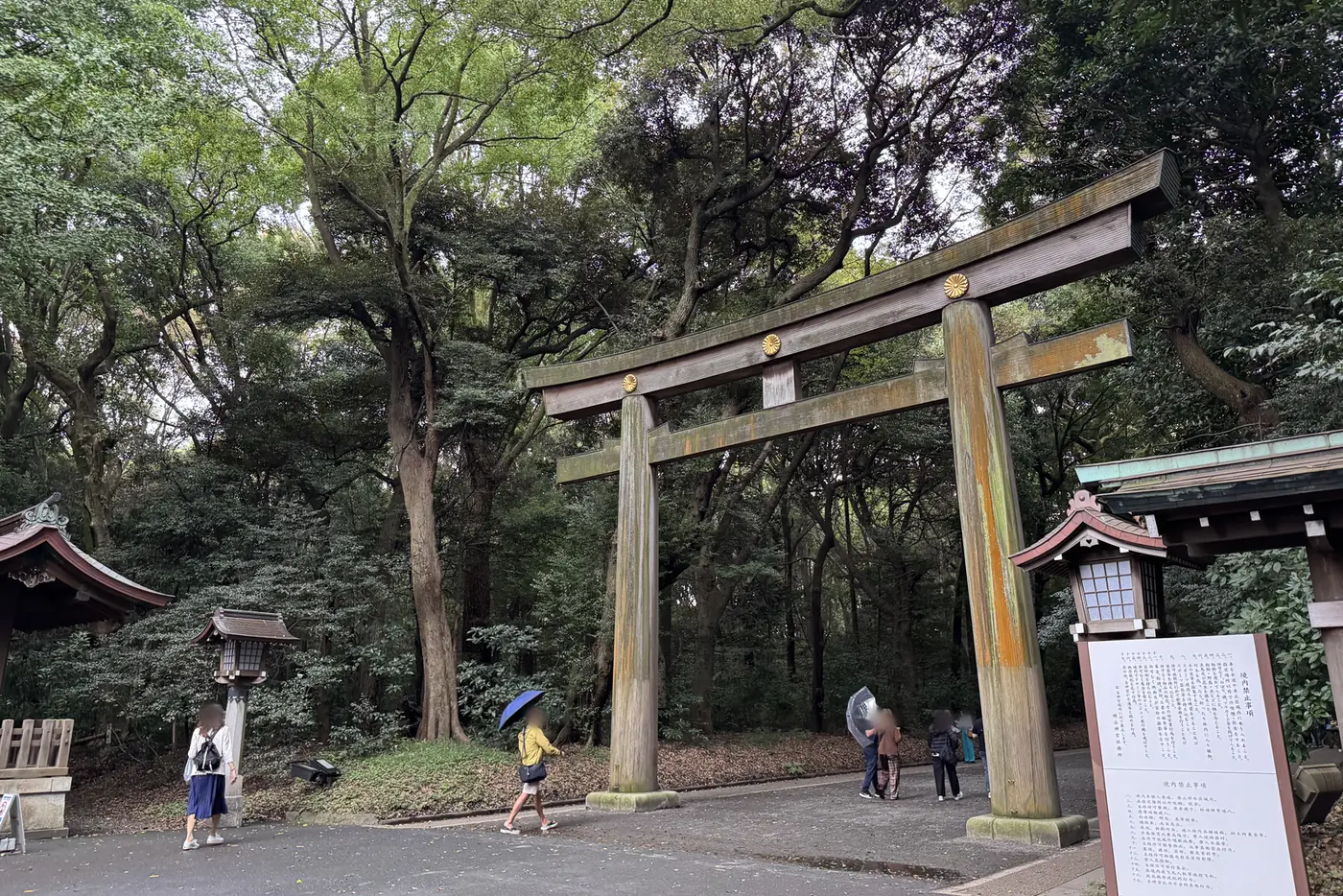
Meiji Jingu (Meiji Shrine) Guide | Access, Hours, Etiquette & Highlights
Meiji Jingu (Meiji Shrine) is a shrine surrounded by forest, right next to Harajuku Station in Tokyo. Admission is free, and it is open from sunrise to sunset. Using official information and photos taken on site, this guide explains how to get there from the nearest stations, the opening and closing times for each month, how to pray, highlights such as the Inner Garden and the sake barrels, and what to know about food, souvenirs, Wi-Fi and luggage.
Ad · Affiliate This article contains links to partner booking and shopping pages (affiliate links). If you book or buy through these links, the site operator may receive a commission from the partner. Our advertising policy
Overview
Meiji Jingu (Meiji Shrine) is a shrine right next to Harajuku Station in Tokyo. It is dedicated to Emperor Meiji and Empress Shoken and was established in 1920. The grounds are a forest of about 70 hectares. This forest was created by planting about 100,000 trees that were donated from all over Japan when the shrine was established.
- Admission is free, and the shrine is open every day of the year. The Inner Garden (Meiji Jingu Gyoen) and the Meiji Jingu Museum, both inside the grounds, charge a fee.
- It is open from sunrise to sunset. The opening and closing times differ from month to month.
- According to Meiji Jingu’s guidance, allow about 1 hour if you are only visiting the shrine, and about 2 hours if you also see the Inner Garden and the Meiji Jingu Museum.
- Anyone can visit and pray here, regardless of religion.
Getting there
Nearest stations and entrances
There are three entrances. From any of them, it takes about 10 minutes to walk along the approach through the forest to the Main Shrine (the building where you pray).
| Nearest station | Line | Meiji Jingu entrance | From the station to the entrance |
|---|---|---|---|
| Harajuku Station | JR Yamanote Line | Harajuku Entrance | 1-minute walk |
| Meiji-jingumae ‘Harajuku’ Station | Tokyo Metro Chiyoda Line and Fukutoshin Line | Harajuku Entrance | 1-minute walk |
| Yoyogi Station | JR Yamanote Line, JR Chuo-Sobu Line, Toei Oedo Line | Yoyogi Entrance | 5-minute walk |
| Kita-sando Station | Tokyo Metro Fukutoshin Line | Yoyogi Entrance | 5-minute walk |
| Sangubashi Station | Odakyu Line | Sangubashi Entrance | 3-minute walk |
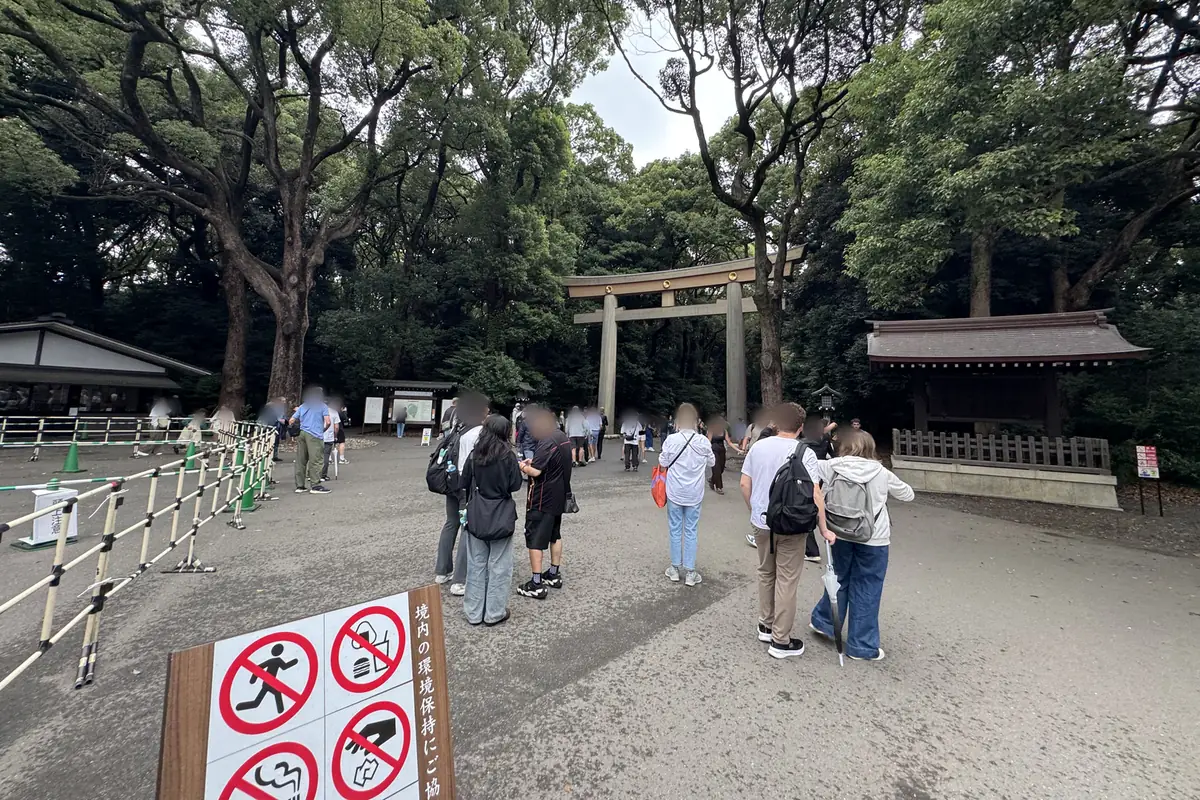
- If you enter at the Harajuku Entrance and follow Minami-sando (the south approach), you will pass the sake barrels and wine barrels on the way, and the Ootorii (the great torii gate) stands beyond them.
- If you are coming from a Tokyo Metro or Toei Subway station, you can also use an unlimited-ride subway ticket. For details, see Tokyo Subway Ticket (24, 48 and 72 hours) | Prices, where to buy it and how to use Tokyo's unlimited subway pass.
- You cannot enter the grounds by bicycle or motorcycle. Leave it at the parking area at the entrance.
- You can borrow a wheelchair at the entrance.
How to use coin lockers is explained in How to Use Coin Lockers at Train Stations in Japan | Typical Prices, Payment and the 3-Day Limit.
Opening hours
Opening and closing times by month
| Month | Gates open | Gates close |
|---|---|---|
| January | 6:40 | 16:20 |
| February | 6:20 | 16:50 |
| March | 5:40 | 17:20 |
| April | 5:10 | 17:50 |
| May | 5:00 | 18:10 |
| June | 5:00 | 18:30 |
| July | 5:00 | 18:20 |
| August | 5:00 | 18:00 |
| September | 5:20 | 17:20 |
| October | 5:40 | 16:40 |
| November | 6:10 | 16:10 |
| December | 6:40 | 16:00 |
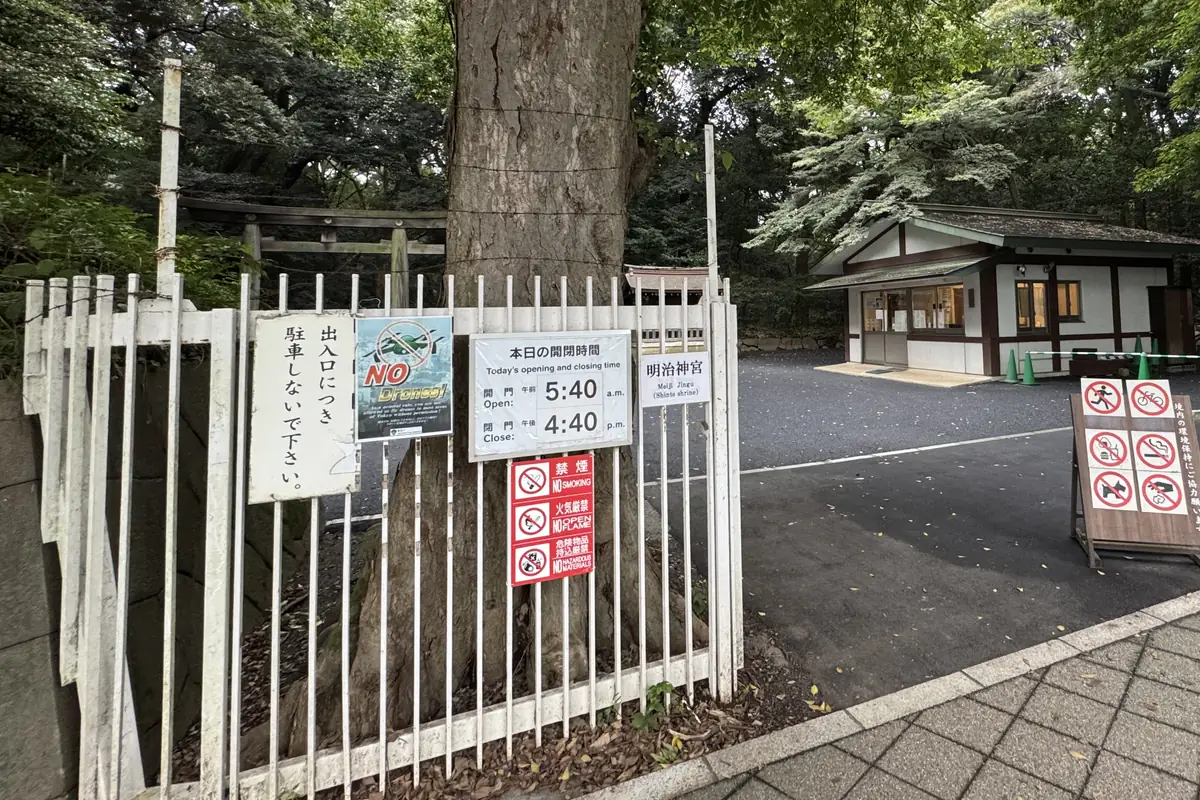
- As the photo shows, the day’s opening and closing times are posted at the entrance.
- Some facilities in the grounds are open for shorter hours than these (according to Meiji Jingu’s guidance, mainly from 9:00 to 16:00).
- The counter for goshuin (shrine seals) is open from 9:00 until the gates close.
Hours and fees for the Inner Garden and the Museum
- Inner Garden (Meiji Jingu Gyoen): When you enter, you pay a garden maintenance contribution of ¥500. The opening hours given on the official website are 9:00–16:30 from March to October and 9:00–16:00 from November to February. In June only, however, the garden stays open longer: 8:00–17:00 (until 18:00 on Saturdays and Sundays). There are no closed days.
- Meiji Jingu Museum: 10:00–16:30 (last admission at 16:00). Admission is ¥1,000 for adults and ¥900 for high school students and younger. It is closed on Thursdays (open if the Thursday is a public holiday). It is also closed during periods when the exhibits are being changed.
Step by step
Passing through the torii
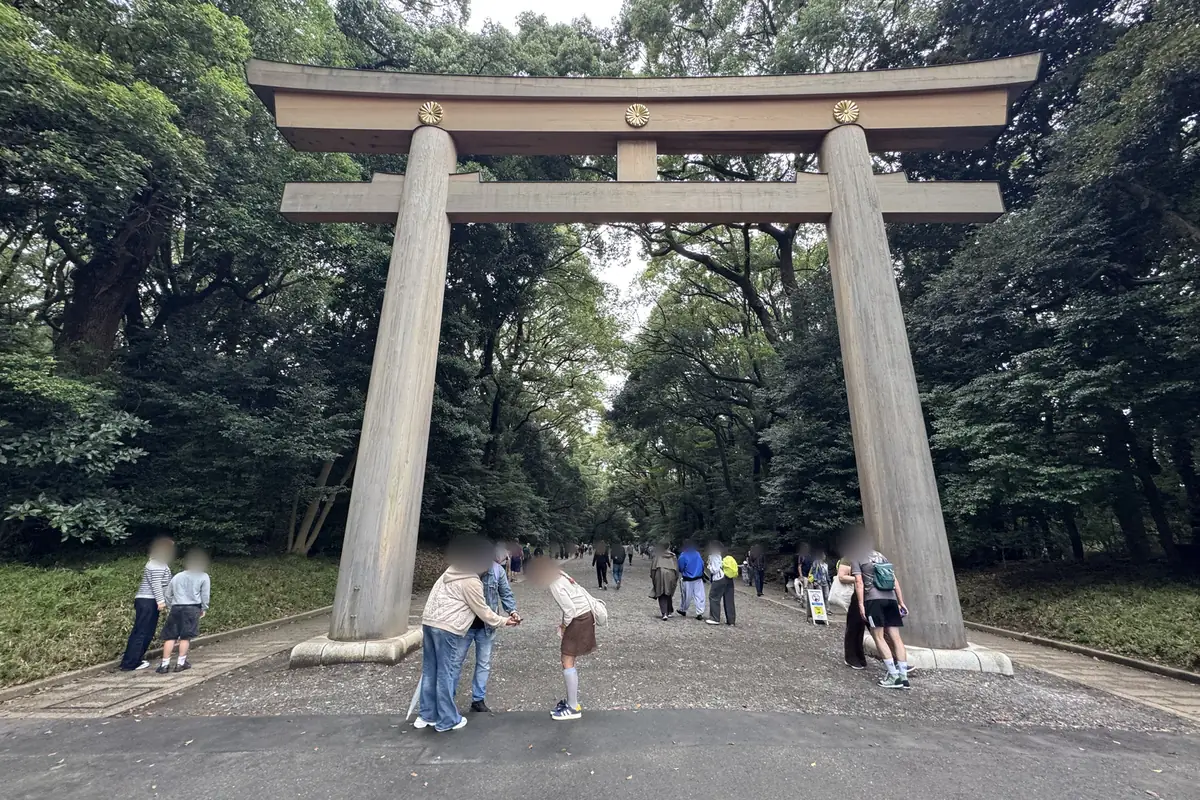
A torii is a gate that marks the entrance to a shrine. People who come to pray bow lightly in front of the torii when they enter and when they leave.
Purifying your hands and mouth with temizu
Before going on to the Main Shrine, you purify your hands and mouth at a water basin called the Temizusha. Anyone can do this, regardless of religion.
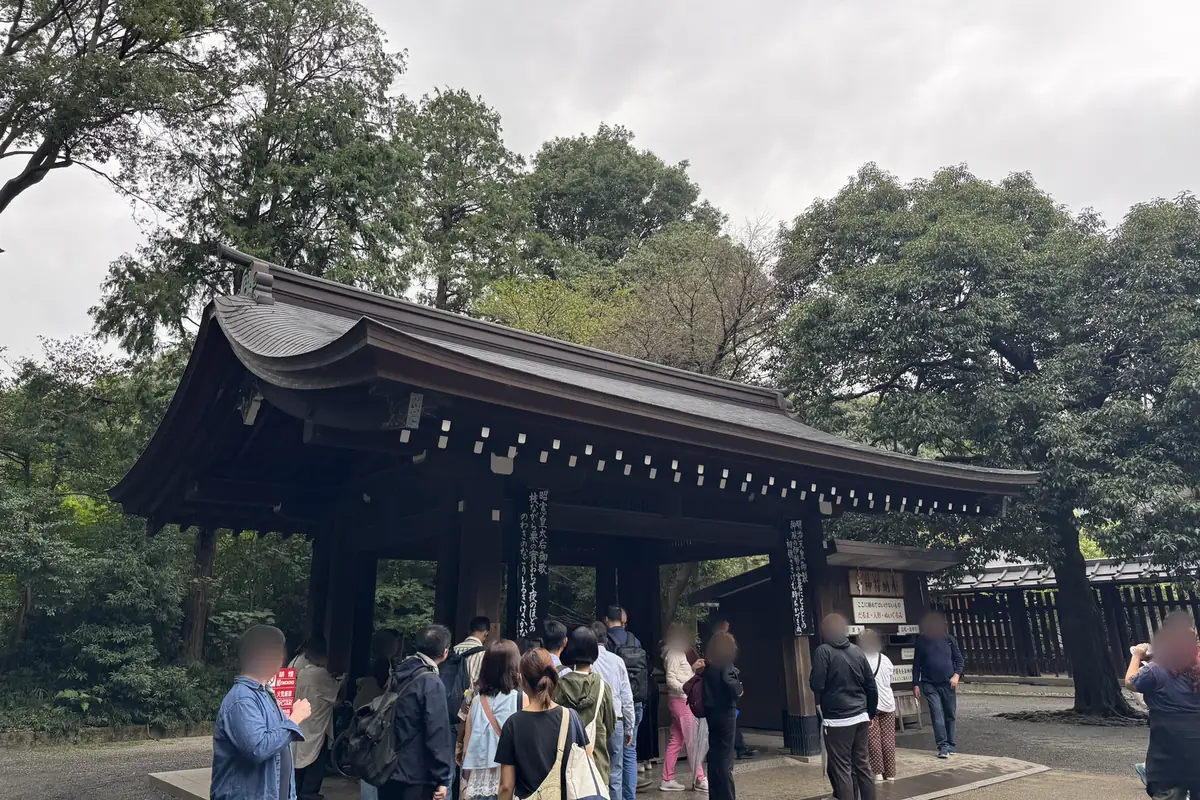
- Wash both hands.
- Take water in both hands and rinse your mouth.
- Wash both hands once more.
Praying at the Main Shrine
When you go through the gate in front of the Main Shrine (Minami Shinmon), step over the wooden threshold at your feet without treading on it.
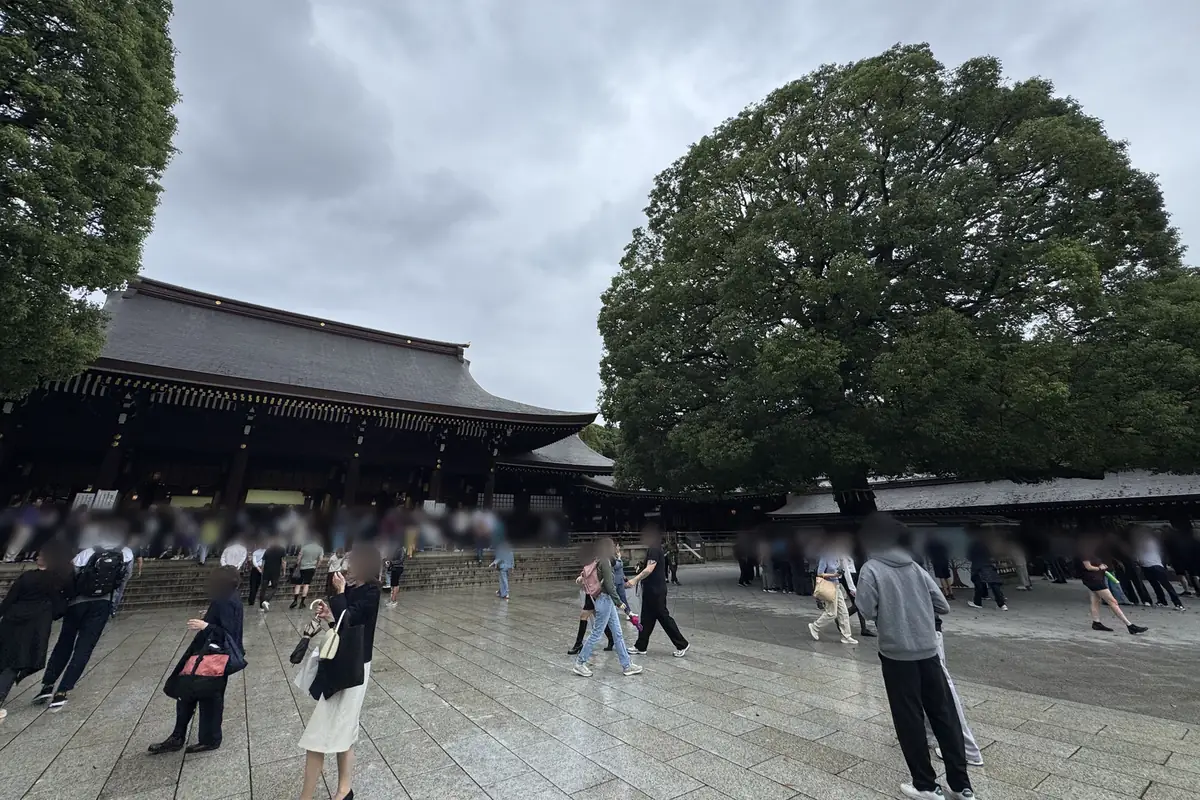
- Make a money offering. The amount is up to you.
- Bow deeply twice.
- Clap your hands twice in front of your chest.
- Finally, bow deeply once.
Highlights
Ootorii (the great torii)
This torii stands where Minami-sando (the south approach) and Kita-sando (the north approach) meet. It is 12 meters high and 17.1 meters wide, and according to Meiji Jingu’s guidance, it is the largest wooden myojin torii (a torii whose top crossbeam curves upward at both ends) in Japan.
Sake barrels and wine barrels
Barrels of Japanese sake and barrels of wine are lined up along the side of Minami-sando.
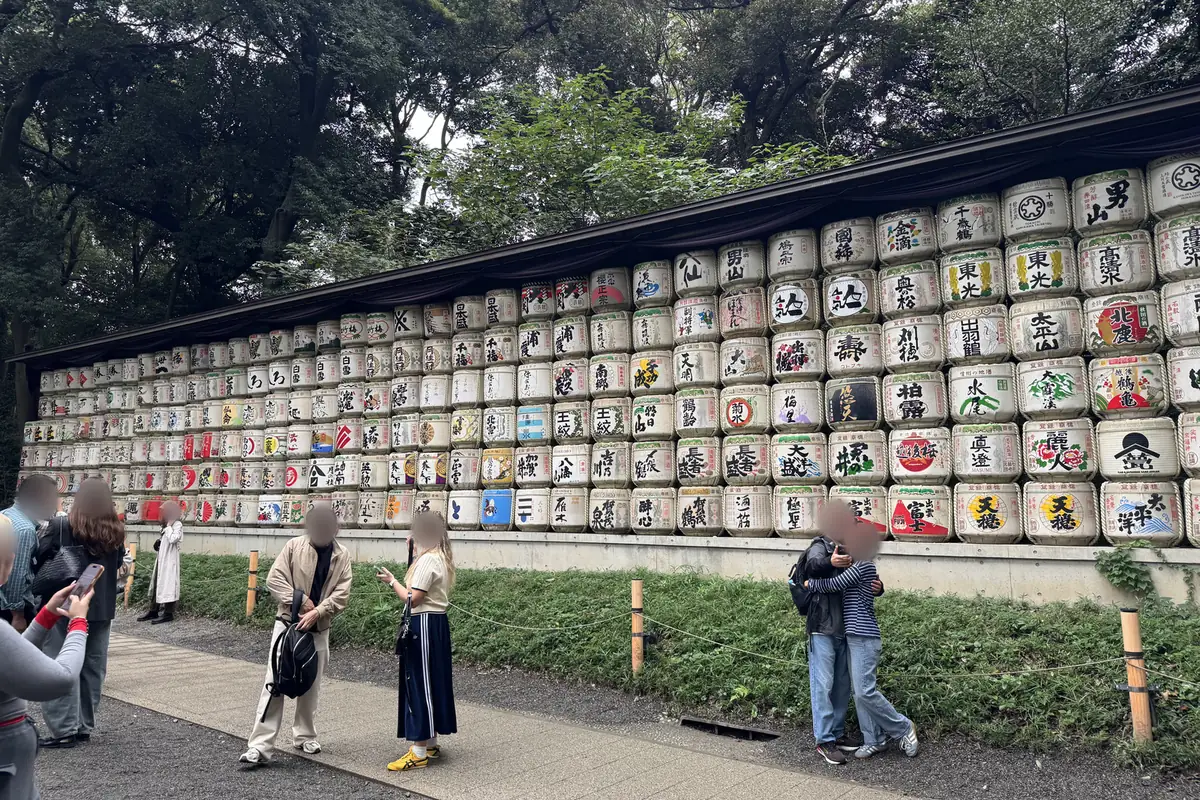
The sake barrels are dedicated every year by sake brewers from all over Japan. The barrels are decorative and are empty inside.
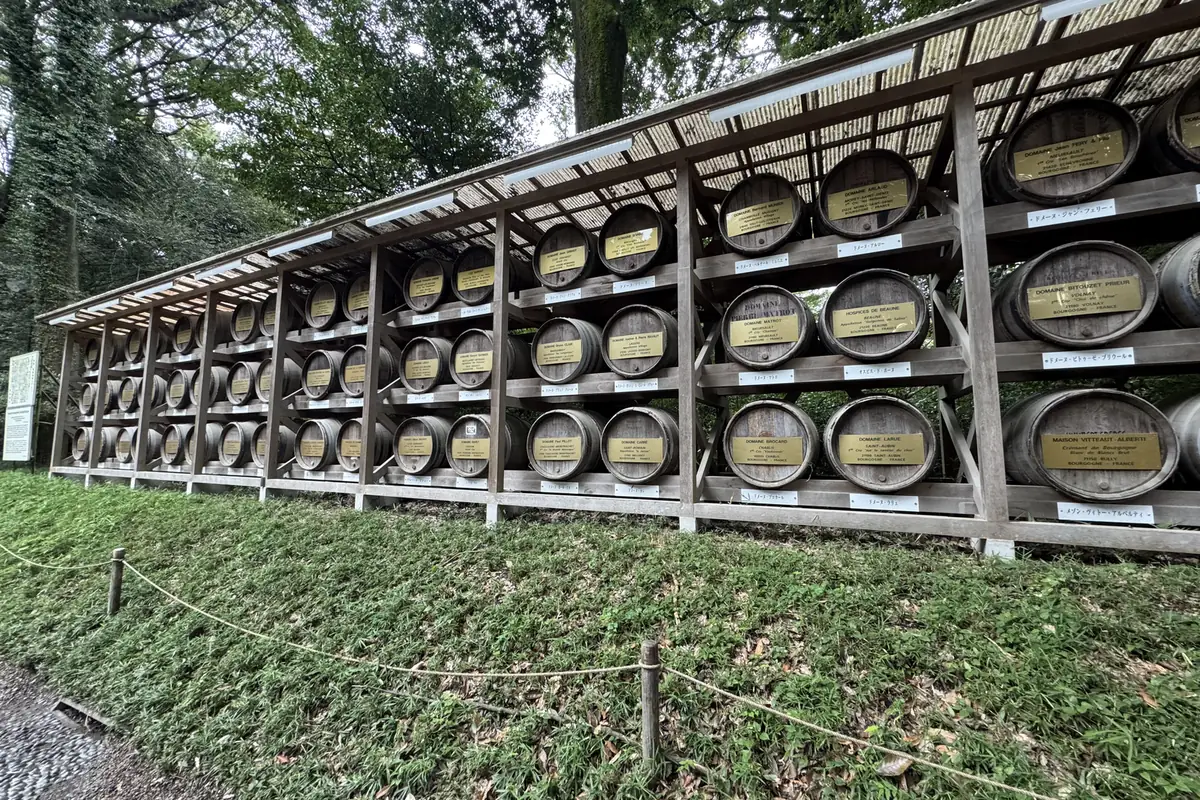
The wine barrels were dedicated by wineries in the Burgundy region of France. The dedication began in 2006, in connection with Emperor Meiji’s fondness for Western food and wine.
Meoto Kusu, ema, omikuji and goshuin
- Meoto Kusu: Two camphor trees standing side by side in front of the Main Shrine. They were planted when the shrine was established in 1920 and are joined by a shimenawa rope. They are regarded as a symbol of harmony between husband and wife and within the family.
- Ema (¥500): A wooden tablet on which you write a wish or words of thanks. You may write in any language. Once you have written it, hang it on the ema rack in front of the Main Shrine (a rack built around a single camphor tree).
- Omikuji (¥100): With omikuji, you draw one slip of paper and receive the words written on it. Each omikuji at Meiji Jingu has one waka poem by either Emperor Meiji or Empress Shoken, with an English translation.
- Goshuin (¥500): Ink calligraphy and a vermilion seal that you receive as a record of your visit. Even without a goshuincho (a book for collecting goshuin, ¥1,500), you can receive a goshuin on a sheet of paper.
Inner Garden (Meiji Jingu Gyoen) and Kiyomasa’s Well
The Inner Garden is a garden that was here before Meiji Jingu was built. Japanese irises bloom in June. Kiyomasa’s Well, inside the garden, is a well where water springs up all year round.
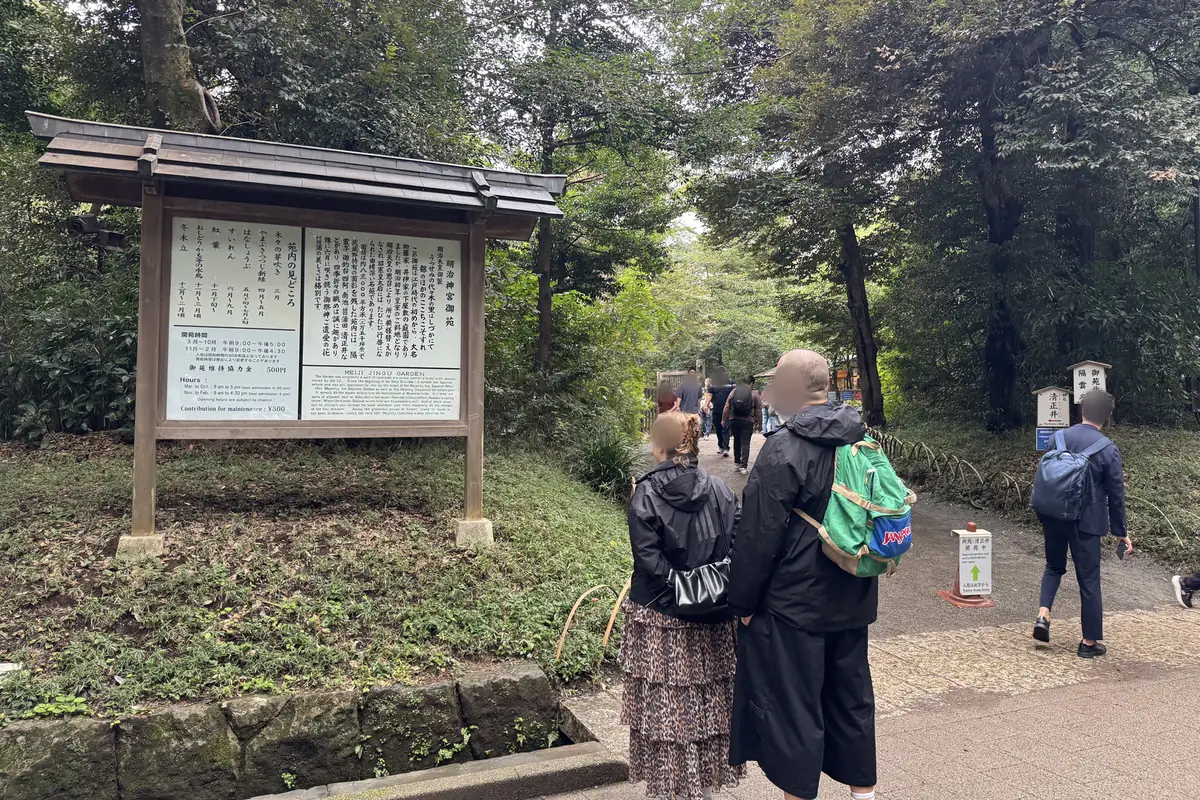
The photo shows the entrance to the Inner Garden at the time it was taken. The sign at the entrance said that last entry is 30 minutes before the garden’s closing time. Allow plenty of time when you go in.
The lawn by the North Pond and the kame ishi
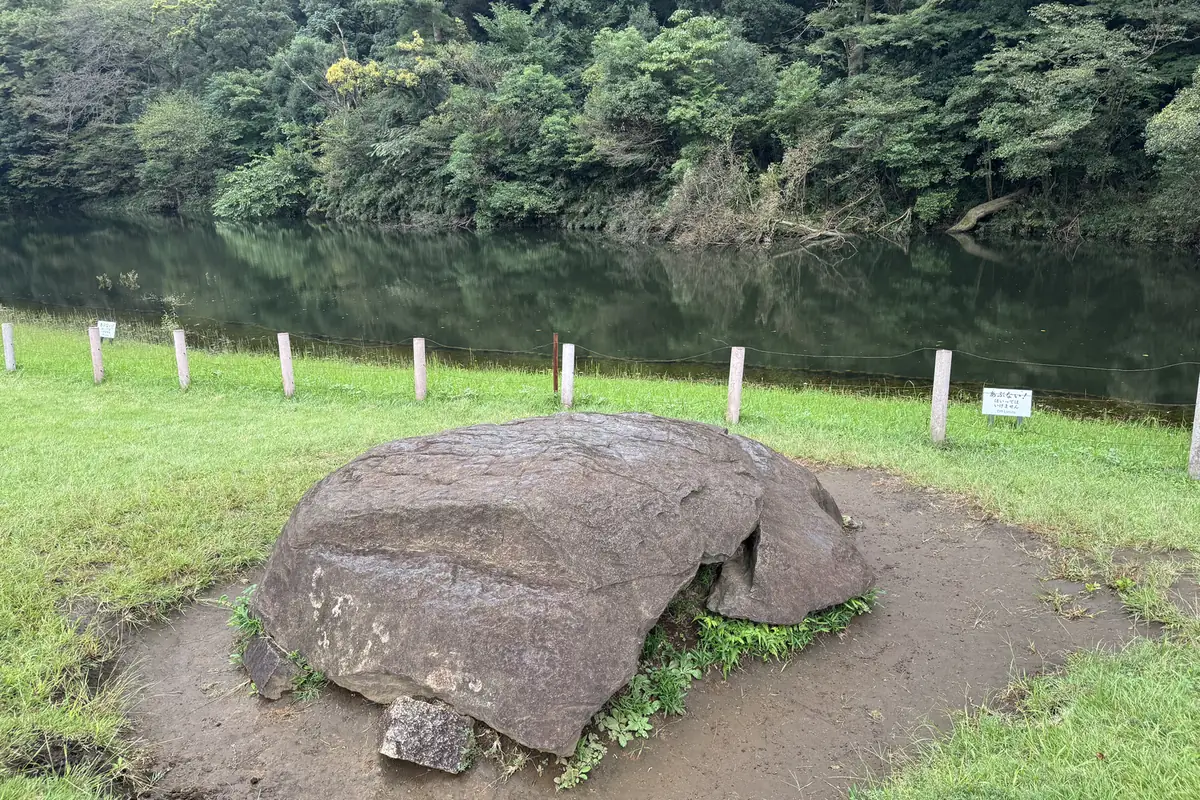
On the north side of the Main Shrine there is an open lawn where you can sit and rest. Beside the pond is the kame ishi (turtle stone), a rock shaped like a turtle. The lawn is also part of the shrine grounds, and the rules in the grounds are the same here. You cannot drink alcohol.
Meiji Jingu Museum
This facility exhibits items associated with Emperor Meiji and Empress Shoken, and it opened in 2019. It is near the Harajuku Entrance, along Minami-sando. Note that the Treasure Museum, on the north side of the grounds, is currently closed.
Services
Food and souvenirs
Forest Terrace Meiji Jingu, partway along Minami-sando, has a restaurant, a food court serving noodles and rice bowls, and a souvenir shop. In front of the torii at the Harajuku Entrance is Café “Mori no Terrace”.
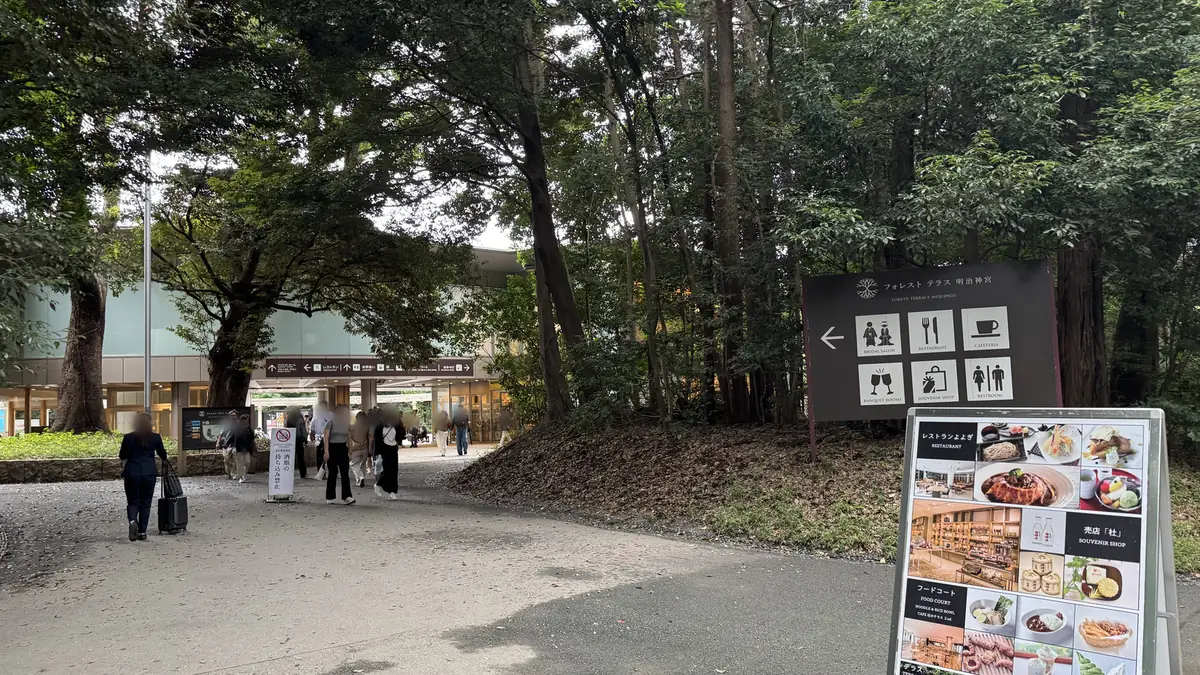
- These designated places are the only places in the grounds where you can eat and drink. Please do not eat or drink on the approaches.
- You can use credit cards at the restaurant and the shop. They cannot be used at the Juyosho, the Kaguraden or the goshuin counter, so have cash ready.
- The locations of the restrooms are shown on the map of the grounds on the official website.
Wi-Fi and guided tours
- According to Meiji Jingu’s guidance, Wi-Fi is available at the restaurant and the shop. If you want to look up maps or train connections on the approaches or in the forest, arrange your own internet connection. How to choose one is explained in Getting Online in Japan | eSIM vs SIM Card vs Pocket Wi-Fi, What to Check First, and Airport Pickup.
- Meiji Jingu has no official guided tours. If you want to go around while listening to a guide’s explanations, you will need to look for a tour run by a travel company or another operator.
Good to know
Rules in the grounds
Meiji Jingu is a place of prayer. The main rules in the official guidance are as follows.
- You can eat, drink and smoke only in the designated places.
- You cannot fly drones.
- You cannot run or play sports.
- You cannot leave the approaches and go into the forest. You cannot take out or bring in living creatures, flowers, branches, nuts and the like.
- To film video or to shoot for advertising purposes, you need permission from Meiji Jingu. You can take photos to remember your visit, but not in the area in front of the Main Shrine where people are praying.
Other things to know
- There are insects in the forest. Meiji Jingu advises visitors to avoid clothing that leaves skin exposed and to watch out for insect bites.
- Telephone inquiries about lost property are handled in Japanese only. You can also ask at a nearby koban (police box).
- Hours and fees may change. Check the official website before you go.