Shinjuku, Harajuku and Shibuya in One Day | Route through Shinjuku Gyoen, Meiji Jingu (Meiji Shrine), Yoyogi Park and SHIBUYA SKY, Closing Times, Subway and JR Fares and Travel Times, and Whether the Tokyo Subway Ticket Saves Money
A one-day route through Shinjuku, Harajuku and Shibuya in Tokyo, built only from the official opening hours and admission fees of Shinjuku Gyoen, Meiji Jingu, Yoyogi Park and SHIBUYA SKY, and the official fares and travel times of Tokyo Metro and JR East. It explains how the Tokyo Metro Fukutoshin Line compares with the JR Yamanote Line, why the route starts with the places that close earliest, how to adjust the route on a Monday when Shinjuku Gyoen is closed, the total for one adult, and how many rides it takes for the Tokyo Subway Ticket 24-hour ticket to save money.
Ad · Affiliate This article contains links to partner booking and shopping pages (affiliate links). If you book or buy through these links, the site operator may receive a commission from the partner. Our advertising policy
Overview
Shinjuku, Harajuku and Shibuya are three districts on the west side of central Tokyo. The three districts are connected by Shinjuku-sanchome Station, Meiji-jingumae ‘Harajuku’ Station and Shibuya Station on the Tokyo Metro Fukutoshin Line, and every section takes about 2 to 7 minutes by subway. This article sets out a one-day route through Shinjuku Gyoen National Garden in Shinjuku, Meiji Jingu (Meiji Shrine) and Yoyogi Park in Harajuku, and SHIBUYA SKY in Shibuya, using only figures from the official websites of each facility and railway company. The times, admission fees and fares in this article were checked on the official websites of each facility and company on October 24, 2026.
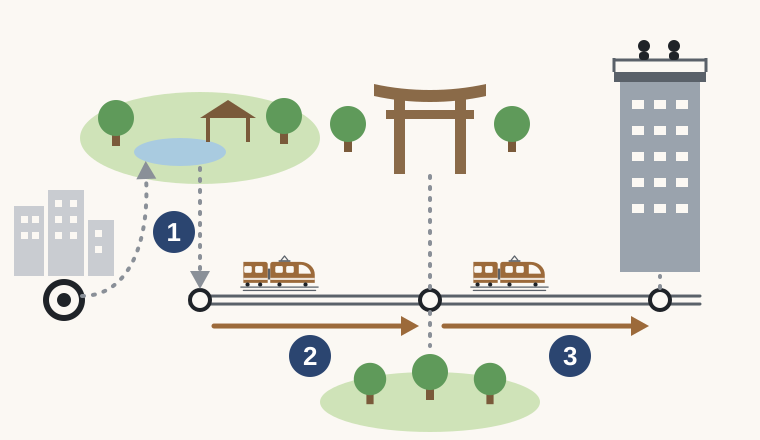
- Walk from Shinjuku Station to Shinjuku Gyoen. After leaving Shinjuku Gyoen, walk to Shinjuku-sanchome Station.
- At Shinjuku-sanchome Station, take the Tokyo Metro Fukutoshin Line and get off at Meiji-jingumae ‘Harajuku’ Station. Walk from the station to Meiji Jingu. Yoyogi Park, next to Meiji Jingu, is also within walking distance of the station. Meiji Jingu and Yoyogi Park are separate places.
- From Meiji-jingumae ‘Harajuku’ Station, take the same Tokyo Metro Fukutoshin Line and get off at Shibuya Station. Go to SHIBUYA SKY, an observation facility at the top of a building next to the station.
- Meiji Jingu closes in line with sunset. Each month has one set closing time; over the five months from October to February, the earliest of these is 16:00 and the latest is 16:50. At Shinjuku Gyoen, from October 1 to March 14, the last time you can enter is 16:00. SHIBUYA SKY admits visitors until 21:20, so this article visits SHIBUYA SKY last.
- On this route you take the subway three times (Shinjuku-sanchome Station to Meiji-jingumae ‘Harajuku’ Station, Meiji-jingumae ‘Harajuku’ Station to Shibuya Station, and on the way back, Shibuya Station to Shinjuku-sanchome Station). If you pay with an IC card, the three fares add up to ¥534. The total for one adult, including the Shinjuku Gyoen admission fee and the SHIBUYA SKY admission fee, is given under the heading “Total for one adult” in this article.
Getting there
Comparing the subway and JR
You can travel between Shinjuku, Harajuku and Shibuya on either the Tokyo Metro Fukutoshin Line (subway) or the JR Yamanote Line. Both can be used with an IC card (such as Suica).
| Section | Tokyo Metro Fukutoshin Line | JR Yamanote Line |
|---|---|---|
| Shinjuku to Harajuku | Shinjuku-sanchome Station to Meiji-jingumae ‘Harajuku’ Station: 4 min by express, 5 min by local train. IC card ¥178, paper ticket ¥180 | Shinjuku Station to Harajuku Station: 4 min. IC card ¥155, paper ticket ¥160 |
| Harajuku to Shibuya | Meiji-jingumae ‘Harajuku’ Station to Shibuya Station: 2 min. IC card ¥178, paper ticket ¥180 | Harajuku Station to Shibuya Station: 3 min. IC card ¥155, paper ticket ¥160 |
| Shibuya to Shinjuku | Shibuya Station to Shinjuku-sanchome Station: 6 min by express, 7 min by local train. IC card ¥178, paper ticket ¥180 | Shibuya Station to Shinjuku Station: 7 min. IC card ¥199, paper ticket ¥200 |
| Tokyo Subway Ticket | Can be used | Cannot be used |
- The travel times and fares in the table are the results of searching for trains departing around midday on a weekday in the fare and route search on the official Tokyo Metro website. For any journey of up to 6 km, the Tokyo Metro fare is ¥178 with an IC card and ¥180 with a paper ticket. The JR fares are the same as the figures in JR East's fare table in effect from March 14, 2026.
- During the daytime, the Tokyo Metro Fukutoshin Line has 13 to 15 trains per hour leaving Shinjuku-sanchome Station and Meiji-jingumae ‘Harajuku’ Station in the direction of Shibuya Station (on weekdays as well as on Saturdays, Sundays and public holidays).
- Tokyo Metro's Meiji-jingumae ‘Harajuku’ Station and JR's Harajuku Station are separate stations run by different companies. Meiji-jingumae ‘Harajuku’ Station is underground, and its name includes “Harajuku”.
- On the route in this article, you walk from JR Shinjuku Station to Shinjuku Gyoen (step 1 of the route in this article), and after leaving Shinjuku Gyoen, you take the subway from Shinjuku-sanchome Station on the Tokyo Metro Fukutoshin Line, a 5-minute walk from Shinjuku Gate.
Does the Tokyo Subway Ticket save money?
The Tokyo Subway Ticket lets you ride all Tokyo Metro and Toei Subway lines. The 24-hour ticket costs ¥1,000 for adults and ¥500 for children. JR lines are not included in the area where it can be used. Only people who meet certain conditions can buy it; those conditions and where to buy it are covered in Tokyo Subway Ticket (24, 48 and 72 hours) | Prices, where to buy it and how to use Tokyo's unlimited subway pass.
- On the route in this article you take the subway three times, and the IC card fares add up to ¥534. Paying each ride with an IC card is cheaper than the 24-hour ticket (¥1,000).
- Five rides on sections with an IC card fare of ¥178 add up to ¥890, which is still cheaper than the 24-hour ticket. On a day when you ride sections with an IC card fare of ¥178 6 times or more, the 24-hour ticket is cheaper. On a day when you ride sections with a higher fare than this, the 24-hour ticket may be cheaper with fewer rides. Compare the two if you also travel to other districts by subway on the same day.
Itinerary
Route table
| Step | Place | Opening hours | Admission (adults) | Getting there from the station |
|---|---|---|---|---|
| 1 | Shinjuku Gyoen | From October 1 to March 14: 9:00 to 16:30 (last entry 16:00). Closed on Mondays as a rule | ¥500 | A 10-minute walk from the South Exit of JR Shinjuku Station to Shinjuku Gate |
| 2 | Meiji Jingu | From sunrise to sunset (times are set for each month) | Free | A 1-minute walk to the entrance from either Meiji-jingumae ‘Harajuku’ Station or JR Harajuku Station. From the entrance to the Main Shrine, a further walk of about 10 minutes |
| 2 | Yoyogi Park | Open at all times | Free | A 3-minute walk from either Meiji-jingumae ‘Harajuku’ Station or JR Harajuku Station |
| 3 | SHIBUYA SKY | 10:00 to 22:30 (last admission 21:20) | Bought online: ¥2,700 for admission before 15:00, ¥3,400 for admission from 15:00 | In the uppermost part of Shibuya Scramble Square, right next to Shibuya Station |
The “Step” numbers in the table are the same as the numbers in the diagram above. Meiji Jingu and Yoyogi Park share the same number because you reach both on foot after getting off at Meiji-jingumae ‘Harajuku’ Station.
1. Shinjuku Gyoen
Shinjuku Gyoen is a garden managed by Japan's Ministry of the Environment. You can enter through three gates: Shinjuku Gate, Okido Gate and Sendagaya Gate. It is a 10-minute walk from the South Exit of JR Shinjuku Station to Shinjuku Gate. From Shinjuku Gate to Shinjuku-sanchome Station (Exit E5) is a 5-minute walk. You can pay the admission fee at the ticket office at each gate, or with an IC card at the automatic entry gates there.
- Opening hours change with the season. From March 15 to September 30, the garden is open from 9:00 to 18:00 (last entry 17:30). However, from June 11 to July 31, it is open from 9:00 to 19:00 (last entry 18:30). From October 1 to March 14, it is open from 9:00 to 16:30 (last entry 16:00).
- Admission is ¥500 for general visitors, and ¥250 for people aged 65 or over and for students of high school age or older. Junior high school students and younger children enter free.
2. Meiji Jingu and Yoyogi Park
Meiji Jingu opens every day at sunrise and closes at sunset. Visiting is free. The official Meiji Jingu website says that visiting only the Main Shrine takes about 1 hour. The opening and closing times for each month are in the table under the heading “Closing times” in this article. Some facilities within the grounds have shorter opening hours. How to pray at the shrine and the places within the grounds are covered in Meiji Jingu (Meiji Shrine) Guide | Access, Hours, Etiquette & Highlights.
Yoyogi Park is a Tokyo Metropolitan park next to Meiji Jingu, and it is open at all times. Admission is free. The places inside the park are covered in Yoyogi Park Guide | Free Tokyo Park Open at All Hours, Access from Harajuku Station and Yoyogi-koen Station, Events at Event Square (October–November 2026), Yoyogi Forest of Lights Illumination, Cycling Center, Toilets and Rules.
3. SHIBUYA SKY
SHIBUYA SKY is an observation facility in the uppermost part of Shibuya Scramble Square, next to Shibuya Station, and you can go out onto the rooftop. You buy a ticket by choosing the date and time of admission. Tickets are sold for dates up to two weeks ahead of the day you buy them. When adult tickets are sold out online, adult tickets are also sold out at the same-day ticket counter.
- The price for adults (aged 12 and over) depends on whether your admission time is before 15:00 or from 15:00 onward. Bought online, the price is ¥2,700 (before 15:00) or ¥3,400 (from 15:00); bought at the same-day ticket counter, it is ¥3,000 or ¥3,700.
- Child tickets are sold only at the same-day ticket counter (¥1,200). How the child category is determined and how to buy tickets are covered in How to Buy SHIBUYA SKY Tickets | Release Dates, Sell-Outs, Prices by Time Slot, Cancellations, What to Leave Behind for the Rooftop.
Visiting when Shinjuku Gyoen is closed
On days when Shinjuku Gyoen is closed, you can go to the observatories of the Tokyo Metropolitan Government Building instead of Shinjuku Gyoen. Entry to the observatories is free. The Tokyo Metropolitan Government Building is about a 10-minute walk from the West Gate of JR Shinjuku Station. After that, you can take the JR Yamanote Line from JR Shinjuku Station to Harajuku Station (4 min, IC card ¥155) and go on to Meiji Jingu and Yoyogi Park.
- The Tokyo Metropolitan Government Building has two observatories. The South Observatory admits visitors from 9:30 to 21:30 and is closed on the first and third Tuesdays of every month. The North Observatory admits visitors from 9:30 to 17:00 and is closed on the second and fourth Mondays of every month. For both, when a closing day falls on a public holiday, the observatory is closed on the next weekday instead.
- When you go to the observatories of the Tokyo Metropolitan Government Building instead of Shinjuku Gyoen, you do not pay the Shinjuku Gyoen admission fee. The first ride is on the JR Yamanote Line instead of the subway (from Shinjuku Station to Harajuku Station, ¥155 with an IC card). The “Total for one adult” table in this article is the total for the route that goes to Shinjuku Gyoen.
- Where the observatories of the Tokyo Metropolitan Government Building are and how to get in are covered in Walking from the West Exit of Shinjuku Station to Nishi-Shinjuku | Free Observatories at the Tokyo Metropolitan Government Building (Hours, Closed Days, Entrance) and Sights in the Skyscraper District.
Costs
Total for one adult
This is the total when you visit Shinjuku Gyoen, Meiji Jingu, Yoyogi Park and SHIBUYA SKY on the route in this article and pay the subway fares with an IC card.
| Time of admission to SHIBUYA SKY | Total |
|---|---|
| Before 15:00 | ¥3,734 |
| From 15:00 | ¥4,434 |
- The total is the sum of the subway fares for three rides (¥534), the general admission fee for Shinjuku Gyoen (¥500) and the adult price for SHIBUYA SKY when bought online. Meiji Jingu and Yoyogi Park are free.
- The three subway rides are Shinjuku-sanchome Station to Meiji-jingumae ‘Harajuku’ Station, Meiji-jingumae ‘Harajuku’ Station to Shibuya Station, and Shibuya Station to Shinjuku-sanchome Station. If you return to Shinjuku Station on the JR Yamanote Line instead, the last ride costs ¥199 with an IC card.
- If you ride the subway with paper tickets, each ride costs ¥180. Subway fares for children are ¥89 with an IC card and ¥90 with a paper ticket. Children's fares on Japanese public transport are covered in Child Fares on Japan's Trains and Subways | When Kids Pay Adult Fare, Free Rides for Young Children, Child IC Cards.
Conditions
Closing times
These are Meiji Jingu's opening and closing times for each month.
| Month | Opening time | Closing time |
|---|---|---|
| January | 6:40 | 16:20 |
| February | 6:20 | 16:50 |
| March | 5:40 | 17:20 |
| April | 5:10 | 17:50 |
| May | 5:00 | 18:10 |
| June | 5:00 | 18:30 |
| July | 5:00 | 18:20 |
| August | 5:00 | 18:00 |
| September | 5:20 | 17:20 |
| October | 5:40 | 16:40 |
| November | 6:10 | 16:10 |
| December | 6:40 | 16:00 |
- The gates of Shinjuku Gyoen open at 9:00 in every season. Meiji Jingu opens earlier than that in every month. The last time you can enter Shinjuku Gyoen is 16:00 from October 1 to March 14, and 17:30 from March 15 to September 30 (18:30 from June 11 to July 31).
- From November to January, Meiji Jingu's closing time (November 16:10, December 16:00, January 16:20) is the same as, or a little later than, the last entry time at Shinjuku Gyoen (16:00). Plan your route so that you arrive at Meiji Jingu before its closing time, and at Shinjuku Gyoen before 16:00.
Weather and crowds
- SHIBUYA SKY may close the rooftop in strong wind, rain, snow, thunderstorms and similar conditions. You cannot take bags, hats, selfie sticks and similar items out onto the rooftop. Leave anything you cannot take out in the dedicated lockers inside SHIBUYA SKY.
- Shinjuku Gyoen says that because it gets very crowded during the cherry blossom season, it may admit only people who have reserved in advance, mainly on Saturdays, Sundays and public holidays.
- Japan's public holidays and the busy travel periods are covered in Japan Public Holidays 2027 and Busy Periods | New Year, Golden Week, Obon, 3-Day Weekends, Shinkansen Busy Seasons and All-Reserved Nozomi.
Good to know
- The route in this article is built from the opening hours of each facility and the official fares and travel times of the railway companies. How long you spend at each place differs from person to person, so this article does not set it.
- Both the subway and JR lines you use in Shinjuku, Harajuku and Shibuya can be ridden with an IC card. How to buy an IC card is covered in Welcome Suica: How to Buy and Use It | A 28-Day IC Card for Visitors to Japan.
- Yoyogi Hachimangu Shrine, near Meiji Jingu, is covered in Yoyogi Hachimangu (Yoyogi Hachiman Shrine) Guide | The Shrine in the Film PERFECT DAYS, Toyo Ito's Toilet Below the Stone Steps, Getting There from Yoyogi-Hachiman Station, Goldfish Omamori and Goshuincho, Setsubun and the Annual Grand Festival.